The short version
For continuous monitoring, Holter, telemetry, ambulatory and any prolonged skin contact, single-use disposable ECG electrodes are the standard of care — mainly because they eliminate patient-to-patient bioburden transfer at the gel-skin interface and hold consistent adhesion for the rated wear period. Reusable electrodes (mostly suction-cup and limb-clamp designs) remain in use for short resting 12-lead ECG in cardiology and outpatient clinics, where contact time is brief and reprocessing is manageable. The total-cost-of-ownership case typically favors disposables in continuous monitoring; the infection-control case favors disposables across all populations, especially immunocompromised, neonatal, isolation and infectious-disease patients.
📋 What this guide covers: the three categories of ECG electrode (single-use, reusable, consumer dry); why disposables dominate continuous monitoring; the cross-contamination case from an infection-control view; Spaulding classification and reprocessing; regional regulatory differences; a total-cost-of-ownership (TCO) framework with a worked example; a 4-question decision flowchart; a hospital transition guide; and bulk procurement notes for the MedLinket V0014 / V0015 series.
↗️ This is the cost-and-infection-control node of the cluster. The replacement-schedule guide covers 24h vs 48h timing once you have chosen disposable; the sterile electrodes guide covers when sterile packaging is mandatory.
❌ Not covered here: the 24h vs 48h schedule (own guide), low-allergy design rationale (low-allergy guide), and specific OEM monitor compatibility.
🎯 Best for: procurement managers, infection-control nurse leaders, biomedical/clinical-engineering leads, and tender-evaluation teams comparing single-use and reusable strategies.
Educational disclaimer. This article is for procurement and infection-control education. It is not a substitute for the device IFU, your facility's infection-control policy, or applicable regional regulations. Cost figures and the worked TCO example are illustrative frameworks only — actual numbers depend on each facility's negotiated pricing, labor rates and reprocessing protocols. Always verify the current version of the relevant standards (AAMI EC12, ISO 10993, ISO 11607, the CDC Guideline for Disinfection and Sterilization, regional reprocessing guidance) and follow your facility's protocols when selecting electrode strategies.
The disposable-vs-reusable question rarely has a one-size-fits-all answer for a hospital. The right strategy depends on what the electrode is being used for, who the patient is, and how the institution measures cost. For continuous monitoring the answer has converged on disposable; for resting 12-lead ECG in low-volume cardiology clinics it is more nuanced. This article walks through both decisions with the procurement, clinical and infection-control inputs that matter, plus a TCO framework you can plug your own numbers into.

Are ECG electrodes reusable?
Short answer: most ECG electrodes used in modern hospital monitoring are single-use disposables. Reusable electrodes do exist — primarily suction-cup chest electrodes and limb-clamp electrodes for resting 12-lead ECG. They are non-critical devices contacting intact skin, so they require cleaning with low-level disinfection between patients per the Spaulding classification, plus visual inspection for damage.
For continuous monitoring, Holter, telemetry, ambulatory and any prolonged skin contact, single-use disposable electrodes are the standard of care.
The reusable category is narrower than many procurement teams first assume. Three things have pushed the standard of care toward disposables over the past few decades:
- Adhesive technology matured. Modern Ag/AgCl disposable electrodes with stable conductive gel and acrylate or hydrophilic pressure-sensitive adhesives deliver 24–48 hour wear that no reusable design has matched.
- Infection-control standards tightened. Cross-contamination concerns documented across multiple patient populations have made low-level disinfection between patients an insufficient safeguard for many institutional protocols — particularly for immunocompromised, neonatal and infectious-disease populations.
- Reprocessing logistics consume nursing capacity. Each reuse cycle requires cleaning, low-level disinfection, drying, inspection and storage — time that is increasingly hard to justify against a low per-unit disposable cost.
That said, reusable electrodes have not disappeared. The next section covers the three categories you may encounter.
The three categories of ECG electrode
Short answer: ECG electrodes fall into three categories — (1) single-use disposable, the dominant category for continuous and ambulatory monitoring; (2) reusable, primarily suction-cup chest and limb-clamp designs for resting 12-lead ECG; and (3) consumer-grade dry electrodes in fitness wearables and patient-owned devices, not used in hospital diagnostic workflows.
Category 1: Single-use disposable electrodes
What they are: pre-gelled adhesive electrodes with an Ag/AgCl coating, a pressure-sensitive adhesive backing and a snap or pinch lead-wire connection. Discarded after a single patient use.
Where they are used: continuous ICU monitoring, telemetry, Holter / ambulatory, NICU, stress testing, ED, OR, transport — essentially every continuous-monitoring application.
Sub-categories: center-post (concentric) and offset (eccentric) connector geometries; foam vs non-woven backing; metal-snap (V0014) vs carbon-snap (V0015, radiolucent for CT/DR/MRI). Available sterile and non-sterile.
Category 2: Reusable electrodes
What they are: rigid or semi-rigid electrodes with a conductive surface (often nickel-plated brass or stainless steel) held in skin contact mechanically — by suction (suction-cup chest electrodes) or by spring clamp (limb-clamp electrodes). Used with conductive gel or paste applied at each use.
Where they are still used: resting 12-lead ECG in cardiology departments, outpatient cardiology and primary care, where contact time is brief (typically under 5 minutes per patient), making reprocessing manageable.
Why they persist: low per-test consumable cost in low-volume settings, no per-test disposal stream, and historical familiarity in established cardiology practice.
Category 3: Consumer-grade dry electrodes
What they are: metal or conductive-fabric contact electrodes used without conductive gel, integrated into fitness wearables (chest straps), home Holter-like devices and consumer ECG-capable smartwatches.
Where they are used: wellness and consumer monitoring. Not used in hospital diagnostic-grade ECG because of inferior signal quality, motion sensitivity and the absence of validated AAMI EC12 performance.
Why they are out of scope here: hospital procurement decisions for diagnostic ECG do not include this category.
The procurement decision for hospital and clinic settings reduces to Category 1 vs Category 2. The rest of this guide focuses on that comparison.

Why disposables dominate modern continuous monitoring
Short answer: three reasons drive disposable dominance in continuous monitoring — cross-contamination elimination, predictable adhesion for the rated wear period, and elimination of reprocessing labor and validation. Reusable electrodes cannot reasonably match disposables on any of these for prolonged skin-contact applications.
✅Single-use disposable
- Eliminates patient-to-patient bioburden transfer by design
- Consistent 24–48h adhesion (engineered PSA + gel)
- No reprocessing labor or validation
- Predictable signal quality across the wear window
- Available sterile for NICU / immunocompromised use
⚠️Reusable (suction / clamp)
- Suction adhesion fails after minutes — not days
- Requires cleaning + low-level disinfection + drying + inspection per use
- Conductive-surface biofilm risk over many patients
- Suction bulbs / clamp springs degrade and need replacement
- Cost-competitive only at low resting-ECG volumes
Reason 1: cross-contamination elimination
A disposable electrode contacts one patient and is discarded. A reusable electrode contacts dozens or hundreds of patients across its life. Even with a strict reprocessing protocol, residual bioburden, biofilm on the conductive surface and degradation of the suction bulb or clamp introduce cross-contamination risk that disposables eliminate by design. A 2024 review in the Journal of Hospital Infection proposing a complementary cleaning-classification system argues that a focus on microbial inactivation alone is insufficient without effective cleaning — and cites skin electrodes explicitly as a non-critical patient-care device.
Reason 2: adhesion & signal stability
Continuous monitoring needs stable gel-skin contact for hours or days. Disposable adhesive electrodes are engineered for exactly this — the pressure-sensitive adhesive holds controlled contact resistance across the rated wear period. A clinical study of resting-ECG electrodes found that reusable electrodes fell off in about 35% of patients while none of the single-use electrodes detached during the recording — and that the single-use electrodes were easier to use with less preparation. Reusable suction cups rely on negative pressure that gradually fails as skin conforms; reusable limb clamps rely on mechanical pressure unsuitable for chest leads. Neither is appropriate for 24–48 hour wear.
Reason 3: workflow & reprocessing overhead
Reusable electrodes require a full reprocessing cycle between every patient: visual inspection, cleaning per the IFU, low-level disinfection, drying, re-inspection, clean storage, and eventual replacement when the conductive surface degrades. Each cycle consumes nursing or technician time. For a 200-bed continuous-monitoring facility running roughly five electrodes per patient, this overhead becomes prohibitive at scale.
Cross-contamination risk: the infection-control case
Short answer: reusable ECG electrodes — and especially reusable lead wires used with disposable electrodes — present documented cross-contamination risk. ECG devices contact intact skin (sometimes compromised skin) and move between patients in busy workflows. Single-use disposable electrodes plus single-patient-use lead wires are the safer choice for high-acuity, immunocompromised, neonatal, isolation and infectious-disease populations.

The infection-control case rests on three observations:
- The skin-contact surface is hard to fully decontaminate. Reusable conductive surfaces accumulate residual gel, skin oils and skin flora that low-level disinfection wipes do not always fully remove, and suction bulbs and clamp springs have crevices where biofilm can establish.
- Reprocessing compliance varies in busy workflows. Reprocessing assumes adherence to the IFU. In a high-throughput cardiology clinic running many resting ECGs per hour, abbreviated reprocessing — or none — is a documented concern.
- The reusable lead-wire problem is often overlooked. Even hospitals using disposable electrodes frequently use reusable lead wires (the 3-, 5- or 7-lead bundle to the monitor). The same concerns apply: snap connectors and clip terminations contact the electrode and indirectly the skin, and they move between patients without consistent reprocessing. Some institutional infection-control policies treat reusable lead wires on isolation patients as effectively semi-critical, requiring high-level disinfection rather than a low-level wipe-down.
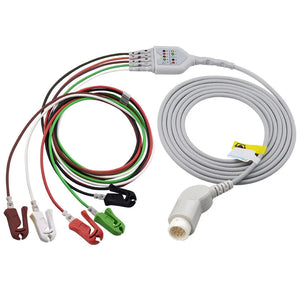
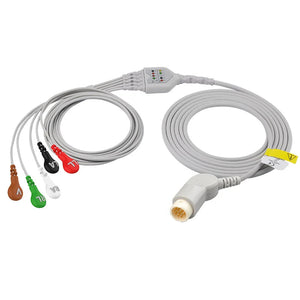
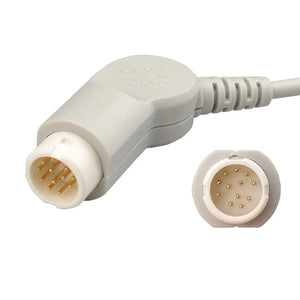
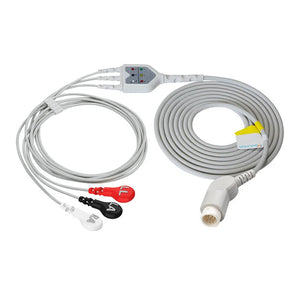
For institutions implementing infection-control upgrades, MedLinket offers single-patient-use ECG lead-wire options paired with the V0014 / V0015 disposable electrode series, which removes patient-to-patient transfer at every node of the monitoring chain.
- Offset structure reduces artifacts → lab data on how eccentric geometry reduces lead-wire-induced fall-off and signal disruption.
Spaulding classification & reprocessing requirements
Short answer: ECG skin electrodes are non-critical medical devices under the Spaulding classification — they contact intact skin only. Non-critical devices require cleaning with low-level disinfection between uses per CDC guidance. But low-level disinfection is the minimum, not the maximum, and many institutional policies require disposable alternatives in elevated-risk populations (isolation, immunocompromised, neonatal).
The Spaulding classification, originally proposed by Earle H. Spaulding in 1957 and now embedded in CDC, FDA and AORN reprocessing guidance, divides devices into three categories. The 2024 Journal of Hospital Infection review by Kremer et al. uses ECG skin electrodes as the canonical non-critical example.
| Spaulding category | Definition | Reprocessing requirement | ECG device examples |
|---|---|---|---|
| Critical | Contact with sterile tissue or the vascular system | Sterilization required | Not applicable to surface ECG electrodes |
| Semi-critical | Contact with mucous membranes or non-intact skin | High-level disinfection minimum | Not applicable to surface electrodes; some institutions treat reusable lead wires on isolation patients as effectively semi-critical |
| Non-critical | Contact with intact skin only | Cleaning with low-level disinfection between uses | Reusable suction-cup electrodes, reusable limb clamps, reusable lead wires (in standard use) |
That surface ECG electrodes are non-critical does not mean low-level disinfection is always adequate. Several considerations push beyond the Spaulding minimum:
- Compromised-skin scenarios. Any breach in skin integrity (eczema, dermatitis, recent biopsy, IV insertion site) can functionally move device contact toward semi-critical territory.
- Outbreak and isolation settings. During MRSA, VRE, C. difficile or other contact-precaution situations, infection-prevention teams routinely require disposable alternatives for any reusable device contacting patient skin — some facilities apply this to all isolation rooms.
- Immunocompromised populations. Oncology, transplant and severe-immunodeficiency populations often have institutional policies preferring disposables across the board, including disposable lead wires.
- Cleaning vs disinfection. The 2024 Kremer et al. review specifically argues that cleaning (physical removal of soil and bioburden) is as important as disinfection (microbial inactivation), and that residual gel and skin oils on reusable surfaces can interfere with downstream disinfection efficacy.

Regional regulatory differences
Short answer: the disposable-vs-reusable decision is also a regulatory one. Reprocessing of single-use devices is restricted under EU MDR; reusable devices have specific validation requirements; and FDA, NMPA, MHRA, ANVISA, TGA and PMDA take differing approaches. Teams sourcing internationally should verify both the supplier's clearances and their own facility's regional reprocessing-validation obligations.
| Region | Framework | Key considerations |
|---|---|---|
| United States | FDA 510(k) — Class II surface ECG electrodes | Both disposable and reusable variants accepted under 510(k); reprocessing of single-use devices regulated separately under FDA reprocessing guidance. |
| European Union | EU MDR (2017/745) — Class IIa | Reprocessing of single-use devices permitted only under strict conditions per Article 17; reusable devices require specific validation, reprocessing IFU and labelling. Pushes most facilities toward disposables for monitoring. |
| China | NMPA Class II registration | Both formats registrable under Class II; local hospital infection-control policies vary by tier and region. |
| United Kingdom | MHRA (post-Brexit) Class IIa | Aligned closely with EU MDR principles for reusable-device validation; CE marking accepted during transition periods (verify current dates). |
| Brazil | ANVISA Class II | Site-audited registration; both formats permitted with appropriate documentation. |
| Australia | TGA Class IIa | Reprocessing validation for reusable devices required; conformity assessment under the TGA framework. |
| Japan | PMDA Class II | Specific reprocessing-validation requirements; institutional preference for disposables in acute care is common. |
⚠️ This table summarises frameworks at a high level — it is not legal advice. Each pathway has specific clinical-evidence and labelling requirements that change over time. Verify the current applicable regulation with the relevant national authority and your hospital's regulatory-affairs team before finalising procurement strategy.
Total cost of ownership: building the comparison
Short answer: a meaningful TCO comparison includes per-patient consumable cost, capital purchase, nursing application time, reprocessing labor and supplies (for reusables), waste handling, and the indirect cost of cross-contamination incidents. For continuous monitoring the TCO case typically favors disposables. For low-volume resting 12-lead ECG, reusables can stay cost-competitive on direct costs — but the indirect-cost calculation often shifts the answer.
The six TCO inputs to quantify
| TCO input | Disposable | Reusable |
|---|---|---|
| Per-patient consumable cost | (electrode pieces) × (unit price) | conductive gel/paste cost only (after capital amortization) |
| Capital purchase | None | Initial set purchase + periodic replacement (suction bulbs, clamps degrade) |
| Application time (nursing) | ~30–60 sec / electrode | ~30–60 sec / electrode + gel application |
| Reprocessing labor & supplies | Zero | Cleaning + low-level disinfection + drying + inspection + storage |
| Waste handling | Per-piece disposal (regulated medical waste in some jurisdictions) | Disinfectant waste + periodic device-replacement disposal |
| Indirect: cross-contamination cost | Negligible (single-use eliminates) | Outbreak-investigation cost + patient-care cost if linked to an incident |
On the consumable line specifically, published figures place single-use Ag/AgCl wet ECG electrodes in the region of a fraction of a US dollar each, which is the number procurement teams should benchmark their own negotiated bulk pricing against rather than relying on any single quoted figure.
Worked example: 200-bed continuous-monitoring facility (illustrative only)
The following uses placeholder pricing to make the framework concrete. Replace with your own negotiated figures and loaded labor rates before drawing facility-specific conclusions.
SCENARIO ASSUMPTIONS (illustrative):
  - 200-bed facility, 5-lead continuous monitoring
  - ~70% bed occupancy on telemetry-active beds
  - 48-hour replacement interval (general patient mix)
  - Loaded nursing rate: $1.20 per minute (~$72/hr)

MONTHLY ELECTRODE VOLUME (capacity ceiling):
  200 beds x 70% x 5 electrodes/setup x (30 / 2 days)
  = ~10,500 pieces/month = ~126,000 pieces/year

----------------------------------------------------
PATH A - DISPOSABLE STRATEGY (illustrative)
----------------------------------------------------
  Material:     126,000 pcs x unit price (your quote)
  Labor:        standard application only = baseline
  Reprocessing: zero
  Waste:        per-piece disposal
  ----------------------------------------------------
  Annual TCO:   material + waste (no reprocessing line)

----------------------------------------------------
PATH B - HYPOTHETICAL "ALL REUSABLE" EQUIVALENT
(continuous-monitoring-grade reusable does not exist
 in modern practice - this path is purely illustrative)
----------------------------------------------------
  Capital amortisation (sets + replacement bulbs/clamps)
  + conductive gel/paste consumable
  + reprocessing labor: ~3 min x (126,000 / 5 setups)
    x $1.20/min  ->  this line dominates the total
  + disinfectant supplies
  + periodic device replacement
  ----------------------------------------------------
  The reprocessing-labor line alone typically exceeds
  the entire disposable material cost at clinical volume.

----------------------------------------------------
TAKEAWAY:
  At hospital scale the labor dimension, not the
  per-piece price, decides the comparison - and it
  favors disposables for continuous monitoring,
  before counting indirect cross-contamination cost.
----------------------------------------------------
⚠️ The figures above are illustrative only. The "all-reusable" path does not represent real continuous-monitoring practice — modern reusable electrodes cannot meet 24–48h adhesion requirements. The example shows how the labor dimension dominates at hospital scale, not your facility's exact savings. For a populated worksheet with your bed count, occupancy and negotiated pricing, request it using the contact details below.
⚠️ Where reusables remain cost-competitive is resting 12-lead ECG at low volumes (roughly under 30 tests/day) in cardiology offices, where reprocessing is brief and capital amortizes over many years. In continuous monitoring the reprocessing labor alone usually exceeds disposable bulk pricing at clinical volumes.
Decision framework: when to choose each
Short answer: use a four-question framework. (1) Is this continuous monitoring/ambulatory, or a short resting test? (2) Is the patient in an elevated-risk infection category? (3) Will the device enter an imaging environment (CT/DR/MRI)? (4) What is the institutional reprocessing capacity? The answers make the choice clear in most scenarios.
1Continuous monitoring or short resting test?
Continuous (ICU, telemetry, Holter, ambulatory): disposable. No reusable design provides 24–48 hour stable adhesion.
Short resting test (12-lead, under ~5 minutes per patient): either is technically viable; the other questions decide.
2Elevated infection-risk category?
Yes (immunocompromised, neonatal, NICU, infectious-disease, MRSA/VRE precautions, oncology, transplant, isolation): disposable, ideally a sterile-packaged variant.
No (general adult, intact skin, no precautions): either acceptable; the cost framework decides.
3Imaging-environment crossover?
Yes (patient may go to CT, DR, MRI or cath lab during monitoring): disposable carbon-snap (V0015 radiolucent) is generally preferred — reusables typically contain ferromagnetic components incompatible with MRI and create CT/DR artifacts. See the radiolucent electrodes guide.
No: no imaging-driven preference.
4Institutional reprocessing capacity?
Limited (high-throughput clinics, no dedicated CSSD support, busy nursing units): disposable — reprocessing failures are predictable in capacity-constrained environments.
Robust (low-volume cardiology office with a dedicated reprocessing protocol): reusable can be operationally feasible for resting 12-lead.
Across the four questions, the most common hospital answer set is "continuous, mixed risk, possible imaging, busy unit" — which converges on disposable. For a broader buyer's guide integrating this decision with electrode design (offset, sizing, backing, low-allergy), see the complete buyer's guide.
Transitioning a hospital from reusable to disposable
Short answer: a structured five-step transition de-risks the change, builds nursing buy-in and ensures regulatory alignment. Many hospitals have made this change over the past two decades, particularly in continuous-monitoring environments. The right pace is phased, not big-bang — start with the highest-value units (NICU, isolation, immunocompromised) and expand outward.
Step 1: procurement-side TCO calculation
Populate the six-input framework above with your facility's negotiated reusable supply costs (gel/paste, replacement bulbs, disinfectant), loaded reprocessing labor, and disposable bulk-pricing tiers from the supplier. Run the comparison at per-month rather than per-piece resolution to make the labor cost visible.
Step 2: infection-control validation
Document the infection-control rationale alongside the cost case — cross-contamination risk reduction, alignment with isolation policy, and elimination of reprocessing-compliance variance. Engage the infection-prevention officer early; many will champion the transition once the data is in front of them.
Step 3: clinical engineering & lead-wire compatibility
Verify the proposed disposable SKU's snap diameter (4 mm is standard) matches your installed lead wires. Decide whether to upgrade to single-patient-use lead wires at the same time, which closes the cross-contamination loop on the whole monitoring chain. Confirm sterile-packaging variants are validated to ISO 11607 for any sterile-field use.
Step 4: phased rollout
Start with the highest-value units, in this order:
- NICU (sterile-packaged disposable from initial application)
- Isolation rooms (disposable + single-patient-use lead wires)
- Oncology / transplant / immunocompromised wards
- Cath lab / EP lab (radiolucent V0015 disposable)
- General telemetry and ICU
- Resting 12-lead ECG cardiology (last — the cost case is weakest here)
Step 5: nursing workflow training
Train application technique (skin prep, hair management, electrode positioning), replacement cadence (24h vs 48h by population — see the replacement schedule guide), and the skin-inspection protocol. Track dermatitis incidence in the first 90 days to validate the transition.
⚠️ What to avoid: "big-bang" transitions across all units at once. The risk is logistical (inventory shortfalls during ramp-up) and clinical (workflow disruption). Phased rollout starting with elevated-risk units captures the highest infection-control value first while building organisational confidence.
MedLinket disposable ECG electrode series

MedLinket disposable ECG electrodes are organised in two primary series spanning the standard six sizes from the smallest round (Φ25 mm) through the adult Holter 70.5 × 55 mm rectangle. All are produced under ISO 13485:2016 quality systems with a validated 2-year sealed shelf life.
| Series | Snap material | Imaging compatibility | Primary applications |
|---|---|---|---|
| V0014 series | 4 mm metal snap | Standard (radio-opaque) | General continuous monitoring, ICU, telemetry, Holter |
| V0015 series | 4 mm carbon snap | Radiolucent (CT / DR / MRI-friendly) | Cath lab, interventional radiology, patients scheduled for imaging during monitoring |
Standard bulk packaging formats
- Sterile pouch ("-S-" code): 10 pcs per pouch (packed 5 + 5). For NICU, infection-control upgrades, immunocompromised patients and high-quality-standard hospital tenders.
- Non-sterile bag (rectangular electrodes, e.g. 70.5 × 55 mm and 50.5 × 35 mm): 20 pcs per bag, 400 pcs per outer box.
- Non-sterile bag (round electrodes, Φ25 / Φ30 / Φ42 / Φ50): 25 pcs per bag, 250 pcs per outer box.
For procurement teams making a strategic upgrade, a typical positioning path runs entry-level (non-sterile concentric) → mid-tier (non-sterile offset/eccentric) → standard (sterile concentric, low-allergy) → preferred (sterile offset/eccentric, low-allergy). The right tier depends on patient population and institutional quality positioning (note that "low-allergy" describes a design positioning to confirm against the IFU, not a completed clinical claim).
Procurement: bulk pricing & quote request
For hospitals and distributors evaluating a disposable strategy or transitioning from a reusable/mixed one, MedLinket provides:
- Bulk pricing tiers by monthly volume across the V0014 and V0015 series.
- TCO worksheet populated with your facility's bed count, occupancy, lead configuration and replacement interval.
- Certification pack: ISO 13485:2016, ISO 11607 (sterile-barrier validation), ISO 10993-1/-5/-10 (biocompatibility), AAMI EC12 lot-level test reports, and FDA 510(k), CE and NMPA registrations as required by jurisdiction.
- Sample units for in-hospital BMET evaluation before tender finalization.
📦 Request a quote for bulk disposables
Email shopify@medlinket.com with: hospital name + your monthly volume estimate (or bed count if not yet calculated) + preferred series (V0014 metal-snap or V0015 carbon-snap) + sterile or non-sterile preference + required certifications by jurisdiction.
💬 WhatsApp our sourcing team on +852 6467 3105 for sample requests, MOQ details and lead-time inquiries.
📋 We respond with a tiered quote, the TCO worksheet and the full certification pack.
Frequently asked questions
Are ECG electrodes reusable?
Most ECG electrodes used in modern hospital monitoring are single-use disposables. Reusable electrodes do exist — primarily suction-cup chest electrodes and limb-clamp electrodes for resting 12-lead ECG in cardiology and outpatient clinics. They are non-critical devices contacting intact skin, so they require cleaning with low-level disinfection between patients per the Spaulding classification, plus visual inspection for damage. For continuous monitoring, Holter, telemetry, ambulatory and any prolonged skin contact, single-use disposable electrodes are the standard of care because of cross-contamination risk and adhesion-quality requirements.
Why are disposable ECG electrodes preferred over reusable ones?
Three reasons: cross-contamination — disposables eliminate patient-to-patient bioburden transfer at the gel-skin interface; adhesion quality — single-use adhesive performs predictably for the rated wear period while suction or clamping is less stable (one clinical study saw reusable electrodes fall off in about 35% of patients vs none of the single-use electrodes); and workflow — disposables remove the reprocessing labor, validation and documentation required for reusable devices. The cost-of-ownership case usually favors disposables in continuous and long-wear applications.
How do disposable and reusable ECG electrodes differ in cost?
Disposables have a clear per-piece cost (published figures put single-use Ag/AgCl electrodes in the region of a fraction of a US dollar each) and zero reprocessing burden. Reusables carry a higher initial purchase plus ongoing reprocessing labor, disinfectant consumables, periodic replacement of suction bulbs and clamps, and maintenance. A full TCO comparison adds nursing application time, waste handling and the indirect cost of cross-contamination incidents. For continuous monitoring at typical hospital volumes the TCO case usually favors disposables; for low-volume resting 12-lead ECG (under ~30 tests/day) reusables can stay cost-competitive on direct costs.
What is the cross-contamination risk with reusable ECG electrodes?
Reusable electrodes — and especially reusable lead wires used with disposable electrodes — present documented cross-contamination risk because the device contacts intact skin (sometimes compromised skin) and moves between patients. Under Spaulding, ECG skin electrodes are non-critical devices requiring at minimum cleaning with low-level disinfection between uses. But that does not remove all bioburden, and compliance varies in busy workflows. For high-acuity, immunocompromised, neonatal, isolation and infectious-disease populations, single-use disposable electrodes plus single-patient-use lead wires are the safer choice; some institutional policies treat reusable lead wires on isolation patients as effectively semi-critical.
How often should disposable ECG electrodes be replaced?
For general adults on continuous monitoring, disposable electrodes are commonly replaced every 48 hours. For elderly (60+), neonates, infants, sensitive-skin and immunocompromised patients, a 24-hour interval is generally preferred. Replace earlier if there is visible adhesion failure, signal degradation or skin reaction. For the full protocol, see the dedicated guide on how often ECG electrodes should be changed.
Are MedLinket disposable ECG electrodes available in bulk for hospitals?
Yes. The MedLinket V0014 (metal-snap) and V0015 (carbon-snap, radiolucent) series are available in bulk hospital pricing tiers. Standard packaging includes sterile pouches at 10 pcs (5+5) per pouch; non-sterile rectangular bags at 20 pcs per bag, 400 per box; and non-sterile round bags at 25 pcs per bag, 250 per box. Sealed shelf life is 2 years. Bulk quote requests, MOQ details, lead times and certification documentation can be requested via shopify@medlinket.com.
How can a hospital switch from reusable to disposable ECG electrodes?
The transition typically involves five steps: (1) a procurement-side TCO calculation comparing reusable reprocessing costs against disposable bulk pricing using your own volume and labor inputs; (2) infection-control validation against institutional standards and applicable regulations (FDA, EU MDR, NMPA, etc.); (3) clinical-engineering verification that snap diameters, lead-wire compatibility and sterile-packaging variants match the installed monitor base and the relevant units; (4) phased rollout starting with elevated-risk units (NICU, isolation, immunocompromised) and expanding to general telemetry; and (5) nursing workflow training on application, replacement cadence and skin inspection. MedLinket can provide TCO worksheets, samples, lot-level test reports and the full certification pack. See the transition guide above for the detailed sequence.
Do regional regulations affect the disposable vs reusable decision?
Yes. Under EU MDR (2017/745), reprocessing of single-use devices is permitted only under strict conditions, and reusable devices have specific validation and IFU requirements. The U.S. FDA classifies surface ECG electrodes as Class II and recognizes both disposable and reusable variants under appropriate 510(k) clearance. China's NMPA Class II registration applies to both formats, and Japan's PMDA and Australia's TGA have their own reprocessing-validation requirements for reusable devices. Verify both the supplier's clearances and your facility's regional reprocessing obligations before finalizing strategy. See the regional table above.
Key takeaways
- For continuous monitoring, disposables are the standard of care. Cross-contamination, adhesion stability and reprocessing overhead all favor single-use.
- Reusable electrodes still exist for short resting 12-lead ECG in low-volume cardiology settings, but their footprint has shrunk substantially.
- Three categories: single-use disposable, reusable (suction-cup / limb-clamp), and consumer dry. Hospital procurement focuses on the first two.
- Cross-contamination is the strongest infection-control case. Reusable electrodes — and reusable lead wires — introduce patient-to-patient bioburden transfer that disposables eliminate by design.
- Spaulding places ECG skin electrodes in the non-critical category (cleaning + low-level disinfection per CDC), but institutional policy frequently requires more for elevated-risk and isolation populations.
- Regional regulations vary materially. EU MDR, FDA, NMPA, MHRA, ANVISA, TGA and PMDA have different reprocessing-validation expectations; verify with your regulatory-affairs team.
- The TCO framework has six inputs: consumable cost, capital, application time, reprocessing labor & supplies, waste handling, and indirect cross-contamination cost. Disposables usually win in continuous monitoring, especially once indirect costs are included.
- Use the four-question decision framework: continuous vs short test, infection-risk category, imaging crossover, reprocessing capacity. Most hospital scenarios converge on disposable.
- Transition is phased, not big-bang — start with NICU, isolation and immunocompromised units, then expand.
- The MedLinket V0014 / V0015 series spans the six standard sizes in metal-snap and radiolucent carbon-snap, sterile and non-sterile, with a 2-year sealed shelf life and tiered bulk pricing.
References & standards
Performance & safety standards
- ANSI/AAMI EC12 — Disposable ECG Electrodes: AC impedance, DC offset voltage, bias-current tolerance, defibrillation-overload recovery, combined offset instability/noise.
- ISO 10993-1, -5, -10 — Biological evaluation of medical devices: framework, cytotoxicity, sensitization, applicable to electrode skin-contact materials.
- ISO 11607-1, -2 — Packaging for terminally sterilized medical devices: sterile-barrier requirements and validation.
- ISO 13485:2016 — medical-device quality-management systems.
Reprocessing & infection-control references
- Spaulding EH (1957) — the original framework, "Chemical disinfection of medical and surgical materials," in Disinfection, Sterilization and Preservation (Lawrence CA, Block SS, eds.). Foundational source for the three-tier classification.
- CDC Guideline for Disinfection and Sterilization in Healthcare Facilities — Rutala WA, Weber DJ, and HICPAC. 2008 (updated periodically). Reference for non-critical device reprocessing. cdc.gov
- Kremer TA, McDonnell G, Kremer L, et al. "A proposed cleaning classification system for reusable medical devices to complement the Spaulding classification." Journal of Hospital Infection, 2024. JHI — identifies skin electrodes as the canonical non-critical patient-care device.
- Cleveland Clinic — "ECG Leadwires: Disposable Versus Cleaned, Reusable" (ClinicalTrials.gov NCT01411553) — randomized comparison measuring surface ATP bioburden on disposable vs cleaned reusable ECG lead wires.
- Clinical study of disposable vs reusable resting-ECG electrodes — reported markedly higher reusable-electrode fall-off (≈35% of patients) vs single-use, with easier application for single-use. Confirm the specific study and population against the primary source for your evidence dossier.
- AORN Guidelines for Perioperative Practice — current edition; reference for institutional reprocessing protocols. Plus peer-reviewed infection-control journals (ICHE, AJIC, JHI) for cross-contamination evidence on reusable devices.
Regulatory references
- U.S. FDA 510(k) database — searchable at the FDA website; verify the supplier's clearance number directly.
- EU MDR (2017/745) — particularly Article 17 on reprocessing of single-use devices; CE-marking requirements for ECG electrodes sold in the EU.
- NMPA (China) — Class II registrations applicable to MedLinket V0014 / V0015 series.
- UK MHRA, Brazil ANVISA, Australia TGA, Japan PMDA — current regional authorities; verify the supplier's regional clearance status for your tender.
Internal product references (available on request)
- MedLinket internal product training documentation — cross-contamination risk of reusable lead wires, market-sizing methodology (beds × 5 × 30), and product positioning tiers.
- MedLinket internal product specification documentation — V0014 / V0015 series specifications, sealed shelf life (2 years), packaging formats. Available via shopify@medlinket.com.
Continue reading
Related articles in MedLinket's ECG Electrodes content cluster:
- ECG Electrodes: The Complete Buyer's & Clinical Guide (2026) — the parent pillar covering structure, sizing, material and clinical scenarios.
- How Often Should ECG Electrodes Be Changed? The 24h vs 48h Protocol — the replacement schedule once the disposable strategy is set.
- Offset vs Center-Post ECG Electrodes — the structural design that further reduces fall-off and signal disruption.
- Low-Allergy ECG Electrodes Explained — the design package for sensitive-skin and elevated-risk populations.
- Radiolucent ECG Electrodes for CT, DR, MRI & Cath Lab — the carbon-snap V0015 series rationale.
- Best ECG Electrodes for Holter Monitoring & Telemetry — the application context where disposable dominance is clearest.
- Foam vs Non-Woven ECG Electrodes — backing-material selection that pairs with the disposable strategy.
- Sterile ECG Electrodes Clinical Guide — sterile-packaged variants for NICU, isolation and immunocompromised use.
🔧 Procurement, infection-control or BMET questions on transitioning to a disposable strategy?
📧 Email our clinical engineering team: shopify@medlinket.com · 💬 WhatsApp: +852 6467 3105
Request the TCO worksheet, V0014 / V0015 lot-level test reports, and the certification pack (ISO 13485:2016, ISO 11607, ISO 10993, FDA 510(k), CE, NMPA).
About MedLinket
MedLinket (Shenzhen Med-link Electronics Tech Co., Ltd) has specialised in capturing and transmitting vital biological signals since 2004. The company holds ISO 13485:2016, ISO 9001:2015 and MDSAP certifications alongside NMPA, FDA 510(k) and CE product registrations, and supplies more than 2,000 hospitals across over 110 countries with disposable ECG electrodes, single-patient-use ECG lead wires, SpO₂ sensors, NIBP cuffs, IBP transducers, temperature probes and EtCO₂ accessories.
The MedLinket V0014 (metal-snap) and V0015 (carbon-snap, radiolucent) disposable ECG electrode series — available sterile and non-sterile across the standard six sizes through the adult Holter 70.5 × 55 mm size, with a validated 2-year sealed shelf life — are the foundation of the company's biopotential-signal product portfolio. Product-liability insurance is carried across the product line up to USD 5 million; distributors may request a certificate of insurance (additional-insured status) during the policy period. Certification documents, TCO worksheets and the internal test reports referenced here are available on request via shopify@medlinket.com.