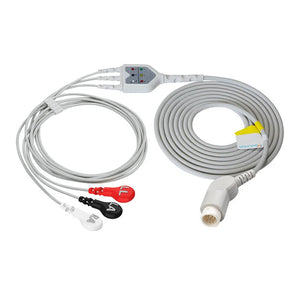
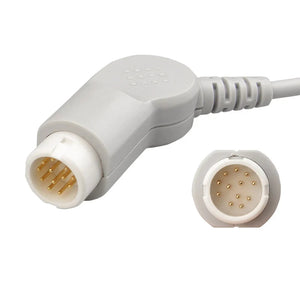
⚡ Quick Takeaway
Choosing the right ECG cable requires matching three things: your monitor brand's connector, the lead configuration (3-lead, 5-lead, or 12-lead), and the electrode attachment type (snap or grabber). One-piece cables are faster to deploy; trunk + leadwire systems cost less to maintain long-term. An AAMI industry survey found that 36% of biomedical technicians encounter ECG cable-related problems daily or weekly — most are preventable with the right cable selection and replacement schedule. This guide covers every decision point. For step-by-step electrode placement instructions, see our 12-Lead ECG Placement Guide.
Every vital sign displayed on a patient monitor starts with a physical connection. For cardiac monitoring, that connection is the ECG cable and leadwire system — the hardware that carries electrical signals from electrodes on the patient's skin to the monitor's processing circuitry. When this hardware fails, degrades, or is mismatched, the consequences range from nuisance artifact and false alarms to missed arrhythmias and diagnostic errors.
Yet ECG cable selection is often treated as an afterthought. A 2010 AAMI survey of biomedical equipment technicians and clinical engineers found that ECG electrode, leadwire, and cable malfunctions are the most common source of ECG device problems — far more frequent than failures of the monitors themselves. The survey respondents called for better connector standardization, more durable cable construction, and clearer compatibility labeling across brands.
This guide addresses exactly those issues. Whether you are a biomedical equipment technician (BMET) maintaining a fleet of monitors, a hospital procurement specialist sourcing accessories, a clinical nurse educator standardizing equipment, or a medical device distributor matching products to customer needs — this is the product-level reference for ECG cables and leadwires. It is not a placement tutorial. For electrode positioning, mnemonics, and skin prep instructions, see our dedicated guides:
→ 3-Lead ECG Placement: Step-by-Step
→ 5-Lead ECG Placement: Colors, Mnemonics & Steps
→ 12-Lead ECG Placement: The Complete Guide
Anatomy of an ECG Cable System: What the Parts Actually Do
Understanding the components helps you troubleshoot faster and order the right replacements. An ECG monitoring system consists of four linked elements, each of which can independently fail:
| Component | Function | Typical Failure Mode |
|---|---|---|
| Electrodes | Adhesive pads with conductive gel that detect electrical signals at the skin surface | Gel dries out (usually after 24h), losing skin contact → "leads off" alarm or baseline wander |
| Leadwires | Individual wires that connect from each electrode to the junction point or trunk cable; color-coded per AHA or IEC standard | Internal conductor break at the snap/grabber junction from repeated flexion → intermittent signal loss |
| Trunk cable | Main cable from the monitor connector to the leadwire junction; carries all leads in a single shielded bundle | Broken strain relief at the monitor connector, damaged shielding → 50/60 Hz interference or multi-lead dropout |
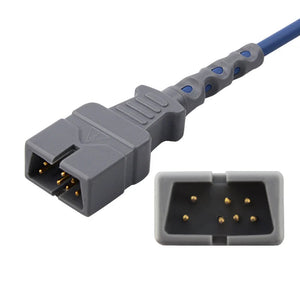
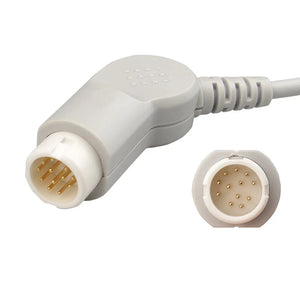
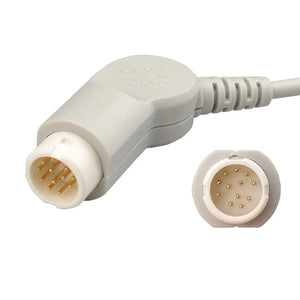
| Monitor connector | Proprietary plug that interfaces with a specific monitor brand and model | Bent pins, corrosion, or physical damage → complete signal failure |
💡 BMET Troubleshooting Rule: When diagnosing ECG signal problems, work from the patient back to the monitor. Check electrodes first, then leadwires, then the trunk cable, then the monitor module. AAMI troubleshooting guidelines recommend connecting a known-good accessory set at each stage to isolate the faulty component. Build a "hero kit" with spare electrodes, leadwires, and a patient simulator for rapid diagnosis.
One-Piece ECG Cables vs. Trunk + Leadwire Systems
This is the most fundamental product decision in ECG cable selection. Both architectures carry the same signals, but they differ significantly in deployment speed, maintenance cost, and replacement logistics.
| Feature | One-Piece (Direct-Connect) | Trunk Cable + Leadwires |
|---|---|---|
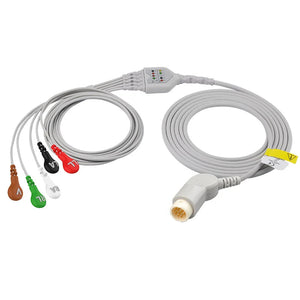
| Construction | Integrated: monitor plug → fixed leadwires → electrode ends; one unit | Modular: trunk cable (monitor plug → junction) + detachable leadwires (junction → electrodes) |
| Setup speed | Fastest — plug in and connect to patient; no assembly | Slightly slower — must connect leadwires to trunk first |
| Best for | Emergency transport, ambulances, ER crash bays, short-term monitoring | ICU, telemetry, long-term inpatient monitoring, multi-bed units |
| Maintenance cost | Higher — if one leadwire fails, the entire cable must be replaced | Lower — replace only the damaged leadwire; trunk cable stays in service |
| Typical lifespan | 6–12 months depending on use intensity | Trunk: 12+ months; Leadwires: 6 months (individual replacement) |
| Inventory complexity | Simpler — one SKU per monitor model and lead count | More SKUs — trunk cable + leadwire sets must be stocked separately |
In practice, most hospitals use both. One-piece ECG cables dominate in transport and emergency settings where speed matters; trunk cable + leadwire systems dominate in ICUs and telemetry where cost-efficiency and individual-wire replacement reduce total cost of ownership.
💡 Procurement Insight: A single damaged leadwire on a 5-lead one-piece cable forces replacement of the entire $50–$120 unit. With a modular trunk + leadwire system, the same repair costs $10–$40 for just the failed leadwire. Over a 100-bed telemetry unit replacing cables monthly, the savings compound significantly.
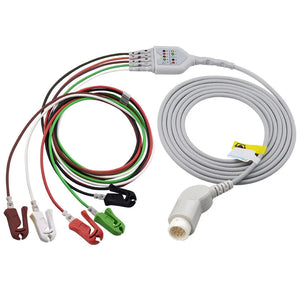
Need a snap electrode end or a 3-lead version instead? The same direct-connect family includes a 3-lead snap M1972A ($48) and a 5-lead snap M1977A ($52) for Philips IntelliVue monitors.
3-Lead, 5-Lead & 12-Lead: Choosing the Right Configuration
The number of leads in your ECG cable system determines what the monitor can see. More leads provide more diagnostic information, but also require more complex cabling, more electrodes, and more setup time. The right choice depends on the clinical setting and monitoring objective.

| Configuration | Electrodes | What It Shows | Primary Use |
|---|---|---|---|
| 3-Lead | 3 (RA, LA, LL) | Leads I, II, III — basic heart rate and rhythm (Einthoven's Triangle) | Transport, ambulance, basic screening, home care, step-down units |
| 5-Lead | 5 (RA, LA, RL, LL, V) | Leads I, II, III, aVR, aVL, aVF + 1 chest lead — rhythm + limited ST-segment monitoring | ICU, telemetry, ER, inpatient cardiac monitoring, post-surgical |
| 12-Lead (10-wire) | 10 (4 limb + 6 chest) | All 12 standard leads — full diagnostic ECG with ST analysis, ischemia detection, MI localization | Diagnostic cardiology, chest pain evaluation, cardiac catheterization labs |
A critical detail for ordering: a "12-lead ECG" actually uses 10 physical wires (4 limb + 6 precordial). The 12 "leads" are mathematical derivations from those 10 electrode positions. When you see a "10-lead ECG cable," it is a 12-lead system.

⚠️ Common Ordering Mistake: Specifying "12-lead cable" when you need a 12-lead diagnostic ECG cart cable versus a 12-lead monitoring cable. Diagnostic cables connect to standalone ECG machines; monitoring cables connect to bedside patient monitors. The connectors are different. Always specify: monitor brand + model + use case (monitoring vs. diagnostic).

For detailed electrode positioning with each configuration, see our step-by-step placement guides: 3-lead, 5-lead, or 12-lead.
Snap vs. Grabber vs. Pin: Electrode Connector Types
The electrode end of each ECG leadwire uses one of three attachment mechanisms. This choice affects clinical workflow, electrode compatibility, and signal reliability.
| Connector Type | Mechanism | Pros | Cons |
|---|---|---|---|
| Snap | Presses onto a metal stud on the electrode; locks with friction | Low profile, secure connection, works with most disposable electrodes | Slightly harder to disconnect quickly; repeated use can loosen the snap |
| Grabber (Pinch/Clip) | Spring-loaded jaw clamps onto the electrode tab | Quick connect/disconnect, easy one-handed use, ideal for high-turnover settings | Higher profile on the skin, slightly more prone to snagging on clothing or bedding |
| Banana pin (DIN) | 4mm pin that inserts into a socket on the electrode or adapter | Standard for diagnostic ECG (EKG) machines, universal fit across EKG carts | Not commonly used for bedside monitoring; requires matching socket-type electrodes |
When ordering ECG cables and leadwires, always specify the electrode connector type alongside the monitor connector and lead count. MedLinket manufactures all three types across telemetry leadwires, one-piece cables, and EKG leadwire sets.
AHA vs. IEC Color Coding: Why It Matters for Cable Selection
Two international standards govern ECG leadwire color coding. Using the wrong color standard does not change electrical function, but it causes lead misidentification at the bedside — a source of placement errors and diagnostic confusion.
| Lead Position | AHA (Americas) | IEC (International) |
|---|---|---|
| Right Arm (RA) | ⬜ White | 🟥 Red |
| Left Arm (LA) | ⬛ Black | 🟨 Yellow |
| Right Leg (RL) | 🟩 Green | ⬛ Black |
| Left Leg (LL) | 🟥 Red | 🟩 Green |
| Chest / V | 🟫 Brown | 🟫 Brown |
Notice the potential for confusion: the red wire is Right Leg in one system and Left Arm in the other. This is why experienced clinicians advise trusting lead labels (letters) first, colors second. When purchasing cables, specify "AHA" or "IEC" to match your facility's standard. All MedLinket ECG cables are available in both AHA and IEC configurations.
💡 Clinical Tip: Common placement mnemonics by color standard — AHA: "White on right, smoke over fire" (black above red on the left), "snow on the grass" (white above green on the right). IEC: "Red on right, sun over meadow" (yellow above green on the left). For the full mnemonic walkthrough, see our 5-Lead ECG Placement guide.
Brand Compatibility: Matching Cables to Your Monitor
The monitor-side connector is where compatibility matters most. Each major patient monitor brand uses a proprietary connector design — different pin counts, physical shapes, and sometimes proprietary communication protocols. You cannot plug a Philips cable into a GE monitor, even if the lead count and electrode end are identical. If you're weighing a non-OEM option, it helps to be clear on what "compatible" actually means at the connector level — true compatibility is about verified pin mapping and fit, not just a plug of the right shape.
The 5-Step Cable Identification Method
Use this systematic approach to identify and order the correct ECG cable for any monitor in your facility:
-
Identify the monitor brand and model. Check the front panel label or asset tag. Common examples: Philips IntelliVue MX800, GE CARESCAPE B650, Mindray BeneView T8, Dräger Infinity Delta.
-
Determine the lead count needed. 3-lead for basic rhythm? 5-lead for telemetry? 12-lead for diagnostic? This is driven by your clinical unit's monitoring protocol.
-
Choose one-piece or trunk + leadwire. ER/transport → one-piece. ICU/telemetry → trunk + leadwires for modularity and cost savings.
-
Specify connector type at the electrode end. Snap, grabber (pinch), or banana pin — match what your unit's electrodes use.
-
Confirm color standard. AHA (white/black/green/red/brown) or IEC (red/yellow/black/green/brown). Match your facility's standard to prevent bedside confusion.
Compatible Cables by Monitor Brand
MedLinket manufactures cross-compatible ECG cables and leadwires for all major patient monitor brands. Each product is cross-referenced against the OEM part number for verified fit and function — see how we verify connector fit, pinout and signal stability before a cable ships:
| Monitor Brand | Product Collection | Popular OEM Part Numbers |
|---|---|---|
| Philips | ECG cables & leadwires | M1669A (trunk), M1668A (trunk), M1671A / M1673A / M1605A (leadwires), 989803160731 (one-piece) |
| GE Healthcare | ECG cables & leadwires | 2008594-002 (leadwire), 2106305-001 (trunk), Multi-Link series |
| Mindray | ECG cables & leadwires | 115-004869-00 / 115-004867-00 (telemetry leadwires), EV6201 series |
| Dräger | ECG cables & leadwires | MP03401 (leadwire), Infinity series trunk cables |
| Nihon Kohden | ECG cables & leadwires | JC-906PA series, BR-913P leadwires |
Not sure which cable fits your monitor? MedLinket offers free compatibility verification — send your monitor brand and model to shopify@medlinket.com and our engineering team will confirm the exact part match.
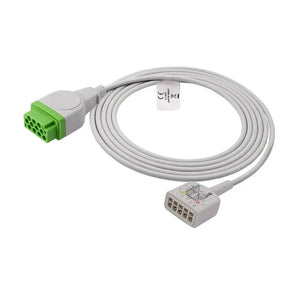
If GE is your fleet, this trunk cable is one piece of a wider set — browse the full GE CARESCAPE B-series compatible accessory list to match electrodes, leadwires and SpO2 in the same connector family.
How ECG Cable Quality Affects Signal Accuracy & Alarm Rates
The ECG waveform you see on a patient monitor is only as good as the signal chain that delivers it. A degraded cable introduces noise, artifact, and false readings — directly impacting patient care and staff workload through alarm fatigue.
Cable-Related Signal Problems
| Problem | What You See | Cable-Related Cause |
|---|---|---|
| 50/60 Hz interference | Fine, regular oscillation on the baseline (AC mains artifact) | Damaged cable shielding allows electromagnetic interference (EMI) from power lines, pumps, and bed motors to couple into the signal |
| Baseline wander | Slow, rolling drift of the entire tracing up and down | Intermittent conductor contact inside the cable, often at the connector junction; also caused by cable tension on electrodes |
| Intermittent signal dropout | Waveform disappears briefly and returns; "leads off" alarm fires intermittently | Internal conductor break — typically at the stress point where the wire meets the snap/grabber connector due to repeated flexion |
| False arrhythmia alarms | Monitor reports V-tach, V-fib, or asystole when the patient is clinically stable | High-impedance connection from corroded pins or cracked insulation creates noise that the algorithm misinterprets as a lethal rhythm |
MedLinket's in-house testing demonstrates measurable quality benchmarks that directly translate to cleaner signals: our disposable ECG electrodes achieve AC impedance as low as 109Ω — well below the ≤2kΩ industry standard (YY/T 0196-2005). Our patented eccentric (offset) electrode design (Patent CN202120112524.5) places the leadwire connection point off-center with a flexible FPC base and narrow neck structure, allowing 360° cable rotation without disturbing the electrode-skin interface — dramatically reducing motion artifact in ambulatory and telemetry patients.
💡 AAMI Best Practice: When artifact persists after replacing electrodes and ensuring good skin prep, the cable is often the culprit. Replace leadwires when you observe cracked jackets, corroded snap/pin contacts, or intermittent "wiggle-test" signal loss. Replace the trunk cable when you see broken strain reliefs, exposed conductors, or multi-lead dropouts that follow the trunk cable rather than individual leads.
OEM vs. Compatible ECG Cables: Making an Informed Choice
Hospital procurement teams face a recurring decision: buy original equipment manufacturer (OEM) cables at full price, or source compatible (aftermarket) alternatives at significant savings. The answer depends on verifiable quality, regulatory status, and warranty coverage — not brand name alone.
OEM Cables
Manufactured by the monitor brand itself (Philips, GE, etc.). Guaranteed compatibility. Higher price point ($80–$300+). Availability can be limited; lead times may be longer. May come with monitor warranty integration.
Quality Compatible Cables
Manufactured by third-party specialists like MedLinket. Cross-referenced against OEM part numbers for verified fit. Typically 30–60% less expensive. Must be sourced from ISO 13485/FDA/CE certified manufacturers for safety assurance. Independent product liability insurance provides additional coverage.
The key quality indicators to evaluate in any compatible ECG cable supplier:
| Quality Criterion | What to Verify | MedLinket Status |
|---|---|---|
| Manufacturing QMS | ISO 13485 certification (medical device quality management) | ✅ Certified since 2005; 3 factories (Shenzhen, Shaoguan, Indonesia) |
| Regulatory clearance | FDA 510(k) clearance (US), CE marking (EU), additional local registrations | ✅ FDA registered, CE marked; passed NMPA (China), ANVISA (Brazil) on-site audits |
| Biocompatibility | ISO 10993 testing for all patient-contact materials; latex-free | ✅ Third-party biocompatibility reports; RoHS compliant; 100% latex-free |
| Product liability insurance | Minimum $1M USD coverage; individual certificates available | ✅ $5M USD product liability insurance; individual certificates on request |
| Factory testing | 100% electrical testing before shipment | ✅ 100% factory-tested; each item must pass before shipment |
| Warranty | Minimum 6-month warranty for reusable accessories | ✅ 6 months (leadwires, electrodes) / 12 months (trunk cables, one-piece cables) |
For a detailed comparison framework applicable to all patient monitoring accessories — not just ECG — see our guide on OEM vs. Compatible Patient Monitor Accessories in the Hospital Monitor Reading & Accessories Guide. If you want to see the bench side of that decision, our breakdown of exactly what we bench-test on a compatible cable vs the OEM walks through the verification step by step, and what FDA 510(k), ISO 13485 and $5M liability coverage actually mean explains the certifications in the table above.
ECG Cable Maintenance, Inspection & Replacement Schedule
Proactive cable management prevents the majority of ECG signal problems. The AAMI survey data reinforces this: hospitals that replace cables on a scheduled basis report significantly fewer daily troubleshooting incidents than those that run cables to failure.
Recommended Replacement Intervals
| Component | Replacement Interval | Inspection Trigger |
|---|---|---|
| Disposable ECG electrodes | Every 24 hours (or when gel dries out) | Baseline wander, increased impedance, "leads off" alarms |
| Reusable leadwires | Every 6 months (or at first sign of failure) | Cracked jacket, corroded snaps/pins, intermittent signal loss on "wiggle test" |
| Trunk cables | Every 12 months (or at first sign of failure) | Broken strain relief, exposed conductors, multi-lead dropout |
| One-piece cables | Every 6–12 months depending on use intensity | Any single-lead failure (since the entire cable must be replaced) |
The modular advantage is clearest here: when a single Mindray telemetry lead fails the wiggle test, you can swap just the 115-004867-00 leadwire ($35, 22% off) instead of replacing a whole one-piece cable — keeping the trunk in service.
💡 Cable Care Extends Lifespan: Route cables with gentle loops — avoid sharp bends at connectors. Clean with approved disinfectants per manufacturer guidelines; avoid immersing connectors. Store cables coiled loosely, not tightly wound. Never pull on the cable to disconnect — always grasp the connector body. These practices from clinical best practice guides can extend usable life by 30–50%.
Specialized ECG Cable Types
Beyond standard bedside monitoring, specific clinical environments require purpose-built ECG cables:
Telemetry Cables
Telemetry ECG leadwires connect to portable wireless transmitters carried by ambulatory patients. They must be lightweight, flexible, and resistant to motion artifact from patient movement. MedLinket's telemetry leadwires feature enhanced flexibility and secure snap/grabber connections designed for patients who are walking, eating, and sleeping while monitored.
Holter Monitoring Cables
Holter ECG cables connect to 24–48 hour continuous recorders. Durability and patient comfort over extended wear are paramount. These cables must withstand daily activities without generating significant motion artifact.
EKG (Diagnostic) Cables
EKG cables and leadwires are designed for standalone electrocardiograph machines used in cardiology clinics, pre-operative screening, and diagnostic workups. They typically use banana pin (DIN) connectors rather than snap/grabber and are built for the relatively shorter, controlled use cycles of diagnostic testing. Available as direct-connect, trunk, or individual leadwire configurations.

Defibrillation-Rated Cables
Cables used in any setting where defibrillation is possible (ICU, ER, code carts) must be rated for defibrillation discharge. Non-rated cables can conduct defibrillation energy to the monitor, damaging the ECG module. Always verify defibrillation rating when ordering cables for critical care areas.

Frequently Asked Questions
What is the difference between a one-piece ECG cable and a trunk cable with separate leadwires?
A one-piece cable integrates everything into a single unit — plug it in and connect to the patient immediately. A trunk cable + leadwire system is modular: the trunk stays connected to the monitor, and individual leadwires can be swapped without replacing the entire assembly. One-piece is faster (for example, the Philips-compatible M1975A, $52); trunk + leadwire is more cost-effective over time.
How do I know which ECG cable is compatible with my patient monitor?
Match three variables: (1) monitor brand and model (determines the connector), (2) lead count (3/5/12-lead), and (3) electrode connector type (snap/grabber/pin). Also specify your color standard (AHA or IEC). If unsure, contact MedLinket at shopify@medlinket.com with your monitor model for free compatibility verification.
What is the difference between snap and grabber (pinch) connectors?
Snap connectors press onto a metal stud on the electrode for a secure, low-profile connection. Grabber (pinch) connectors use a spring-loaded jaw for faster connect/disconnect. Both deliver equivalent signal quality. Choose based on your clinical workflow: snap for long-term monitoring; grabber for high-turnover settings like the ER.
How often should ECG cables be replaced?
Disposable electrodes: every 24 hours. Reusable leadwires: every 6 months or at first sign of damage. Trunk cables: every 12 months. Replace immediately if you observe cracked insulation, corroded pins, intermittent signal, or fail a continuity test.
Are compatible (non-OEM) ECG cables safe?
Yes — when sourced from manufacturers that hold ISO 13485 certification, FDA/CE regulatory clearance, and carry independent product liability insurance. All MedLinket compatible cables are manufactured in ISO 13485-certified facilities, 100% factory-tested, and backed by $5M USD product liability coverage.
What causes persistent ECG artifact that doesn't resolve with new electrodes?
When good skin prep and fresh electrodes don't resolve artifact, the cable is the most likely cause. Test by swapping in a known-good leadwire set. Look for: cracked cable jackets (EMI entry point), corroded snaps/pins (high impedance), internal conductor breaks at flex points (intermittent dropout), and broken trunk cable shielding (50/60 Hz noise). See our pillar guide troubleshooting section for the full decision tree.
What is the difference between AHA and IEC ECG color coding?
AHA (American Heart Association) uses white/black/green/red/brown; IEC (International Electrotechnical Commission) uses red/yellow/black/green/brown. The same lead positions have different colors between the two systems — for example, the Right Arm lead is white in AHA but red in IEC. Always specify your facility's standard when ordering. Experienced clinicians recommend trusting lead labels over colors.
Can I use a 5-lead trunk cable with 3-lead leadwires?
This depends on the specific cable system and monitor. Some modular systems allow variable lead counts; others require matched sets. Mixing incompatible trunk and leadwire configurations can result in no signal, incorrect lead identification, or error messages. Always verify compatibility with the manufacturer's specifications.
Summary: Your ECG Cable Selection Checklist
Selecting the right ECG cable comes down to a systematic match of five variables: monitor brand connector, lead count, cable architecture (one-piece vs. modular), electrode connector type, and color standard. Getting these right eliminates the most common source of ECG device problems and contributes directly to cleaner waveforms, fewer false alarms, and better patient outcomes.
One-piece vs. trunk vs. detachable leadwire — the exact choices this guide walks through
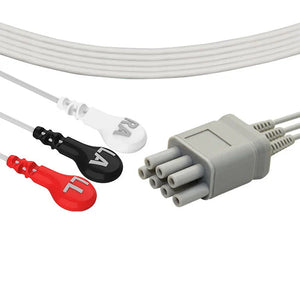
Confirm your monitor brand & model before ordering — each cable matches a different connector.
This guide covers the product and selection perspective. For the complete clinical monitoring picture — including how to interpret ECG readings, manage alarms, and troubleshoot all vital sign parameters — explore the Hospital Monitor Reading & Accessories Guide.
Need Help Matching ECG Cables to Your Monitors?
MedLinket's engineering team provides free compatibility verification for any monitor brand and model. Send us your equipment list and we will confirm exact part matches — no obligation. Samples available with refund on bulk order.
Browse ECG Cables & Leadwires · Disposable Electrodes · EKG Cables
Contact Us · Email: shopify@medlinket.com · WhatsApp: +86 189 2972 7044
Related Guides & Resources
| Topic | Guide |
|---|---|
| Complete monitoring reference | Hospital Monitor Reading & Accessories Guide (Pillar) |
| 3-lead electrode positioning | 3-Lead ECG Placement: Step-by-Step |
| 5-lead electrode positioning | 5-Lead ECG Placement: Colors, Mnemonics & Steps |
| 12-lead electrode positioning | 12-Lead ECG Placement: The Complete Guide |
| Heart rate alarms | Heart Rate Alarm High/Low: When to Worry |
| Normal heart rate guide | What Is a Normal Heart Rate on a Hospital Monitor? |
| OEM vs compatible accessories | OEM vs. Compatible Patient Monitor Accessories |
| Beginner's monitor guide | Hospital Monitor Basics for New Nurses |
About MedLinket: Founded in 2004 (NEEQ Stock Code: 833505), MedLinket is a leading manufacturer of patient monitoring accessories — the first listed company of patient monitor accessories in China. With 3 manufacturing facilities, ISO 13485/ISO 9001 certification, FDA 510(k) registration, CE marking, and successful on-site audits by China's NMPA, US FDA, and Brazil's ANVISA, MedLinket serves 2,000+ hospitals across 120+ countries. Our product range includes SpO2 sensors, ECG cables & leadwires, ECG electrodes, NIBP cuffs, temperature probes, IBP transducers, EtCO2 accessories, and EEG/EMG accessories — all cross-compatible with Philips, GE Healthcare, Mindray, Dräger, Masimo, Nellcor, Nihon Kohden, and 30+ other brands. Visit med-linket-corp.com
Disclaimer: This article is intended for educational and product reference purposes for healthcare professionals, biomedical technicians, procurement specialists, and medical device distributors. It does not constitute medical advice. Always follow your facility's protocols and consult qualified professionals for clinical decisions. MedLinket (est. 2004, NEEQ: 833505) is a manufacturer of patient monitoring accessories. All other company and brand names mentioned are for identification and compatibility reference purposes only and do not imply affiliation, partnership, or endorsement.