The short version
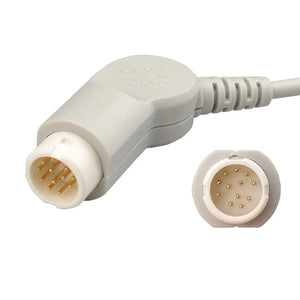
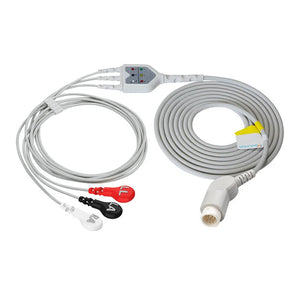
GE Healthcare patient monitors — the CARESCAPE B-series, CARESCAPE ONE, Dash 3000/4000/5000, MAC resting-ECG systems, and ApexPro telemetry — use the industry-standard 4 mm snap connector on adult bedside, telemetry and resting-ECG lead wires. That snap is not proprietary to GE, so disposable ECG electrodes from any reputable maker holding ISO 13485:2016, FDA 510(k) clearance and lot-level AAMI EC12 testing are mechanically and electrically compatible. GE's EK-Pro arrhythmia algorithm runs inside the monitor and is electrode-agnostic — it processes an AAMI EC12-compliant signal regardless of electrode brand. The procurement decision rests on certification verification and a structured BMET check, not on OEM-brand preference. MedLinket's V0014 (metal-snap) and V0015 (carbon-snap, radiolucent) series cover the GE fleet across all six standard sizes in sterile and non-sterile packaging.
📋 What this guide covers: the GE monitor fleet disposable electrodes interface with; why the 4 mm snap makes GE compatibility mechanical rather than proprietary; a 6-step BMET verification checklist; the EK-Pro algorithm question; cath-lab / imaging (radiolucent) workflows on GE platforms; and a directional OEM-vs-compatible cost framework.
↗️ This is the GE-specific deep-dive within our broader OEM compatible ECG electrodes hub. The hub covers every major monitor brand at category level; this page goes monitor-model-specific for GE. For the AMBU competitor comparison see the AMBU BlueSensor vs MedLinket offset comparison, and for the full supplier framework see the 12-criterion supplier evaluation guide.
🎯 Best for: procurement managers running a GE-fleet electrode tender, BMETs validating compatible electrodes against installed CARESCAPE / Dash / MAC monitors, cath-lab teams evaluating radiolucent options, and distributors building a GE-installed-base portfolio.
Educational & procurement disclaimer. This article is for hospital procurement, BMET and distributor education, and is authored by MedLinket — weight that authorship in your evaluation. GE Healthcare, CARESCAPE, Dash, MAC, ApexPro, EK-Pro, MUSE and other product names are trademarks of GE HealthCare Technologies, Inc. or its affiliates, used here solely for legitimate comparative purposes; no endorsement, partnership or affiliation is implied. Verify all current GE specifications, regional availability, lead-wire snap diameters and pricing directly with GE Healthcare or authorized GE distributors before any procurement decision. This article does not substitute for any product's IFU, your facility's protocols, your GE service-contract terms, or applicable regional regulations.
If you run a GE-dominant monitor fleet and want to qualify a lower-cost disposable ECG electrode, the practical question is narrow: will it fit my CARESCAPE / Dash / MAC / ApexPro lead wires, and will the signal be clean enough for EK-Pro? The answer is mostly settled by one shared mechanical standard and one electrical standard — but the verification step is worth doing properly. This page walks through both.
Why GE specifically?
Short answer: GE Healthcare is one of the largest installed-base monitor brands globally, spanning bedside, transport, telemetry and resting ECG. Hospitals on a GE-dominant fleet generate the highest absolute volume of GE-compatible electrode demand, so the GE-specific compatibility question — across the CARESCAPE B-series, CARESCAPE ONE, Dash, MAC and ApexPro — carries the most procurement weight of any single OEM deep-dive.
Three procurement realities make this worth a dedicated page rather than a line in the hub:
- Installed-base scale. The CARESCAPE platform is one of the most widely deployed high-acuity bedside families across North America, Europe and Asia. A hospital running dozens of CARESCAPE monitors across ICU, OR, PACU and step-down can consume disposable ECG electrodes in the hundreds of thousands of pieces a year — the volume where compatible-tier per-unit savings become material.
- Multi-product-line breadth. A GE-equipped hospital rarely runs one model. It runs CARESCAPE in ICU/OR/step-down, Dash in transport, MAC in the cardiology clinic for resting ECG, and ApexPro telemetry across the floors. A single compatible electrode SKU that works across all of these consolidates stocking in a way OEM-only purchasing does not.
- Mixed-age fleet. Most GE sites carry current-generation CARESCAPE alongside earlier Dash and Solar units that stay in service for years. The compatible-electrode question has to hold across both — the 4 mm snap standard means it generally does, but legacy lead wires are exactly where verification matters.
The GE Healthcare monitor fleet (what electrodes interface with)
Short answer: the GE monitors disposable ECG electrodes connect to fall into four groups — CARESCAPE bedside and portable monitors, the Dash portable family, the MAC resting-ECG line, and ApexPro telemetry. The adult lead wires across these use the 4 mm snap standard. The table below is a compatibility orientation, not a GE spec sheet; confirm specifics with GE.
Rather than reproduce GE's product catalogue, here is the compact view a BMET or buyer actually needs — model family, role, and the electrode-relevant interface note:
| GE family | Representative models | Role | Electrode interface note |
|---|---|---|---|
| CARESCAPE bedside | B450 / B650 / B850; CARESCAPE ONE; Canvas; Patient Data Module | High-acuity ICU / OR / step-down + transport | 4 mm snap on adult lead wires verify with GE |
| CARESCAPE portable | V100; B20 | Vital-signs / lower-acuity / ED | 4 mm snap on adult lead wires |
| Dash portable | Dash 3000 / 4000 / 5000; Solar (legacy) | Portable bedside & transport (older, widely installed) | 4 mm snap typical; verify legacy lead-wire |
| MAC resting ECG | MAC 2000 / MAC 5 / MAC 5500 (MAC 1600 discontinued) | 12-lead diagnostic / cardiology clinic | 4 mm snap on standard acquisition lead sets |
| ApexPro telemetry | ApexPro CH / FH with CARESCAPE Telemetry transmitter | Ambulatory floor telemetry | 4 mm snap on telemetry lead wires |
The 4 mm snap standard: GE compatibility is mechanical, not proprietary
Short answer: all major GE Healthcare lead wires for adult bedside, telemetry and resting ECG use the industry-standard 4 mm snap diameter — not a GE-only connector. The same 4 mm snap is shared across Philips, Mindray, Dräger, Nihon Kohden and others. So "GE compatible" describes a mechanical and electrical fit, not a licensing claim.
GE compatibility maps to three industry-standard interfaces — and only the first two involve the electrode at all:

- Mechanical — 4 mm snap diameter. The female snap on a GE lead wire mates with any 4 mm male-snap electrode. GE-OEM and reputable third-party electrodes both use 4 mm snaps, so the mechanical fit is the same. See the dedicated 4 mm snap ECG electrodes connector standard guide for geometry and tolerance.
- Electrical — AAMI EC12. The signal from electrode to monitor amplifier is a low-amplitude (typically 0.5–3 mV) ECG biopotential. AAMI EC12 specifies the electrical performance an electrode must deliver — AC impedance, DC offset voltage, bias-current tolerance, defibrillation-overload recovery, and combined offset instability / internal noise. Both OEM and compatible electrodes are tested to this same standard, so an EC12-compliant compatible electrode delivers an equivalent signal.
- Algorithmic (downstream) — EK-Pro and Marquette 12SL. GE's proprietary algorithms process the EC12-compliant signal they receive; they do not "see" the electrode brand. This is the same logic that lets EK-Pro work across GE-OEM, AMBU, 3M / Solventum, Cardinal Health / Kendall and any other EC12-compliant electrode.
⚠️ Snap-diameter exceptions. Some GE pediatric and neonatal lead wires use 3.4 mm snaps rather than 4 mm, and some legacy Solar-series or very old Dash lead wires may use other geometries. The 4 mm standard covers the bulk of adult bedside, telemetry and Holter use, but always confirm the specific lead-wire snap diameter by physical measurement against the installed base before bulk ordering — especially for pediatric / NICU variants. Verify rather than assume.
The 6-step BMET verification checklist
Short answer: a structured BMET check of any GE-compatible electrode candidate runs six sequential steps over 1–2 weeks — snap-fit verification against your specific GE lead wires, a snap-pull mechanical check, lot-level AAMI EC12 documentation review, an EK-Pro / Marquette 12SL signal-quality smoke test, sterile-barrier review where applicable, and a small-lot pilot on one unit. The protocol suits any GE-compatible electrode regardless of supplier.
Snap-fit verification on your specific GE lead wires
Before any bulk commitment, physically test the candidate's snap fit against the GE lead wires actually installed in your facility — separately for CARESCAPE, Dash, MAC and ApexPro lead wires. The 4 mm snap is standard, but minor lot-to-lot tolerance variation can produce a fit that is "almost right" rather than secure. It should engage with a clean click and resist a gentle pull without disengaging.
Snap-pull mechanical check
Run a bench pull check with a calibrated push-pull gauge, comparing the candidate's snap retention against your incumbent OEM electrode under the same lead-wire condition. The candidate should sit in the same range as the OEM; one that disengages at noticeably lower force is a yellow flag for clinical fall-off. For structural background, the offset vs center-post pull-strength bench data is a useful reference.
Lot-level AAMI EC12 documentation review
Request the most recent lot-level AAMI EC12 test report covering AC impedance (the standard's average and individual-maximum limits), DC offset voltage, bias-current offset, and combined offset instability / internal noise. The report should state the lot number, test date, laboratory, and the measured values against the EC12 limits. For reference, MedLinket's internal lot reports cite AC impedance averaging on the order of ~109 Ω against the ≤2 kΩ average / ≤3 kΩ individual EC12 ceiling — but the point of this step is to read the candidate supplier's own report, not to accept a marketing figure. Documentation gaps are an immediate disqualifier. See the FDA, ISO & CE compliance guide.
EK-Pro / Marquette 12SL signal-quality smoke test
Apply candidate electrodes to a healthy volunteer (or the BMET), connect to a GE monitor running EK-Pro, and record a 5-minute baseline. Watch signal amplitude at standard gain (10 mm/mV), baseline drift over the window, absence of spurious arrhythmia detections, and clean precordial leads on the 12-lead display. For MAC resting-ECG, run a standard 12-lead acquisition with the Marquette 12SL program and check interpretation cleanliness. The candidate should be indistinguishable from the OEM in this short test.
Infection-control sterile-barrier review (sterile variants only)
For sterile-packaged variants used in cath lab, EP lab, NICU, oncology or immunocompromised care, review the supplier's ISO 11607-1 / -2 sterile-barrier validation — pouch material, seal integrity at opening, and sterility maintenance across the rated sealed shelf life. MedLinket's V0014 / V0015 sterile variants (sterile-pack SKU codes) are validated to ISO 11607-1 / -2. See the sterile ECG electrodes clinical guide.
Small-lot pilot on a single unit
Run the candidate on one unit (telemetry step-down works well) for 1–2 weeks in parallel with the OEM on a comparable unit. Track nursing application time, mid-shift fall-off events, skin-reaction reports, patient-comfort feedback and any electrode-related BMET service calls. Document the data for tender finalization. An operational comparison like this does not need IRB review, but does need infection-control sign-off and unit nurse-leadership approval.
The EK-Pro algorithm question
Short answer: EK-Pro is GE Healthcare's proprietary arrhythmia algorithm that runs inside the GE monitor, not inside the electrode. Any disposable electrode meeting AAMI EC12 specifications with a correct mechanical snap fit delivers the signal EK-Pro processes. The algorithm operates downstream of the electrode-monitor interface and is electrode-brand-agnostic.
This comes up often on GE tenders, and it is worth answering directly because it reflects a misunderstanding of where in the signal chain the proprietary processing lives. The chain is:
- Skin-electrode interface — gel chemistry, Ag/AgCl reaction, biopotential pickup. Electrode-side, AAMI EC12-governed.
- Electrode-to-lead-wire snap — 4 mm mechanical fit. Industry-standard.
- Lead wire — shielded conductor to the monitor amplifier. GE-branded.
- Monitor amplifier — analog front-end, anti-aliasing, ADC. GE-branded.
- Algorithm — EK-Pro arrhythmia analysis, ST monitoring. GE proprietary.
- Display & alarm — central station, telemetry, MUSE integration. GE-branded.
The compatible-electrode question lives entirely at steps 1 and 2 — the skin-electrode interface (AAMI EC12) and the snap (4 mm standard). Steps 3 through 6 are GE-branded and unchanged whether the electrode is OEM or compatible. A candidate meeting EC12 and the 4 mm standard therefore delivers the same input to the GE amplifier, and thus to EK-Pro. The proprietary algorithm processes a standardized signal regardless of upstream brand.
GE cath lab & imaging workflows: the V0015 carbon-snap option
Short answer: for imaging-compatible workflows on GE monitors — cath lab, EP lab, hybrid OR, CT-room transport, and MRI suite (per IFU verification) — the MedLinket V0015 carbon-snap radiolucent series is a GE-compatible imaging-friendly option. The carbon-snap construction replaces the metal snap and rivet with a carbon-loaded polymer that is essentially transparent to X-ray and CT and ferromagnetic-free for MR-conditional workflows (per product documentation; verify against IFU).

GE cath-lab, EP-lab and hybrid-OR setups commonly pair CARESCAPE bedside monitors with CARESCAPE ONE for transport. Carbon-snap radiolucent electrodes help that combined imaging + monitoring workflow for two reasons:
- Image clarity. Metal-snap electrodes appear as bright opaque artifacts on cath-lab fluoroscopy and CT, occasionally obscuring vasculature in the cardiac field of view. Carbon-snap radiolucent electrodes are essentially transparent to X-ray, removing that artifact.
- Workflow simplification. Applying carbon-snap electrodes pre-emptively on imaging-likely patients avoids last-minute removal-and-replacement before imaging, which interrupts continuous monitoring and adds nursing labor.
Full clinical and procurement context is in the radiolucent ECG electrodes for CT, DR, MRI & cath lab guide. For GE installed bases, the V0015 carbon-snap series is mechanically compatible with CARESCAPE, Dash and ApexPro lead wires using the 4 mm snap.
⚠️ MR-conditional, not "MR safe." Monitoring ECG electrodes designed for MR-conditional workflows are not "MR Safe" in the regulatory sense — they are MR-conditional per the manufacturer's product documentation. Always verify the specific electrode IFU against the GE MRI scanner field strength, gradient and imaging protocol before clinical use. The compatible-electrode decision does not change that verification requirement.
OEM vs compatible: a directional cost framework
Short answer: the OEM-vs-compatible decision for a GE-installed-base hospital has four inputs — per-unit price differential, annual electrode volume across the GE fleet, one-time switching cost (BMET evaluation, nursing re-training, side-by-side stocking window), and any quality-equivalence adjustment. Populate the framework below with your own figures and formal quotations from both GE and the candidate supplier; it is deliberately left without invented prices.
Compatible-tier disposable electrodes are commonly priced below OEM-branded equivalents — savings on the order of 30–50% per unit are frequently cited across the compatible-accessory market, though the actual figure depends entirely on negotiated pricing, your annual volume, the specific lead-set configuration, and your switching cost. Treat any percentage as a market observation to be confirmed with formal quotations, not a guaranteed outcome. For high-volume negotiation, see the bulk ECG electrodes procurement guide, and for the broader cost-of-monitoring picture see disposable vs reusable ECG electrodes.
The MedLinket GE-compatible SKU map
The MedLinket V0014 (metal-snap) and V0015 (carbon-snap, radiolucent) series cover the GE fleet using the 4 mm snap standard. The map below pairs the clinical scenario with the recommended series and the GE families it suits. Confirm the specific lead-wire snap diameter against your installed base before ordering, particularly for pediatric / NICU.
| Clinical scenario | MedLinket series / size | GE monitor families |
|---|---|---|
| Adult ICU / OR continuous (sterile) | V0014 low-allergy, Φ50 mm round, sterile | CARESCAPE B650 / B850, Dash 4000 / 5000, ApexPro |
| Adult Holter / 48-hour ambulatory | V0014 low-allergy, 70.5 × 55 mm rectangular | MAC + Holter-recorder workflows |
| Cath lab / EP lab / imaging-compatible | V0015 carbon-snap, Φ50 mm, sterile, radiolucent | CARESCAPE B650 / B850 cath-lab integration; CARESCAPE ONE transport |
| NICU / neonatal (sterile) | V0014 low-allergy, Φ25 mm round, sterile | CARESCAPE NICU config verify pediatric snap |
| Pediatric continuous | V0014 Φ42 mm round or 50.5 × 35 mm rectangular | CARESCAPE pediatric config verify snap |
| Adult telemetry / step-down (non-sterile) | V0014 low-allergy, Φ50 mm round | ApexPro telemetry, CARESCAPE B450 |
| MAC resting ECG (cardiology clinic) | V0014 Φ50 mm or 50.5 × 35 mm | MAC 2000, MAC 5, MAC 5500 |
📦 Building a GE-compatible disposable ECG electrode portfolio for a tender?
🎁 Request the GE compatibility verification pack — a GE compatibility cross-reference (CARESCAPE / Dash / MAC / ApexPro), a V0014 / V0015 sample pack for the scenarios above, plus the lot-level AAMI EC12 test report, ISO 13485:2016 certificate, FDA 510(k) clearance number, ISO 10993-1/-5/-10 biocompatibility documentation, ISO 11607 sterile-barrier validation, and latex-free declaration.
📧 Email shopify@medlinket.com with your hospital name, GE monitor inventory, primary application areas, and required regional certifications.
💬 WhatsApp our sourcing team on +852 6467 3105 for sample MOQ, lead times, and the GE switching-evaluation protocol template.
Frequently asked questions
Are GE compatible ECG electrode pads FDA cleared?
Disposable ECG electrodes are FDA-cleared (not "approved") under the 510(k) process. A reputable supplier of GE-compatible electrodes holds its own 510(k) clearance for the electrode family — separate from GE Healthcare's clearance for the monitor. Request the supplier's 510(k) number and verify it directly in the FDA 510(k) database. MedLinket's V0014 and V0015 series hold FDA 510(k) clearance and fit GE monitors using the standard 4 mm snap.
Which GE Healthcare monitors do MedLinket ECG electrodes work with?
MedLinket V0014 and V0015 electrodes are mechanically compatible with GE monitors using the standard 4 mm snap — including the CARESCAPE B-series, CARESCAPE ONE, V100, B20, Dash 3000 / 4000 / 5000, MAC 2000 / 5 / 5500, and ApexPro telemetry. Always verify the specific lead-wire snap diameter against the installed base before bulk ordering, since some pediatric and neonatal lead wires use 3.4 mm snaps.
What is the difference between OEM GE pads and GE compatible pads?
OEM pads are sold under the GE Healthcare brand and usually cost more. Compatible pads are made by third-party manufacturers to meet the same AAMI EC12 electrical specifications and to fit GE lead wires mechanically. Performance is generally equivalent when the compatible maker holds ISO 13485 certification, FDA 510(k) clearance and provides lot-level test reports. Compatible electrodes are commonly priced well below OEM in many markets — confirm with formal quotations for your SKUs and volumes.
Do GE compatible ECG electrodes work with the EK-Pro arrhythmia algorithm?
Yes. EK-Pro runs inside the GE monitor, not the electrode. Any electrode meeting AAMI EC12 specifications with a correct 4 mm snap fit delivers the signal EK-Pro processes. The compatibility question is at the electrode-to-lead-wire and electrode-to-skin interfaces; the on-monitor algorithm operates downstream and is agnostic to electrode brand.
Can compatible electrodes work with GE radiolucent imaging workflows in cath lab?
Yes — for imaging-compatible workflows (CT, DR, MRI suite, cath lab, EP lab) on GE monitors, the MedLinket V0015 carbon-snap radiolucent series provides imaging-compatibility comparable to OEM radiolucent variants. The carbon-snap construction is essentially transparent to X-ray and CT and ferromagnetic-free for MR-conditional workflows (per product documentation; verify against IFU). It is available across the six standard sizes and pairs with GE lead wires using the 4 mm snap.
Do I need GE Healthcare's approval to use compatible ECG electrodes?
No. Hospitals may procure disposable consumables from any qualified supplier whose product meets the relevant performance and biocompatibility standards (AAMI EC12, ISO 10993). A monitor warranty and service contract typically cover the monitor itself, not the disposable consumables chosen for use with it; review your specific service-contract language with your GE representative if questions arise. The mechanical (4 mm snap) and electrical (AAMI EC12) interfaces are industry-standard, not proprietary to GE.
What snap diameter does GE Healthcare use on its lead wires?
GE lead wires use the industry-standard 4 mm snap for adult bedside, telemetry and Holter monitoring; some pediatric and NICU lead wires use 3.4 mm snaps. The 4 mm standard is shared across major monitor brands (Philips, Mindray, Dräger, Nihon Kohden and others), which is why compatible electrodes from reputable makers fit mechanically across brands. Always confirm the specific lead-wire snap diameter against the installed base before bulk ordering, especially for legacy GE monitors or pediatric / NICU variants.
Key takeaways
- GE runs a broad, mixed-age fleet — CARESCAPE bedside/portable, Dash, MAC resting ECG and ApexPro telemetry — and the adult lead wires across it use the 4 mm snap standard.
- GE compatibility is mechanical and electrical, not proprietary. The 4 mm snap is industry-standard; AAMI EC12 defines the electrical performance. There is no GE-only electrode interface.
- EK-Pro runs on the monitor, not in the electrode. Any AAMI EC12-compliant electrode delivers a signal EK-Pro processes correctly.
- The 6-step BMET check — snap-fit, snap-pull, lot-level EC12 docs, EK-Pro / 12SL smoke test, sterile-barrier review, small-lot pilot — takes 1–2 weeks and yields a defensible decision.
- For imaging workflows on GE platforms, the V0015 carbon-snap radiolucent series gives full 4 mm-snap compatibility.
- Cost savings are real but must be quantified. Use the four-variable framework with formal supplier quotations rather than a headline percentage.
- The V0014 / V0015 SKU map covers adult ICU/OR, transport, telemetry, NICU, pediatric, cath lab/EP lab and MAC resting-ECG scenarios.
- Verify with GE. Confirm current specifications, regional availability and lead-wire snap diameters with GE Healthcare or authorized distributors; pediatric and neonatal lead wires sometimes use 3.4 mm snaps.
References & standards
Performance & safety standards
- ANSI/AAMI EC12 — Disposable ECG Electrodes: AC impedance, DC offset voltage, bias-current tolerance, defibrillation-overload recovery, combined offset instability / internal noise. The universal electrical-performance bar for all reputable disposable ECG electrode families regardless of OEM brand.
- IEC 60601-2-25 — basic safety and essential performance of electrocardiographs (applies to GE MAC resting ECG and electrode integration).
- IEC 60601-2-27 — basic safety and essential performance of ECG monitoring equipment (applies to GE CARESCAPE / Dash / ApexPro pairings).
- ISO 10993-1, -5, -10 — biological evaluation of medical devices: framework, cytotoxicity, sensitisation, applicable to electrode adhesives.
- ISO 13485:2016 — medical-device quality-management systems.
- ISO 11607-1, -2 — packaging for terminally sterilized medical devices (sterile-pack variants for cath lab, NICU, oncology).
Regulatory references
- U.S. FDA 510(k) database — searchable at the FDA 510(k) database; the authoritative reference for clearance verification.
- EU MDR (2017/745) — CE-marking requirements for ECG electrodes sold in the EU.
- NMPA (China) — Class II registrations applicable to MedLinket V0014 / V0015 series.
- Regional authorities — UK MHRA, Brazil ANVISA, Australia TGA, Japan PMDA and others for cross-border distribution.
GE Healthcare product references
- GE HealthCare public product documentation — CARESCAPE B-series / ONE / Canvas / V100 / B20, Dash 3000 / 4000 / 5000, MAC 2000 / 5 / 5500, ApexPro CH / FH, and EK-Pro arrhythmia analysis. Specifications, regional availability and lead-wire snap diameters must be verified directly with GE Healthcare or authorized distributors. CARESCAPE, Dash, MAC, ApexPro, EK-Pro, MUSE and related names are trademarks of GE HealthCare Technologies, Inc. or its affiliates, used here solely for legitimate comparative purposes.
Internal product references (available on request)
- MedLinket internal product specification documentation — V0014 / V0015 sizes, snap material, backing material, packaging formats and shelf life. Available to qualified buyers via shopify@medlinket.com.
- MedLinket internal GE-compatibility verification documentation — snap-fit protocol, the BMET 6-step checklist, and the GE SKU map referenced here.
- MedLinket internal lot-level AAMI EC12 test report — covering the electrical-performance specifications above.
- Patent CN202120112524.5 — MedLinket eccentric (offset) ECG electrode structural design (granted utility-model patent), publicly searchable in the CNIPA database.
Continue reading
Related GE-and-procurement deep-dives in the MedLinket ECG Electrodes content cluster:
- OEM Compatible ECG Electrodes: How to Choose Safe Replacements — the parent multi-brand hub this article sits under.
- AMBU BlueSensor vs MedLinket Offset Electrodes — direct competitor comparison with a structured switching-evaluation protocol.
- How to Evaluate ECG Electrode Suppliers: 12 Must-Check Criteria — the broader supplier framework.
- 4 mm Snap ECG Electrodes — the snap-diameter standard behind most GE-compatibility decisions.
- Radiolucent ECG Electrodes for CT, DR, MRI & Cath Lab — the V0015 carbon-snap series for GE cath-lab / EP-lab workflows.
- ECG Electrodes FDA, ISO & CE Compliance Guide — the documentation framework behind step 3 of the BMET checklist.
Foundational articles in the cluster:
- ECG Electrodes: The Complete Buyer's & Clinical Guide (2026) — the parent pillar.
- Offset vs Center-Post ECG Electrodes — structural design with pull-strength data.
- Disposable vs Reusable ECG Electrodes — broader procurement framework.
- Best ECG Electrodes for Holter Monitoring & Telemetry — relevant to GE ApexPro telemetry and 48-hour Holter.
- ECG Electrode Sizes Guide — the size-by-size SKU coverage to map.
Browse the full GE Healthcare-compatible accessories collection and the broader disposable ECG electrodes range.
🔧 Procurement, BMET or distributor questions on GE-specific electrode compatibility?
📧 Email our clinical engineering team: shopify@medlinket.com · 💬 WhatsApp: +852 6467 3105
Request the GE compatibility verification pack, V0014 / V0015 lot-level AAMI EC12 test reports, ISO 13485:2016 certificate, FDA 510(k) clearance number, ISO 10993 biocompatibility documentation, ISO 11607 sterile-barrier validation, and the BMET 6-step evaluation protocol template.
About MedLinket
MedLinket (Shenzhen Med-link Electronics Tech Co., Ltd) has specialised in capturing and transmitting vital biological signals since 2004. The company holds ISO 13485:2016, ISO 9001:2015 and MDSAP certifications alongside NMPA, FDA 510(k) and CE product registrations, and supplies more than 2,000 hospitals across over 110 countries with disposable ECG electrodes, single-patient-use ECG lead wires, SpO₂ sensors, NIBP cuffs, IBP transducers, temperature probes and EtCO₂ accessories.
The MedLinket V0014 (metal-snap) and V0015 (carbon-snap, radiolucent) series provide GE-compatible mechanical and electrical equivalence across the GE fleet using the 4 mm snap standard, spanning all six standard sizes in sterile and non-sterile packaging. The eccentric (offset) structural design available within the series is protected under utility-model patent CN202120112524.5 — one of multiple patents in the company's portfolio. Certification documents and the internal test reports referenced here are available on request via shopify@medlinket.com.