Quick answer: a SpO2 sensor (pulse oximeter) shines two wavelengths of light — red at about 660 nm and infrared at about 940 nm — through a thin part of the body such as a fingertip. Oxygenated and deoxygenated hemoglobin absorb the two wavelengths differently, so by measuring how much of each passes through and isolating the pulsatile (arterial) part of the signal, the sensor calculates the percentage of hemoglobin carrying oxygen (SpO2) and the pulse rate — all without a blood draw.
SpO2 sensors — commonly called pulse oximeters — measure blood-oxygen saturation non-invasively and are among the most widely used devices in both clinical and home settings. This guide explains how they actually work, the factors that affect their accuracy, and how to place and use them correctly. (For normal SpO2 ranges by age, see What is SpO2 and what is a normal SpO2 level?; for choosing between sensor types, see how to choose the right SpO2 sensor.)
How SpO2 sensors work: the principle
Short answer: pulse oximetry relies on two facts — oxygenated hemoglobin (HbO₂) and deoxygenated hemoglobin (Hb) absorb red and infrared light differently, and only arterial blood pulses with the heartbeat. The sensor measures the changing (pulsatile) portion of transmitted light at both wavelengths and uses the ratio to calculate SpO2.
A transmissive SpO2 sensor has a light emitter on one side of the measurement site and a photodetector on the other. The emitter alternately flashes red light (~660 nm) and near-infrared light (~940 nm) through the tissue, and the detector measures how much of each wavelength gets through.
The physics that makes this work: deoxygenated hemoglobin absorbs more red light, while oxygenated hemoglobin absorbs more infrared light. By comparing the absorption at the two wavelengths, the device computes the ratio of oxygenated to total hemoglobin — the oxygen saturation, or SpO2.
But tissue, bone, skin, and venous blood also absorb light, and those are relatively constant. The key insight of pulse oximetry is that only arterial blood pulses with each heartbeat, so the part of the light signal that rises and falls with the pulse comes from arterial blood. The sensor isolates this pulsatile component (the "AC" signal) from the steady background ("DC") signal — which is also why it can report pulse rate at the same time. In short: no pulse, no pulse oximetry reading.
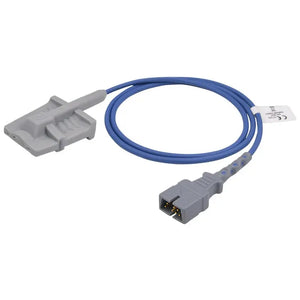
 A transmissive finger sensor: emitter over the nail, detector on the finger pad.
This is why probe placement matters so much: the emitter and detector must line up directly across the tissue, and the site must have good arterial blood flow. Poor alignment, poor perfusion, or anything that adds non-pulsatile absorption (like nail polish or ambient light leaking into the detector) degrades the reading.
Factors that affect SpO2 accuracy
Short answer: accuracy is affected by two broad categories — external interference factors (things in the environment or on the skin) and physiological factors (things about the patient's blood and circulation).
Interference factors
These are external conditions that disrupt the optical measurement: intravenous (IV) dyes, MRI or electrosurgical interference, nail polish or artificial nails, bright ambient or surgical lighting, patient movement, improper sensor placement or emitter–detector misalignment, prolonged use at one site, and skin-pigmentation effects. Most are correctable with better placement, light shielding, or removing the obstruction.
Physiological factors
These relate to the patient's own physiology and are not fixed by repositioning the probe: hypoxemia, low skin temperature, reduced peripheral perfusion, anemia, venous congestion, and abnormal hemoglobin levels. A particularly important limitation is abnormal hemoglobin variants — a standard two-wavelength oximeter cannot distinguish carboxyhemoglobin (from carbon monoxide) or methemoglobin from oxygenated hemoglobin, so it can read falsely normal in those conditions.
Skin tone and occult hypoxemia. Skin pigmentation can influence light absorption, and the clinical literature has documented the potential for "occult hypoxemia" — a normal-appearing SpO2 reading that overestimates true arterial oxygenation in some patients. Best practice is to treat a reading that doesn't match the clinical picture with caution, optimize placement and perfusion, and confirm with arterial blood gas (ABG) analysis when in doubt. Quality sensors are designed for use across skin tones, but clinical correlation always takes priority over the number on the screen.
Best practices for accurate readings
- Remove nail polish or artificial nails before applying a finger sensor, to prevent interference with light transmission.
- For patients in shock or with poor perfusion, consider the earlobe — it is often less affected by vasoconstriction and may stabilize faster than a fingertip.
- Rotate the sensor site periodically (commonly every few hours) to reduce the risk of pressure-related skin injury, especially in fragile-skin and long-monitoring patients.
- In hypothermia, warm the extremity before sensor application to restore adequate blood flow to the site.
- If carbon monoxide poisoning is suspected, do not rely on a standard pulse oximeter — confirm oxygenation status with arterial blood gas (ABG) analysis or a CO-oximeter.
 Correct emitter–detector alignment is essential to a stable, accurate reading.
Common usage errors & solutions
Most inaccurate SpO2 readings trace back to a small number of avoidable application errors. The table below maps each to its risk and the correct technique.
| # | Improper use | Risk | Correct application |
|---|---|---|---|
| 1 | Wrist / ankle placement | Measurement failure | Age-specific sites — adults/children: fingertip or earlobe; infants: toe; neonates: foot/sole |
| 2 | Emitter–detector misalignment | Inaccurate readings; localized heating | Ensure the red-light emitter aligns directly opposite the detector |
| 3 | Weight–site mismatch | Signal loss | For larger patients, use the earlobe or dorsal foot |
| 4 | Strong-light interference | Inaccurate readings | Use a light shield in bright or phototherapy environments |
| 5 | Unsecured cables | Sensor displacement, cable damage | Secure the cable to the limb with medical tape |
| 6 | Sensor displacement | Signal loss | Position the emitter about one-third back from the nail tip; check periodically |
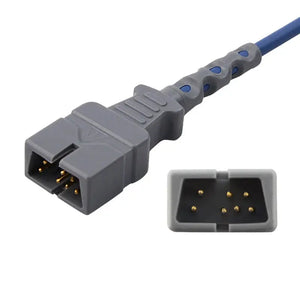
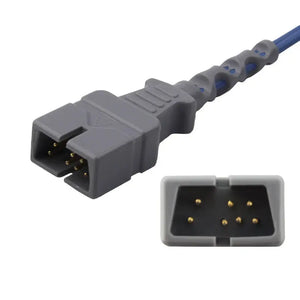
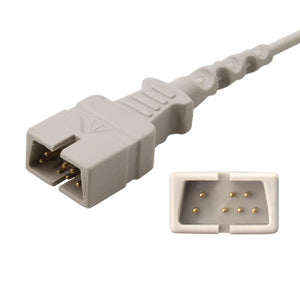
| 7 | Incompatible cable | Equipment damage; invalid reading | Use manufacturer-certified, compatibility-verified cables |
Where SpO2 sensors are used
Continuous or spot-check SpO2 monitoring is used across a wide range of clinical and home settings — including respiratory illness (such as COVID-19 and COPD), sleep apnea, perioperative and anesthesia monitoring, emergency and pre-hospital care, the ICU, general wards, the PACU, in-hospital transport, and home care. In each setting the right sensor type matters as much as the monitor itself.
 Disposable single-patient-use sensors are common in the OR and ICU to reduce cross-contamination.
MedLinket SpO2 sensor types
Short answer: MedLinket offers both reusable probes (for the ICU, ER, outpatient, and home care) and disposable sensors (favored in the OR and for isolation), across adult, pediatric, infant, and neonatal sizes, in finger-clip, soft finger, ear-clip, wrap, and Y-type configurations — compatible with major monitor brands via a "compatible-with" model.
Rather than a single design, SpO2 sensors are matched to the patient and the setting:
- Reusable probes — cost-efficient for routine monitoring where cleaning SOPs are established (general wards, outpatient, home care). Configurations include adult and pediatric finger clips, silicone soft finger sleeves, infant sleeves, neonatal silicone wraps, adult ear clips, a multi-function Y-type, and an elastic finger-ring design. Reusable probes are also suitable for veterinary use.
- Disposable (single-patient-use) sensors — preferred for the OR, ICU, and isolation, where they remove reprocessing time and help reduce cross-contamination. Available in four material/adhesion options: 3M Microfoam adhesive, Transpore transparent-tape adhesive, elastic-fabric adhesive, and non-adhesive comfort foam.
- Skin-friendly / Ultra-Soft series — designed for fragile-skin and pressure-injury-prone patients (neonatal, preterm, elderly, critically ill) using a low-peel silicone-gel adhesive and low-profile pressure relief. This is a design positioning to reduce medical-device-related pressure injury (MDRPI) risk; confirm suitability against the product IFU.
A safety design worth knowing: over-temperature protection
For long-duration monitoring — and especially in neonates, whose skin is thin and delicate — MedLinket offers an over-temperature-protection sensor with a temperature sensor built into the probe end. If the skin temperature at the monitoring site exceeds 41 °C, the probe stops operating and triggers the monitor alarm (with a red indicator on the adapter cable); once the temperature falls back below 41 °C, SpO2 monitoring resumes automatically. It is a design intended to reduce the risk of contact heating during prolonged use — not a guarantee against it.
Neonatal note: per the product guidance, wrap-style measurement is not recommended for neonates over about 3.5 kg, because the foot/sole becomes too thick for a reliable wrap fit. Always follow the IFU for site and patient-weight selection.
Accuracy standards & what to look for
When evaluating an SpO2 sensor, a few objective markers matter more than marketing claims:
- Accuracy standard. ISO 80601-2-61 is the international standard for the basic safety and essential performance of pulse oximeter equipment, defining the accuracy testing pulse oximeters are expected to meet across the clinical SpO2 range.
- Biocompatibility. Skin-contact materials should be evaluated under ISO 10993; quality sensors are latex-free and made from biocompatible materials.
- Regulatory clearance. Look for FDA 510(k) cleared and/or CE marked under EU MDR status, and request the supplier's clearance documentation directly.
- Interference resistance. Features such as ambient-light shielding (e.g., aluminum-foil layers in transparent-membrane sensors), motion tolerance, and secure three-point fixation help maintain signal quality in real-world conditions.
MedLinket SpO2 sensors are designed for use across all skin tones, resist electromagnetic interference (EMI), use thermoplastic-polyurethane (TPU) cables, and are latex-free; the company states its sensor accuracy has been validated by U.S. clinical laboratories over many years of testing (validation reports available on request).
Frequently asked questions
How does a SpO2 sensor work?
It shines red (~660 nm) and infrared (~940 nm) light through a thin body part such as a fingertip. Oxygenated and deoxygenated hemoglobin absorb the two wavelengths differently, so by measuring how much of each is transmitted — and isolating the pulsatile (arterial) part of the signal — the sensor calculates the percentage of hemoglobin carrying oxygen (SpO2) and the pulse rate, without a blood draw.
What is a normal SpO2 reading?
For most healthy adults, SpO2 is commonly 95–100%. Below 90% is generally considered low and warrants prompt clinical evaluation. Neonates are often targeted to 90–95% in the first 24 hours after birth. These are general reference ranges — the patient's clinical context and the device IFU govern interpretation. See What is SpO2 and a normal SpO2 level? for detail by age group.
Why are my SpO2 readings inaccurate?
Common interference factors include nail polish or artificial nails, bright ambient or surgical light, patient motion, poor placement or emitter–detector misalignment, IV dyes, and electrosurgical or MRI interference. Physiological factors include low peripheral perfusion, low skin temperature, anemia, venous congestion, and abnormal hemoglobin (such as carboxyhemoglobin or methemoglobin), which a standard two-wavelength oximeter cannot distinguish.
Where should a SpO2 sensor be placed?
Use age- and site-appropriate placement: fingertip or earlobe for adults and children, toe for infants, and the foot/sole for neonates. The earlobe can be more reliable for patients in shock or with poor perfusion. Avoid the wrist or ankle, ensure the light emitter aligns directly with the detector, and rotate the site periodically to reduce pressure-related skin injury.
Can a pulse oximeter detect carbon monoxide poisoning?
No. A standard two-wavelength pulse oximeter cannot distinguish carboxyhemoglobin (from carbon monoxide) or methemoglobin from oxygenated hemoglobin, so it can read falsely normal in CO poisoning. If CO poisoning is suspected, confirm with arterial blood gas (ABG) analysis or use a CO-oximeter; specialized multi-wavelength modules are required to report carboxyhemoglobin and methemoglobin.
Does skin tone affect pulse oximeter accuracy?
Skin pigmentation can influence light absorption, and the literature has documented the potential for occult hypoxemia in some patients. Good practice is to confirm questionable readings against the clinical picture, optimize placement and perfusion, and use arterial blood gas analysis when a reading doesn't match the patient's condition. Quality sensors are designed for use across skin tones, but clinical correlation remains essential.
What accuracy standard applies to SpO2 sensors?
ISO 80601-2-61 is the international standard for the basic safety and essential performance of pulse oximeter equipment, defining the accuracy testing pulse oximeters are expected to meet across the clinical range. Biocompatibility of skin-contact materials is evaluated under ISO 10993, and devices are typically FDA 510(k) cleared and/or CE marked under EU MDR before clinical sale.
Looking for compatible SpO2 sensors for your monitors?
MedLinket offers reusable and disposable SpO2 sensors across adult, pediatric, infant, and neonatal sizes — in finger-clip, soft-finger, ear-clip, wrap, and Y-type designs — compatible with major monitor brands. Send us your monitor brand and model for free compatibility verification.
📧 shopify@medlinket.com | 💬 WhatsApp +852 6467 3105
Browse disposable SpO2 sensors → Reusable SpO2 sensors →Related reading
- What Is SpO2 and What Is a Normal SpO2 Level? — normal ranges by age group and what low readings mean.
- SpO2 Sensors: Types, Accuracy, Placement & How to Choose — transmissive vs reflective, disposable vs reusable.
- Understanding SpO2 Sensors: Masimo, Nellcor & Neonatal Options — brand/technology matching.
- SpO2 Sensor Troubleshooting: Why Your Readings Are Inaccurate — fixing dropouts and artifact on a live monitor.
- How to Read a Hospital Monitor: 6 Vital Signs Explained — where SpO2 fits among the core monitored parameters.
About MedLinket
MedLinket (Shenzhen Med-link Electronics Tech Co., Ltd) has specialized in capturing and transmitting vital biological signals since 2004. The company holds 33 NMPA Class II registrations and is FDA 510(k) cleared, CE marked under MDR 2017/745, and certified to ISO 13485:2016 and MDSAP, with additional registrations across MHRA, ANVISA, TGA and PMDA. Manufacturing runs across a dual self-owned base in Shenzhen (HQ) and Shaoguan, producing over 10,000 product types from more than 2,800 molds, and serving 2,000+ hospitals across 110+ countries.
MedLinket manufactures SpO2 sensors, ECG cables, NIBP cuffs, temperature probes, IBP transducers, and EtCO₂ accessories compatible with Philips, GE, Mindray, Dräger, Masimo, Nellcor, Nihon Kohden and other major monitor brands. (Monitor brand names are referenced for compatibility only and imply no OEM or endorsement relationship.) Compatibility verification and regulatory documentation are available on request via shopify@medlinket.com.