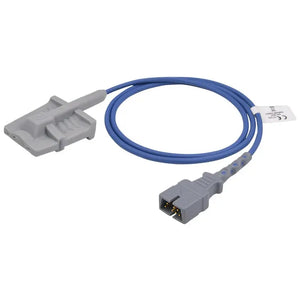
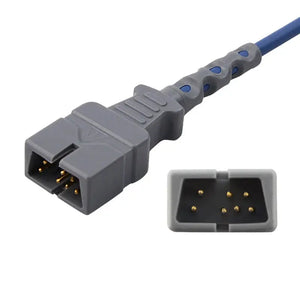
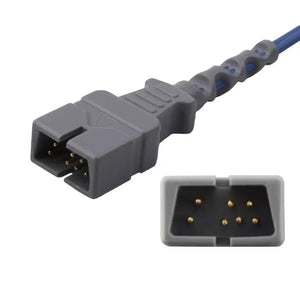
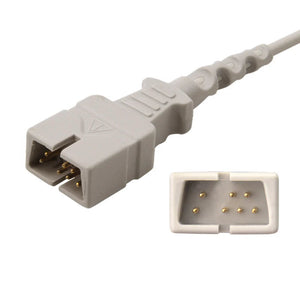
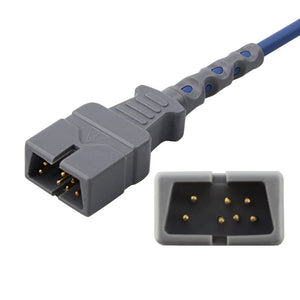
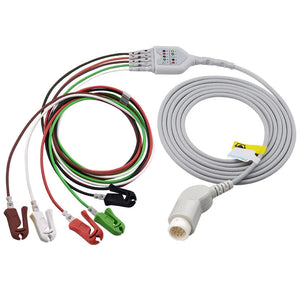
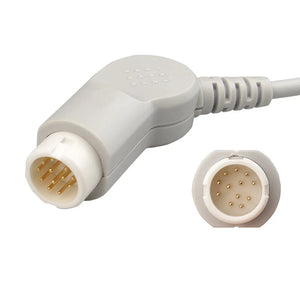
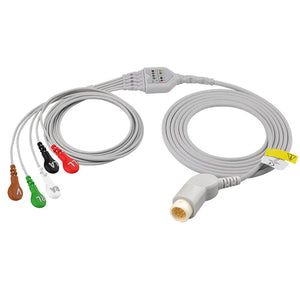
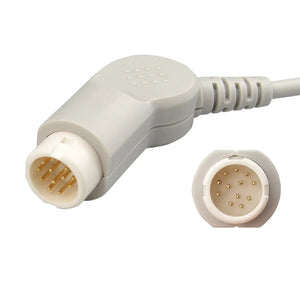
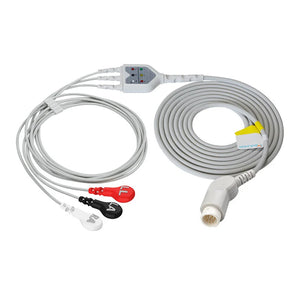
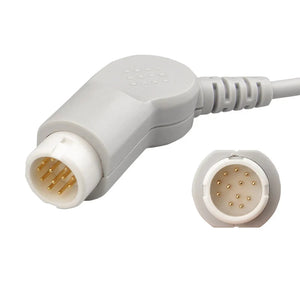
Human and veterinary pulse-oximetry systems use the same general red and near-infrared optical principle, but they are not automatically interchangeable. Veterinary products may differ in probe geometry, fixation, animal-site fit, host-monitor technology, connector, algorithm, intended use, and system specifications. Confirm the exact sensor-monitor combination before use.
The question “Can I use a human pulse oximeter sensor on my dog or cat?” sounds like a comparison between two clips. In practice, pulse oximetry is a system: the patient probe, cable or adapter, connector and pinout, host monitor, signal-processing algorithm, software, application site, and patient condition all contribute to the displayed SpO₂ and pulse rate.
A human finger sensor may sometimes acquire a plausible signal from animal tissue. That does not prove that it fits safely, remains aligned, is validated for the species and site, or matches the monitor's oximetry technology. A dedicated veterinary SpO₂ sensor is selected to solve those practical problems, not because animals use a different law of light absorption.
For animal placement, see dog and cat pulse oximeter sensor placement. For a flexible product comparison, see veterinary multi-site Y-type sensor vs tongue clip. For unstable readings, use the veterinary SpO₂ troubleshooting guide.
Do not rely on the label alone “Human,” “veterinary,” “Nellcor-compatible,” or “Nonin-compatible” does not fully identify the product configuration. Confirm the exact monitor and module, oximetry technology, sensor and adapter part numbers, connector, pinout, intended site, patient type, and instructions before ordering or use.
What is shared between human and veterinary pulse oximetry?
Shared optical foundation
- Red and near-infrared light: pulse oximetry commonly uses wavelengths near 660 and 940 nm to distinguish oxygenated and deoxygenated hemoglobin.
- Pulsatile signal: the system separates the arterial pulse-related change from nonpulsatile tissue and venous background.
- Outputs: the system estimates SpO₂ and pulse rate and may display a pleth waveform or signal-quality indicator.
- Shared limitations: motion, weak perfusion, tissue thickness, pigmentation, temperature, ambient light, probe pressure, and misalignment can affect readings.
What can differ
- Probe geometry and force: finger clip, tongue clip, wrap, Y-type, ear, rectal, or other specialized designs.
- Supported anatomy: tissue thickness, optical path, fur, fixation, cable routing, and patient movement.
- Host technology: monitor algorithm, connector, pinout, sensor identification, adapter, and software.
- Intended use and validation: product labeling, patient type, site, cleaning process, and documented performance.
Same physics does not mean the same product Even when two sensors use similar emitter wavelengths, they may have different electrical characteristics, identifiers, cable architecture, connector pinouts, clip pressure, optical spacing, materials, and intended applications. A physically fitting connector is not sufficient evidence of compatibility.
Sensor differences vs monitor differences
A useful comparison starts by separating the patient sensor from the host monitor and the complete clinical application:

| Layer | What belongs here | Why it matters |
|---|---|---|
| Sensor / probe | Emitter, detector, geometry, clip or wrap, optical spacing, cable, materials, site contact | Controls tissue fit, alignment, fixation, light path, pressure, and signal acquisition |
| Connection | Connector, pinout, sensor ID, extension or adapter cable, direct-connect design | A plug can fit mechanically while the signal or identification remains incompatible |
| Host monitor | Oximetry technology, algorithm, signal processing, software, alarm behavior, displayed range | Converts the optical signal into SpO₂, pulse rate, waveform, and alarms |
| Clinical application | Species, anatomy, site, perfusion, motion, pigmentation, temperature, procedure, restraint | Determines whether the system can acquire and maintain a clinically plausible signal |
| Validation / intended use | Product documentation, patient population, range, accuracy claims, cleaning instructions | Defines what can be claimed for the exact product rather than inferred from appearance |
AM-806 vs AM-806VB-E: a device-system example
MedLinket's published product specifications provide a useful comparison between a human handheld system and a veterinary handheld system. This table compares the complete devices, not generic human and veterinary sensors. The specifications must not be mixed.
| System specification | Human AM-806-C / AM-806B-C | Veterinary AM-806VB / AM-806VB-E |
|---|---|---|
| Product category | Human portable temperature pulse oximeter | Veterinary portable temperature pulse oximeter |
| Stated SpO₂ range | 70%–100% | 35%–100% |
| Stated pulse-rate range | 30–250 bpm | 30–300 bpm; anchor states ±3 |
| Temperature range / accuracy | 25–45°C; ±0.1°C | 25–45°C; ±0.2°C |
| Weight and power | About 31.5 g; two AAA batteries | About 60 g; 3.7 V / 450 mAh; about 7 hours use and 35 days standby in the anchor |
| Display / connectivity | Version-dependent wireless wording; do not generalize | 1.0-inch OLED; AM-806VB-E includes Bluetooth / app support |
| What the comparison proves | These are separately specified human and veterinary host systems. It does not prove that every veterinary sensor has a 35% lower range or that every human sensor is limited to 70%. | |
A wider range is not an accuracy claim Published veterinary studies have reported reduced accuracy or increased bias at lower saturation levels for some pulse oximeters. Do not interpret “35%–100% measurement range” as proof that every value in that range has the same accuracy. Use the exact product accuracy specification and confirm clinically important discordant results.
Why probe geometry matters on animal patients
A human finger clip is designed around a relatively predictable finger thickness and shape. Animal sites vary much more. A dog tongue, cat lip fold, ear pinna, toe web, tail, equine tongue, or specialized veterinary rectal site may require a different probe geometry and fixation method.

- Emitter-detector alignment: transmission probes require the optical components to face each other across suitable pulsatile tissue.
- Supported thickness: a clip that is too narrow, too wide, too loose, or too tight may produce dropout or reduce local perfusion.
- Fixation: tongue clips, flexible wraps, and Y-type sensors manage movement and cable pull differently.
- Fur and pigmentation: these can complicate contact and signal acquisition, but the direction and size of error cannot be predicted from appearance alone.
- Procedure access: dentistry, oral surgery, imaging, recovery, or field work may make one site or probe style impractical.
Can a human-labeled probe ever be used in veterinary care?
The answer must be product-specific. MedLinket documentation states that certain reusable SpO₂ probe families are also suitable for veterinary use. That does not mean every finger clip, disposable sensor, short sensor, or monitor configuration can be moved between human and animal patients.
When product documentation does not establish veterinary use, a human-style sensor may still display a number on animal tissue, but the result should not be presented as a validated veterinary application. A veterinarian should interpret the reading together with waveform quality, independent pulse rate, patient assessment, and other monitoring.
How to verify a sensor on an animal
- Confirm the host system. Identify the monitor, SpO₂ module or technology, connector, adapter cable, and current sensor part number.
- Select a documented site and probe style. Use product instructions and a veterinary protocol rather than copying a human finger application.
- Align and secure the optical elements. Prevent rotation, cable pull, excessive pressure, fur obstruction, and strong ambient light.
- Check the pleth waveform. A repeating waveform supports signal acquisition but does not by itself prove accuracy.
- Compare pulse rates. Match the oximeter pulse rate with ECG, auscultation, palpation, or an arterial pressure trace.
- Reassess discordant results. Change the site or sensor, check perfusion and motion, and obtain another validated measurement or arterial blood gas/co-oximetry when directed by the veterinarian.
Human vs veterinary SpO₂ sensor decision table
| Question | Human-style sensor | Veterinary sensor |
|---|---|---|
| Does documentation support the patient and site? | Required before veterinary use; do not infer from appearance | Confirm exact species/site wording and instructions |
| Does geometry fit animal tissue? | May fit only selected tissue shapes and thicknesses | Available as tongue clip, Y-type, multi-site, and specialized veterinary styles |
| Does it match the monitor? | Exact technology, connector, pinout, adapter, sensor ID, and model must match | |
| Will it remain aligned? | Finger geometry may slip or exert unsuitable pressure | Animal-focused fixation may be more practical but still requires inspection |
| Is it automatically more accurate? | No | No; better fit can improve acquisition, but system and clinical factors still determine performance |
| Can host ranges be assigned to the sensor? | No | No |
Veterinary sensors for animal sites
These products address different monitor technologies and site geometries. Confirm the exact host device and application before treating any two products as interchangeable.
Browse Veterinary Supplies or the Pulse Oximeter collection.
Compatibility request details Send the monitor manufacturer and full model, SpO₂ technology or module, existing sensor and adapter part numbers, connector photos, intended species and site, cable length, direct-connect or adapter configuration, reusable or single-patient preference, and required quantity. Third-party brand references indicate compatibility only.
Why source human and veterinary monitoring accessories from MedLinket?
- Separate human and animal product facts. MedLinket documentation distinguishes the human AM-806 system from the veterinary AM-806VB / AM-806VB-E rather than merging their ranges and accuracy specifications.
- Multiple veterinary probe geometries. The animal range includes tongue-clip, multi-site Y-type, and specialized veterinary SpO₂ styles for different host technologies and workflows.
- Documented cross-use where specified. Certain reusable probe families are described as also suitable for veterinary use, while other products remain patient- and application-specific.
- Compatibility-first selection. Connector, pinout, technology, sensor ID, adapter, patient, and site should be checked before supply or use.
Learn more on the MedLinket company page, review certifications, and read how compatible SpO₂ sensors are tested before shipment.
Frequently asked questions
Can I use a human pulse oximeter sensor on a dog or cat?
What is the main difference between a veterinary and human SpO2 sensor?
Do veterinary SpO2 sensors use different light wavelengths?
Does the AM-806VB-E 35% to 100% range describe the veterinary sensor?
Is a veterinary SpO2 sensor always more accurate on an animal?
Can the same reusable SpO2 probe be used for human and veterinary applications?
How do I know whether an animal SpO2 reading is usable?
What information is needed for a veterinary SpO2 compatibility check?
This article provides general educational and product-selection information. It is not a substitute for a veterinarian's examination, monitoring protocol, device instructions, product labeling, or clinical judgment. Human and veterinary product specifications must not be mixed. Pulse-oximetry performance varies with the complete sensor-monitor system, species, patient, site, perfusion, motion, tissue properties, saturation range, and signal quality. Confirm the exact product specification, intended use, connector, monitor compatibility, cleaning method, and patient/site suitability before purchase or use.