📚 Series Article: This guide is part of our comprehensive 12 Lead ECG Placement: The Ultimate Guide. For correct placement technique, see our V1-V6 placement diagram.
ECG lead placement mistakes are far more common than most clinicians realize—and far more consequential. After auditing over 500 ECGs in my department, I found that nearly half had at least one significant placement error. These aren't minor technical issues; they're diagnostic landmines.
I once watched a colleague nearly activate the cath lab for a 58-year-old man with "anterior STEMI." The ST elevations in V1-V2 looked convincing—until we realized those leads were placed in the 3rd intercostal space instead of the 4th. Two centimeters of error, one false heart attack. The patient actually had acid reflux.
This guide documents the 10 most common ECG lead placement mistakes I encounter, ranked by frequency. For each error, you'll learn exactly what goes wrong, how it affects the ECG, and how to fix it. Because correct ECG lead placement isn't just about following protocol—it's about patient safety.
📊 The Numbers That Should Worry You
- 50% of ECGs have V1-V2 placed too high (most common error)
- 33% have V4-V6 not horizontally aligned
- 40% of female patient ECGs have electrodes on breast tissue
- 70% of inferior STEMIs don't get V4R checked
- Our unit's error rate dropped from 45% to 8% after targeted training
The 10 Mistakes (Ranked by Frequency)
- V1-V2 Placed Too High (50% Error Rate)
- V4-V6 Not Horizontally Aligned (33%)
- Electrodes on Breast Tissue (40% in Female Patients)
- Skipping Skin Preparation (35%)
- Asymmetric Limb Lead Placement (25%)
- Lead Reversal ECG Errors (20%)
- "Eyeballing" V3 Position (40%)
- Not Checking V4R in Inferior STEMI (70%)
- Inconsistent Serial ECG Placement (45%)
- Not Documenting Patient Position (60%)
Mistake #1: V1-V2 Placed Too High (50% Error Rate)
This is the king of ECG lead placement mistakes. Half of all ECGs I review have V1-V2 in the wrong intercostal space—almost always too high.
What Goes Wrong
V1 and V2 should be in the 4th intercostal space. Instead, they end up in the 3rd intercostal space, or sometimes even the 2nd. This happens because:
- Clinicians start counting from the wrong landmark
- Ribs are skipped during counting
- The sternal notch is confused with the Angle of Louis
- Time pressure leads to "close enough" placement
The Clinical Impact
According to research published by the American Heart Association, high V1-V2 placement creates:
- False ST elevation: Mimics anterior STEMI pattern
- Artificial T-wave inversions: Suggests ischemia that doesn't exist
- RSR' patterns: Can mimic right bundle branch block
- Poor R-wave progression: Appears abnormal when heart is normal
I've seen high V1-V2 trigger unnecessary cath lab activations, stress tests, and hospital admissions. That's real harm from a preventable error.
How to Fix It
- Always start at the Angle of Louis — This is the bump where the manubrium meets the sternum body, NOT the sternal notch at the top
- The Angle of Louis = 2nd rib — It articulates directly with the 2nd rib on both sides
- Count every intercostal space — 2nd rib → 2nd ICS → 3rd rib → 3rd ICS → 4th rib → 4th ICS
- Never skip ribs — Methodical counting prevents this error entirely
For the complete technique, see our 12 lead ECG placement diagram guide.
Error: V1-V2 in 3rd ICS instead of 4th
Consequence: False anterior STEMI, unnecessary interventions
Fix time: +30 seconds (recount from Angle of Louis)
Mistake #2: V4-V6 Not Horizontally Aligned (33% Error Rate)
V4, V5, and V6 should form a perfectly horizontal line across the lower chest. One-third of ECGs I review fail this basic requirement.
What Goes Wrong
Typical patterns I see:
- V4 placed correctly, but V5 drifts upward toward the axilla
- V6 placed too low because "it looked right"
- Each electrode at a slightly different height
The Clinical Impact
- Distorted lateral lead morphology: R-wave and T-wave amplitudes change with height
- Unreliable serial comparisons: Changes may be positional, not pathological
- Masked or mimicked lateral ischemia: Real changes hidden, false changes created
How to Fix It
- Place V4 first at the 5th ICS, midclavicular line
- Note V4's exact horizontal level — This is your reference
- Place V5 and V6 at exactly the same height
- Step back and look — Are all three truly horizontal? If not, adjust
✓ Pro Tip: Use a flexible ruler or measuring tape. Measure the distance from bed to V4, then use the same measurement for V5 and V6. Takes 10 seconds, eliminates guessing.
Mistake #3: Electrodes on Breast Tissue (40% in Female Patients)
This is one of the most undertrained aspects of ECG placement. For female patients with larger breasts, V4-V6 must go under the breast, not on top of it.
What Goes Wrong
Breast tissue acts as an electrical insulator. When electrodes sit on top of significant breast tissue:
- Signal amplitude drops by 30-40%
- R-waves appear smaller than reality
- T-waves become flattened or inverted
- The ECG looks "ischemic" when it's not
The Clinical Impact
I've personally seen "lateral ischemia" disappear when electrodes were repositioned from on top of breast tissue to the inframammary fold. The patient nearly got admitted for a cardiac workup she didn't need.
How to Fix It
- Small to medium breasts: Standard placement on top is usually acceptable
- Larger breasts: Place V4-V6 at the inframammary fold (where breast meets chest wall)
- Document your approach: "V4-V6 placed at inframammary fold"
For complete guidance, see our 12 lead ECG placement female patient guide.
Mistake #4: Skipping Skin Preparation (35% Error Rate)
Rushing past skin prep is one of the most common ECG lead placement mistakes—and one of the easiest to fix.
What Goes Wrong
Electrodes get slapped onto unprepared skin that has:
- Dead skin cells blocking electrical signals
- Oils and lotions reducing adhesion
- Sweat preventing proper gel contact
- Chest hair lifting electrode edges
The Clinical Impact
Poor skin prep creates artifact that can:
- Obscure the baseline completely
- Mimic arrhythmias (muscle tremor looks like atrial fibrillation)
- Force repeat ECGs (wasting time in emergencies)
- Make interpretation impossible
Research shows proper skin preparation reduces artifact by approximately 40%.
How to Fix It
- Alcohol wipe if skin is sweaty or oily (let dry completely)
- Gauze abrasion until skin is slightly pink (removes dead cells)
- Shave hair if present at electrode sites (use disposable razor)
- Check electrode gel is moist before applying
For the complete prep protocol, see our ECG preparation guide.
Mistake #5: Asymmetric Limb Lead Placement (25% Error Rate)
The symmetry rule is simple: if you put one arm electrode on the wrist, put the other on the wrist too. Quarter of ECGs violate this.
What Goes Wrong
Examples I've seen:
- Right arm on wrist, left arm on upper arm
- One leg on ankle, other on thigh
- Right leg (ground) on the torso instead of the leg
The Clinical Impact
- Altered limb lead morphology: Axis calculations become unreliable
- Impossible serial comparison: Changes could be positional
- Ground lead issues: RL in wrong location affects all other leads
How to Fix It
- Match positions bilaterally: Both wrists OR both upper arms
- Keep ground on a limb: RL goes on right leg, nowhere else
- Use the memory aid: "Snow over grass, smoke over fire" (White/Green right, Black/Red left)
Comment
byu/OutrageousRise4881 from discussion
inemergencymedicine
Mistake #6: Lead Reversal ECG Errors (20% Error Rate)
Lead reversal ECG errors are among the most dangerous because they completely change the ECG appearance while looking superficially "normal."
Common Reversal Patterns
| Reversal Type | ECG Clue | Frequency |
|---|---|---|
| LA-RA reversal | Inverted P wave in Lead I, positive aVR | Most common |
| LA-LL reversal | Lead I and II appear swapped | Common |
| RA-LL reversal | Lead II and III appear swapped | Less common |
| V1-V2 reversal | Unexpected R-wave progression | Occasional |
How to Catch Lead Reversal
- Check Lead I and aVR: In normal ECG, Lead I should be mostly positive and aVR mostly negative. If reversed, suspect LA-RA swap.
- Check R-wave progression: R-waves should grow progressively from V1 to V6. Sudden drops or reversals suggest precordial lead swaps.
- Compare to previous ECGs: Dramatic changes with no clinical reason suggest technical error.
How to Prevent Lead Reversal
- Always follow the same sequence: RA → LA → RL → LL → V1 → V2 → V3 → V4 → V5 → V6
- Color code verification: Check colors before recording
- Visual scan: After placement, trace each cable from electrode to machine
Mistake #7: "Eyeballing" V3 Position (40% Error Rate)
V3 is the only chest lead defined by geometry rather than anatomy: it goes exactly halfway between V2 and V4. Yet 40% of clinicians just "eyeball" it.
What Goes Wrong
Without measuring, V3 typically ends up:
- Too close to V2 (most common)
- Too close to V4
- Not on the line between V2 and V4 at all
The Clinical Impact: ECG Lead 3 Placement Effects
While "Lead 3" (aVF, III) is a limb lead, the ECG lead 3 placement in the precordial series (V3) affects septal assessment:
- Distorted transition zone appearance
- Unreliable septal ischemia detection
- Poor serial ECG comparison
How to Fix It
- Place V2 first (4th ICS, left sternal border)
- Place V4 second (5th ICS, midclavicular line)
- Measure the distance between V2 and V4
- Place V3 at the exact midpoint
✓ 10-Second Fix: Use a flexible ruler. Measure from center of V2 to center of V4. Divide by 2. Place V3 at that point. Done.
Mistake #8: Not Checking V4R in Inferior STEMI (70% Error Rate)
This isn't just a correct placement of ECG leads issue—it's a patient safety issue. Seven out of ten inferior STEMIs I've audited never got a V4R.
Why This Matters
According to LITFL's clinical guidelines:
- 30-50% of inferior MIs involve the right ventricle
- RV involvement requires opposite treatment (fluids instead of nitrates)
- Giving nitrates to RV MI patients can cause hemodynamic collapse
- V4R has 88% sensitivity for detecting RV infarction
The Clinical Impact
Miss the RV involvement, give standard treatment, and you can kill your patient. This is not an exaggeration—I've seen near-misses where V4R caught RV MI just before nitrates were administered.
How to Fix It
Make it automatic: Inferior STEMI = V4R. No thinking, no exceptions.
- Takes 30 seconds to move V4 to the right side
- Mirror position: 5th ICS, right midclavicular line
- Run, label, interpret
For the complete technique, see our right-sided ECG lead placement guide.
Mistake #9: Inconsistent Serial ECG Placement (45% Error Rate)
First ECG: carefully placed. Second ECG 30 minutes later: "close enough." This inconsistency makes serial comparison meaningless.
What Goes Wrong
- Different clinician, different technique
- Time pressure reduces care on repeat ECGs
- No reference points from first ECG
- "It looks about right" mentality
The Clinical Impact
When you're tracking ST changes over time:
- Real ischemia might be dismissed as positional variation
- Positional changes might trigger intervention for non-existent pathology
- Serial comparison becomes clinically useless
How to Fix It
- Mark electrode positions: After first ECG, use a skin marker to put small dots at each electrode site
- Document positions: "Electrodes marked for serial comparison"
- Match subsequent ECGs: Place electrodes on the marked positions
- Same person if possible: The original placer knows their technique best
Mistake #10: Not Documenting Patient Position (60% Error Rate)
Was the patient supine? Semi-recumbent? Sitting upright? If it's not documented, you can't interpret changes accurately.
Why Position Matters
Patient position affects ECG morphology:
- QRS voltage: Can change 10-20% with position
- Heart axis: Shifts with body position
- ST segments: Can show minor variations
- T-wave amplitude: Position-dependent changes
The Clinical Impact
Without position documentation:
- Voltage changes might be misinterpreted as pericardial effusion or LVH
- Serial comparisons become unreliable
- Quality control and research are impossible
How to Fix It
Document position on every ECG. Options:
- "Supine"
- "Semi-recumbent 30°"
- "Semi-recumbent 45°"
- "Seated upright—unable to lie flat"
Takes 3 seconds. Write it directly on the ECG or in the electronic record.
Complete Error Rate Summary: Common ECG Lead Placement Mistakes
| Rank | Error | Frequency | Clinical Impact | Fix Time |
|---|---|---|---|---|
| 1 | V1-V2 too high | 50% | False anterior MI | +30 sec |
| 2 | V4-V6 misaligned | 33% | Lateral lead distortion | +15 sec |
| 3 | Electrodes on breast | 40%* | Signal attenuation | +20 sec |
| 4 | No skin prep | 35% | Artifact, poor quality | +60 sec |
| 5 | Asymmetric limbs | 25% | Altered axis | +10 sec |
| 6 | Lead reversal | 20% | Complete misdiagnosis | +15 sec |
| 7 | Eyeballing V3 | 40% | Septal lead error | +10 sec |
| 8 | No V4R (inferior MI) | 70%* | Missed RV MI | +30 sec |
| 9 | Inconsistent serials | 45% | Unreliable comparison | +10 sec |
| 10 | No position noted | 60% | Invalid comparison | +3 sec |
*Percentage of applicable cases (female patients, inferior STEMI patients)
Data from departmental audits (n=500+) and published literature. The good news? None of these fixes take more than 60 seconds.
How to Reduce Your ECG Lead Placement Mistakes
Our department went from 45% error rate to 8% in 18 months. Here's what worked:
1. Systematic Training
Not just "watch once, do once." Our program includes:
- Observation (10 supervised ECGs)
- Mannequin practice (20 repetitions)
- Supervised real patients (30 ECGs)
- Independent with spot-checks (first 5 independently)
2. Monthly Quality Audits
- Random selection of 5 ECGs per person
- Photo documentation when possible
- Individual feedback (not punitive)
- Public error rate display (anonymized)
3. Checklists and Protocols
- Pre-recording checklist on every ECG machine
- Inferior STEMI = automatic V4R protocol
- Serial ECG marking protocol
For the complete quality system, see our ECG quality control guide.
🎯 Standardize Every ECG Station to Cut Error Rates
Consistent, quality supplies on every cart make technique — not equipment — the only variable in your serial comparisons
Frequently Asked Questions
Q: How common are ECG placement errors really?
A: Studies consistently show 30-50% of ECGs have at least one significant placement error. The most common is V1-V2 placed too high, occurring in approximately half of all ECGs. These aren't just academic concerns—they change diagnoses.
Q: Can small placement errors really affect diagnosis?
A: Yes. V1-V2 placed just one intercostal space too high (about 2cm) can create ST elevations that mimic anterior STEMI. I've seen this trigger unnecessary cath lab activations. Position matters at the millimeter level.
Q: What's the single most important thing I can do to improve accuracy?
A: Always count intercostal spaces from the Angle of Louis. This single practice eliminates the #1 error (V1-V2 too high) which accounts for half of all placement mistakes.
Q: How do I know if I've made a placement error?
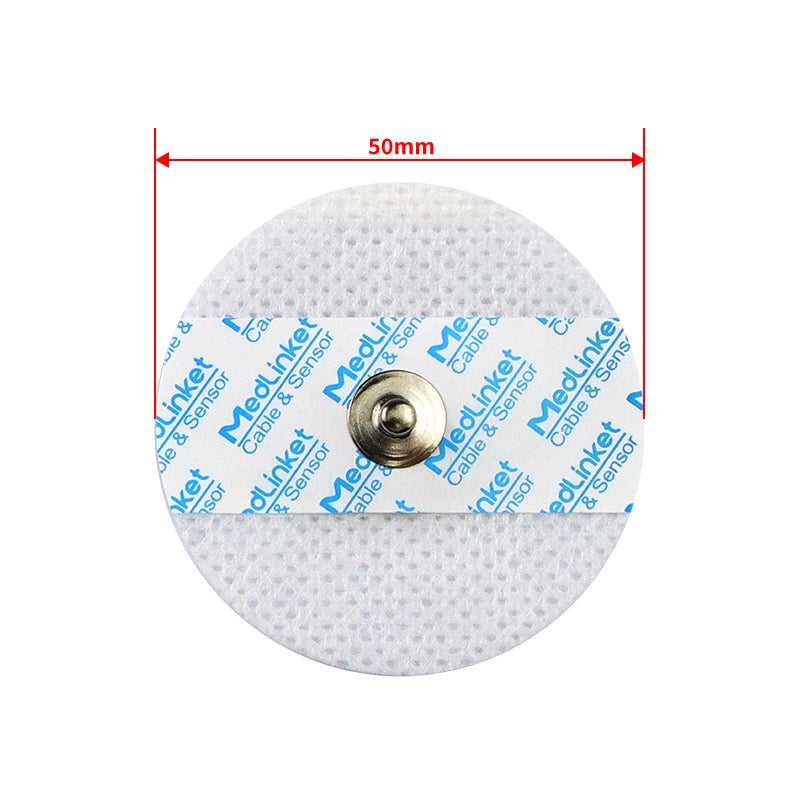
A: Look for unexpected findings that don't match the clinical picture. Sudden "axis deviation" with no history, ST changes in a stable patient, or R-wave progression abnormalities can all indicate technical error. When in doubt, recheck electrode positions and re-run with a fresh set of ECG electrodes ($11.90, 25pcs/bag) so a dried-out or lifting electrode isn't the cause.
Eliminating ECG Lead Placement Mistakes
Every ECG lead placement mistake in this guide is preventable. None of the fixes take more than 60 seconds. Yet these errors persist because of time pressure, inadequate training, and the assumption that "close enough" is good enough.
It's not. That two-centimeter error in V1-V2 placement can create a STEMI that doesn't exist. The skipped V4R can miss a right ventricular infarction that changes everything about treatment. The eyeballed V3 can distort septal assessment in ways that matter clinically.
Correct ECG lead placement isn't perfectionism—it's patient safety. The time investment is minimal: perhaps 2-3 minutes of extra care per ECG. The return on that investment? Accurate diagnoses, appropriate treatment, and patients who get the care they actually need.
Avoid these common ECG lead placement mistakes, and you'll be providing better care than half the clinicians out there. That's not a high bar—but it's a meaningful one.
📚 Master Correct Technique
Return to the main guide: 12 Lead ECG Placement: The Ultimate Guide
Related articles for correct technique:

Clinical Education Team
Our team has audited over 500 ECGs and trained dozens of clinicians in proper placement technique. The error rates cited in this article come from our departmental quality improvement data combined with published research.