⚡ Quick answer: build an ECG quality program in 5 steps
- Baseline audit: review 100 consecutive ECGs to quantify your current error rate by category (V1–V2 placement, V4–V6 alignment, lead reversal, artifact).
- Standardized training: implement a 5-phase competency program (theory → observation → simulation → supervised → independent).
- Monthly audits: score a sample of ECGs per clinician on a 100-point checklist; track individual and department trends.
- Feedback loop: short monthly individual feedback plus department-wide education for common errors.
- Hardware audit: replace worn cables, leadwires and electrodes — even perfect technique fails on degraded equipment.
ECG placement quality is a recognized patient-safety problem, and a recognized solution exists: structured audit-and-feedback quality improvement. Across published QI projects in surgical-safety checklists and inpatient monitoring, the same pattern recurs — baseline audit, targeted training, re-audit, feedback — and it reliably moves compliance in the right direction. This guide adapts that proven methodology to ECG placement, pairing a standardized training program, a monthly audit checklist, and a continuous feedback loop with a step most programs overlook: a hardware audit that removes avoidable artifact at the source.
You'll get a complete, adaptable framework: a downloadable ECG audit checklist, a 5-phase competency program, a 100-point audit score sheet, the feedback systems that make improvement stick, a 90-day rollout plan, and an honest discussion of why hardware quality is inseparable from technique quality. It's written for department managers, clinical educators and quality-improvement leads.
📈 What a mature program can achieve (illustrative)
- Overall placement error rate: a large relative reduction over roughly 12–18 months
- V1–V2 placement errors: brought to a low single-digit rate (the highest-impact target)
- V4R compliance for inferior STEMI: raised toward ~100%
- Repeat-ECG rate from artifact: materially reduced
- Time to competency for new staff: shortened with a structured program
- Avoidable cath-lab activations from V1–V2 misplacement: driven toward zero
Figures are illustrative targets consistent with published audit-and-feedback QI work, not a guaranteed or audited result for any specific facility. Your baseline, case mix and implementation will determine the actual gain.
The hidden cost of ECG placement errors
ECG placement errors aren't just technical imperfections — they're diagnostic landmines. Electrode misplacement is a documented source of ECG misinterpretation that can produce both false-positive STEMIs (unnecessary cath-lab activations) and false-negative readings (missed infarctions and arrhythmias).
What errors actually cost
The cost categories that a placement-error problem creates in any department:
- Unnecessary cath-lab activations when V1–V2 are placed too high, producing false STEMI patterns.
- Missed right-ventricular infarction when V4R is not performed in inferior STEMI.
- Repeat ECGs driven by artifact that requires a new recording.
- Unreliable serial comparisons when electrode positions vary between recordings.
Each item represents real harm: patient risk, wasted resources, delayed care and degraded diagnostic data. A single avoidable cath-lab activation is widely cited in the range of roughly $5,000–$10,000 in direct charges, plus procedural risk to the patient; a missed RV infarction is both a clinical and a medicolegal concern. (Treat dollar figures as order-of-magnitude references and calculate locally.)
Why initial training alone fails
Most facilities rely on initial training and assume competence persists. It often doesn't. Without ongoing reinforcement, skills decay, bad habits develop and compound without feedback, new staff inherit the habits of experienced staff, and "close enough" gradually becomes the unwritten standard. A continuous audit-and-feedback program addresses each of these failure modes — but only if it pairs technique training with the audit infrastructure to measure quality and the hardware quality to support reliable measurement.
The 4-pillar framework
An effective program rests on four pillars; remove any one and the system weakens. A fifth element — the hardware foundation — is the prerequisite that lets the whole framework function (covered further below).
Pillar 1: standardized training program
Everyone who performs ECGs goes through the same 5-phase program — no exceptions — so technique stays consistent regardless of who records the ECG.
| Phase | Duration | Focus | Completion criteria |
|---|---|---|---|
| 1. Theory | 2 hours | Anatomy, landmarks, rationale | Written test ≥ 80% |
| 2. Observation | 10 ECGs | Watch an expert perform ECGs | Checklist signed by mentor |
| 3. Simulation | 20 reps | Mannequin / volunteer practice | 3 consecutive correct placements |
| 4. Supervised | 30 ECGs | Real patients, direct oversight | ≥ 90% accuracy on spot-checks |
| 5. Independent | Ongoing | Audited performance | Monthly audit ≤ 10% error rate |
The theory phase covers surface anatomy (Angle of Louis, intercostal spaces, anatomical lines), the reasoning behind each electrode position, all 10 standard positions, special situations (female patients, obesity, chest deformities), and what makes a "good" ECG. Use your own placement guides as the curriculum — start with the 12-lead ECG placement ultimate guide and the ECG preparation guide.
Pillar 2: deliberate practice (not just more ECGs)
The single most important insight: more ECGs do not improve technique — they reinforce whatever habits the clinician already has. What improves technique is deliberate practice: focused repetition of specific sub-skills with immediate feedback and progressive difficulty. A 5-station protocol targeting the most common errors works well:
- Station 1 — Landmark identification (5 min): find the Angle of Louis with eyes closed; count to the 4th ICS bilaterally; identify all anatomical lines.
- Station 2 — V1–V2 precision (5 min): the most common error in most departments. Always count from the Angle of Louis; both at the right and left sternal borders, same horizontal level.
- Station 3 — V4–V6 alignment (5 min): all three at the same horizontal level after V4 is placed at the 5th ICS midclavicular line.
- Station 4 — V3 measurement (3 min): V3 at the measured midpoint between V2 and V4 — never estimated.
- Station 5 — Complete 10-electrode speed run (5 min): full placement against a timer; competent < 3 min, expert < 2 min.
Pillar 3: monthly audits
You can't improve what you don't measure. A monthly audit provides objective data on placement quality across the department:
- A sample of ECGs per clinician per month (5 is a common target; 3 works for small teams), selected across day/night/weekend shifts.
- Photo documentation when feasible — a chest photo before electrode removal, timestamped to match the ECG.
- 100-point scoring across the categories in the audit score sheet below.
- Individual and department-level tracking — anonymized peer comparison and a monthly trend dashboard.
Pillar 4: feedback and continuous improvement
Data without action is useless. The feedback system turns audit findings into improved practice:
- Monthly individual sessions (≈10 min): private, non-punitive, specific examples shown via photo or ECG, with a collaborative action plan.
- Remediation protocol for low scores: focused review, return to supervised practice, then re-audit.
- Department-wide initiatives when audits reveal common errors: short education sessions, laminated reference cards on every ECG machine, and practice stations in the skills lab.
- Recognition: monthly excellence and most-improved recognition reinforces the behaviors you want repeated.
The ECG audit checklist (free, downloadable)
Two checklists drive the program: a pre-recording checklist posted on every ECG machine, and a 100-point audit score sheet used during monthly review.
Pre-recording checklist
📋 ECG pre-recording checklist (post on every machine)
- ☐ Patient identity confirmed (two identifiers)
- ☐ Skin prepared (cleaned, abraded if needed, hair removed)
- ☐ V1–V2 in 4th ICS (counted from the Angle of Louis, not eyeballed)
- ☐ V4 at 5th ICS, midclavicular line
- ☐ V3 measured halfway between V2 and V4
- ☐ V5–V6 horizontal with V4 (within 1 cm)
- ☐ Limb leads symmetric, distal to elbow/knee
- ☐ Electrodes within their wear window (gel hydrated, in date)
- ☐ Cables visually inspected — no fraying, kinks or damage
- ☐ Patient position documented in the EMR
- ☐ If inferior STEMI suspected → V4R obtained
- ☐ If posterior MI suspected → V7–V9 obtained
100-point audit score sheet
📊 ECG quality audit score sheet
Clinician ID: _______ Date: _______ Auditor: _______
| Criterion | Points | Score |
|---|---|---|
| V1–V2 in correct position (4th ICS) | 25 | |
| V4–V6 horizontally aligned (within 1 cm) | 20 | |
| V3 at measured midpoint (within 0.5 cm) | 10 | |
| No lead-reversal indicators (P, QRS in I and aVR) | 15 | |
| Clean baseline (proper skin prep, fresh electrodes) | 15 | |
| Patient position documented | 10 | |
| V4R if inferior STEMI (when applicable) | 5 | |
| TOTAL | 100 |
Score interpretation: 90–100 = excellent, no significant errors · 80–89 = good, minor issues · 70–79 = acceptable, follow-up · < 70 = remediation required.
The hardware foundation: why audits stall without quality equipment
Here is the part most quality programs learn the hard way: even perfect placement technique produces unreliable ECGs on degraded hardware. A program can drive its V1–V2 technique errors down sharply and still see the overall error rate plateau — because dried electrodes, frayed leadwires and worn trunk cables produce artifact and apparent lead reversal at a stable background rate that no amount of technique training fixes.
The lesson is consistent across departments that have run these programs: a quality effort that addresses only technique tends to leave a meaningful share of the achievable gain on the table. Auditing the hardware and replacing the worst offenders is often what breaks the plateau.
The three hardware components every audit should cover
The ECG signal chain has three replaceable components, each contributing to specific error categories an audit measures:
| Component | Audit errors it causes when degraded | Typical replacement interval |
|---|---|---|
| Electrodes (dried gel, expired) | Baseline wander, "leads off" alarms, false ST changes, false PVC counts | Every 24 hours of use |
| Leadwires (frayed, oxidized contacts) | Intermittent dropout, false asystole, false-arrhythmia alarms, lead-reversal indicators | Every 6–12 months |
| Trunk cable (worn connector, broken shielding) | 50/60 Hz interference, intermittent disconnections, signal loss in specific leads | Every 18–24 months |
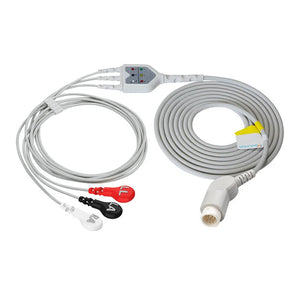
🔗 The ECG signal chain — replace all three components together for the best audit results
Replacing only one component while leaving aged peers in the chain produces inconsistent results. MedLinket manufactures all three at ISO 13485:2016 (TÜV) certified facilities, with product-liability insurance up to USD 5M, built for the durability cycle of an active department.
- ECG electrodes — patented eccentric design, with foam/cloth/hydrogel/radiolucent options
- ECG leadwires — molded snap/grabber/pinch with anti-EMI shielding
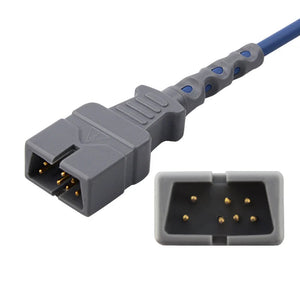
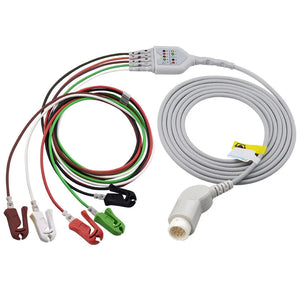
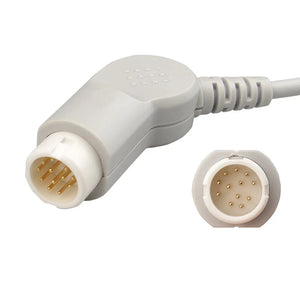
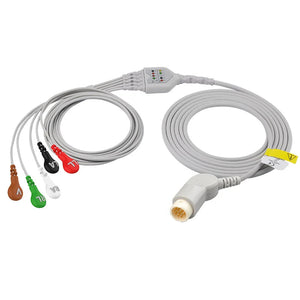
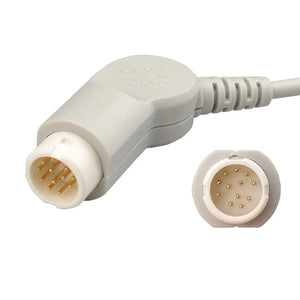
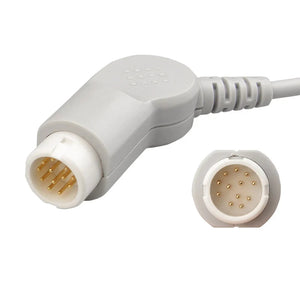
- ECG trunk cables — brand-matched connectors for many monitor brands
Why eccentric electrodes matter for audit-driven programs
Standard center-snap electrodes transmit cable pull and patient motion fairly directly into the ECG signal. In an audit these show up as false ST changes, motion-artifact alarms and intermittent "leads off" events that get attributed to clinician technique when the real cause is electrode design.
MedLinket's patented eccentric (off-center) electrode design (patent CN202120112524.5) places the snap connection off-center on a flexible base, so cable rotation is less likely to disturb the electrode-skin interface. In MedLinket internal bench pull-testing across 0°–90°, the eccentric design withstood roughly double or more the pull force of a conventional center-snap design before disconnection (internal bench data, not a clinical-outcome claim).
🔗 Patented eccentric ECG electrodes — reduce cable-pull artifact at the source
For programs running monthly audits, switching to eccentric electrodes is one of the higher-leverage hardware changes available — the off-center connection reduces a category of artifact an audit was previously attributing to clinician technique.
- Foam (adult): V0014 series — for ICU/CCU long-term monitoring
- Eccentric off-center adult: for telemetry & Holter where patients move
- Cloth (pediatric): for ED & Holter use
- Radiolucent (carbon-snap): V0015 series — far less visible on CT, X-ray and DSA (treat as MR-conditional and verify against the IFU before MRI)
90-day implementation plan
Here's how to roll out this program in your department.
Days 1–30: foundation
| Week | Task | Owner |
|---|---|---|
| 1 | Baseline audit: 100 ECGs across the department | QC lead |
| 1–2 | Identify the top 3 error types from baseline data | QC lead |
| 2 | Hardware audit: inspect all electrodes, leadwires, trunk cables | BMET / QC lead |
| 2 | Develop training materials targeting the top errors | Educator |
| 3 | Department kick-off: share data, explain the program | Manager |
| 4 | Training session #1 (focus: top error type) | Educator |
Days 31–60: implementation
| Week | Task | Owner |
|---|---|---|
| 5 | Launch practice stations in the skills lab | Educator |
| 5–6 | Training sessions #2 and #3 | Educator |
| 6 | Replace identified hardware deficiencies | BMET |
| 6 | Begin the monthly audit cycle | QC lead |
| 7 | First individual feedback sessions | Educator/Manager |
| 8 | Install the department dashboard | QC lead |
Days 61–90: refinement
| Week | Task | Owner |
|---|---|---|
| 9 | Compare Month 2 audit to baseline | QC lead |
| 10 | Adjust training focus based on data | Educator |
| 11 | Begin remediation for persistent issues | Educator |
| 12 | Department update: celebrate progress | Manager |
| 12 | First recognition awards | Manager |
Ongoing (Month 4+)
- Monthly audit cycle continues
- Quarterly training refreshers
- Annual program review and update
- New-staff onboarding through the standard 5-phase program
- Hardware re-audit at 12 and 24 months
Common pitfalls when implementing QC programs
Across departments that have run these programs, three pitfalls account for most failures:
Pitfall 1: resistance from senior staff
Experienced clinicians often feel audits imply criticism of their competence. The fix is framing: data is collected on every staff member, the conversation is non-punitive, and the goal is patient safety, not personal evaluation. Resistance tends to evaporate when senior staff see junior staff held to the same standard. Anonymized comparison to the department average — never name-and-shame — also helps.
Pitfall 2: burning out the auditors
Auditing 5 ECGs × 30 staff × 12 months is roughly 1,800 audits a year — a part-time job. Make audit responsibility shared (rotate 2–3 reviewers), use templated scoring, and accept that perfect coverage isn't required: 80% audit completion is far better than 100% attempted and abandoned.
Pitfall 3: forgetting the hardware variable
The most common trap: invest heavily in technique training, see initial gains, then plateau and conclude "people just won't get it perfect." Often the error floor is being set by hardware — dried electrodes, intermittent leadwires — rather than technique. A focused hardware refresh is frequently what breaks the plateau and allows continued improvement.
🔗 Brand-matched cables & leadwires for a hardware refresh
When auditing hardware, the most common findings are oxidized leadwire contacts and worn trunk-cable connectors — both of which cause intermittent dropout and apparent "lead reversal" that gets blamed on technique. MedLinket cables are matched to your monitor brand's connector standard, removing adapter-induced artifact.
- Mindray: 5-lead EA6252A (Pinch/Grabber, IEC) · 3-lead EA6232A
- Philips: M1603A 3-lead leadwires · Telemetry 5-lead
- GE Healthcare: 5-lead leadwires (Grabber, AHA) · 412681-001
- Nihon Kohden: 5-lead Pinch/Grabber
- Mortara Holter: 10-lead Snap, AHA, 1.2 m
ROI: what quality programs can save
For a finance committee, the case for an ECG quality program rests on a few quantifiable savings categories. The figures below are illustrative order-of-magnitude estimates for a mid-size hospital — replace them with your own volumes, labor rates and baseline before presenting a business case.
| Savings category | Illustrative annual savings (mid-size hospital) | Mechanism |
|---|---|---|
| Avoided unnecessary cath-lab activations | $30,000–$60,000 | A few fewer false STEMIs at ~$5,000–$10,000 direct charges each |
| Reduced repeat-ECG rate | $15,000–$25,000 | Lower repeat rate × tech time × volume |
| Reduced supply waste | $8,000–$12,000 | Fewer wasted electrodes from re-recordings |
| Reduced false-alarm response time | $20,000–$40,000 | Nursing time recovered from artifact response |
| Avoided medicolegal exposure | Variable, high-tail | Missed-STEMI cases are six-figure liability events |
| Illustrative annual total | ~$73,000–$137,000+ | Plus medicolegal protection |
Against these, program costs are modest: educator time (1–2 hours per staff member per year for training and audits), audit time (2–4 hours per month for the QC lead), and a one-time hardware-refresh budget (often in the $5,000–$15,000 range depending on department size). Many departments see positive ROI within the first 6 months — but the point of the table is the structure of the business case, not a promise of any specific figure.
🔗 Plan your hardware refresh — free compatibility verification & samples
Before committing a hardware-refresh budget, MedLinket offers free compatibility verification (send your monitor brand and model and we identify exact-fit cables and leadwires) and clinical evaluation samples so your team can validate quality before bulk purchase.
📧 Request samples 💬 WhatsApp Browse range Product-liability insurance up to USD 5M · 20+ years' manufacturing experience · 2,000+ hospital clients across 110+ countries.Frequently asked questions
How do I start an ECG quality improvement program from scratch?
Start with a baseline audit of 100 consecutive ECGs to quantify your current error rate by category (V1–V2 placement, V4–V6 alignment, lead reversal, artifact, V4R compliance). This data drives everything else: it identifies your top error types to target first, gives you the "before" number to measure against, and supports the case for resources. The first 30 days should focus on data collection, not interventions.
How long until we see results from an ECG audit program?
Published audit-and-feedback QI projects typically show measurable improvement within a few audit cycles — often 3–4 months. Programs that pair technique training with a hardware refresh tend to improve faster, because degraded equipment can otherwise hold the error rate at a stubborn floor that technique training alone cannot move.
What audit tools do we need to run an ECG quality program?
A minimum toolkit: (1) a pre-recording checklist posted on every ECG machine, (2) a 100-point audit score sheet for monthly review, (3) a tracking spreadsheet for individual and department trends, and (4) a method for photo documentation of electrode positions when feasible. The checklists in this article cover most departments without additional purchases.
How do I get staff buy-in for ECG audits?
Three principles work: (1) frame it as patient safety, not personal evaluation — share the cost data on unnecessary cath-lab activations; (2) audit everyone equally including senior staff, with anonymized comparison to the department average rather than name-and-shame; (3) celebrate progress publicly with monthly excellence and most-improved recognition. Resistance usually peaks in month 1–2, then drops once staff see the program is fair.
Can equipment quality affect ECG accuracy as much as technique?
Yes. Aged or damaged electrodes, frayed leadwires and worn trunk cables produce artifact and intermittent dropout that no technique can compensate for. Many programs that plateau have inadvertently set a hardware floor on their error rate. A hardware audit and selective refresh — often a one-time cost in the $5,000–$15,000 range — is frequently among the highest-return interventions available.
What is a reasonable target error rate for ECG placement?
For continuous monitoring (3-lead and 5-lead), an overall placement error rate below 10% is a reasonable target for a mature program. For 12-lead diagnostic ECGs, below 5% is realistic for well-trained staff with quality hardware. V1–V2 placement deserves the tightest target because it has the largest clinical impact (anterior STEMI localization), and V4R compliance for inferior STEMI should approach 100%.
How often should we replace ECG electrodes, leadwires, and cables?
Disposable electrodes are commonly replaced every 24 hours of continuous use (gel hydration drops after that), and every 24 hours for fragile-skin and neonatal patients. Reusable leadwires are typically replaced every 6–12 months in heavy use, sooner if fraying or oxidized contacts appear, and trunk cables roughly every 18–24 months. The best practice: include hardware inspection in your monthly audit, so degraded equipment is caught before it corrupts ECG data.
Can we adapt this program for a small department?
Yes. Scale the audit sample down (3 ECGs per person instead of 5), and accept that one person may wear several hats (educator + QC lead). Keep the core elements: standardized 5-phase training, monthly measurement, individual feedback, and a hardware audit. Even a department of 5 staff can run this in a few hours per month of total leadership time.
What if we don't have resources for photo documentation?
Photo documentation is ideal but not essential. You can audit ECG quality from the tracing alone — looking for lead-reversal patterns (P-wave inversion in lead I, abnormal aVR), R-wave progression abnormalities (which suggest V1–V4 misplacement), artifact levels (which suggest skin prep or electrode age), and the absence of V4R when inferior STEMI is present. It's less precise than photo audit but still drives substantial improvement.
Where can we get ECG cables, leadwires, and electrodes for our quality program?
MedLinket manufactures the full ECG signal chain — disposable electrodes (foam, cloth, hydrogel, radiolucent, neonatal), leadwires (3/5/6/7/12-lead in snap, grabber or pinch styles, both AHA and IEC color codes), one-piece direct-connect cables, and brand-matched trunk cables for Philips, GE, Mindray, Nihon Kohden, Dräger and many other brands. All are made in ISO 13485:2016 (TÜV) certified facilities, with free clinical samples for evaluation. Email shopify@medlinket.com with your monitor model for a free compatibility check.
Building a sustainable ECG quality culture
An effective ECG audit and training program isn't a one-time project — it's a cultural shift that needs leadership commitment, staff buy-in and consistent follow-through over months and years. The investment tends to pay back rapidly through better patient outcomes, fewer unnecessary interventions, recovered nursing time and reduced medicolegal exposure.
What makes quality programs stick:
- Start with data: baseline audits show the real scope of the problem and build the case for resources.
- Make it systematic: ad hoc training doesn't work; a 5-phase competency program does.
- Audit hardware AND technique: most plateaus come from ignoring hardware.
- Measure continuously: what gets measured gets managed.
- Close the loop: feedback without follow-up is wasted effort.
- Celebrate wins: recognition reinforces the behaviors you want repeated.
The downloadable checklists, 5-phase training program, audit score sheet and 90-day rollout plan above are a complete, adaptable starting point. Scale the numbers to your department, but keep the structure intact.
References & further reading
- Surgical Safety Checklist quality-improvement programs using peer audit and feedback demonstrate the audit→intervention→re-audit (PDSA) methodology this framework adapts to ECG placement — see published multi-site QI studies indexed in PubMed.
- Inpatient monitoring QI projects (including daily 12-lead ECG adherence) show baseline-audit-and-feedback cycles improving compliance against defined standards; see QI literature in PubMed.
- Electrode misplacement as a source of ECG misinterpretation (including precordial and limb-lead errors) is well documented in the cardiology and emergency-medicine literature; the MedLinket placement guides linked throughout summarize correct landmarks.
- ANSI/AAMI EC12 — Disposable ECG Electrodes (AC impedance, DC offset, combined offset instability and noise) and ANSI/AAMI EC53 — ECG Cables and Leadwires: the performance standards referenced for the hardware values in this article.
- MedLinket internal product specification and laboratory documentation — eccentric (offset) electrode bench pull-testing and registration test values; available on request via shopify@medlinket.com. Patent CN202120112524.5 is searchable in the CNIPA database.
Planning a hardware refresh for your quality program?
Tell us your monitor brand and model. Our engineering team will verify compatibility and recommend the exact ECG products you need — free of charge. Clinical samples are available for evaluation before bulk purchase.
📧 Email us 💬 WhatsApp +852 6467 3105 Browse ECG range20+ years
countries
hospital clients
MDSAP, MHRA
2016 (TÜV)
product liability
Disclaimer: this article describes a quality-improvement framework adapted from published audit-and-feedback methodology and is intended for educational and clinical-reference use. It does not replace facility-specific quality protocols, regulatory requirements, or the advice of qualified healthcare professionals. Error-rate and savings figures are illustrative, not audited results for any specific facility; results vary by department size, baseline performance and implementation fidelity. MedLinket (Shenzhen Med-link Electronics Tech Co., Ltd, est. 2004) manufactures patient-monitoring accessories, not diagnostic devices.