📚 Series Article: This guide is part of our comprehensive 12 Lead ECG Placement: The Ultimate Guide. For standard chest lead positioning, see our V1-V6 placement diagram. For right-sided leads, see our V4R guide.
Posterior ECG lead placement is the technique most clinicians know exists but rarely perform—until they miss a posterior MI that was hiding in plain sight. The standard 12-lead ECG is essentially blind to the posterior wall of the heart, and that blind spot can cost patients their lives.
Here's what most people don't realize: posterior MIs account for approximately 15-20% of all acute MIs, yet they're among the most frequently missed. The only clue on a standard 12-lead? Subtle ST depression in V1-V3—a finding that's easy to overlook or misinterpret.
This guide teaches you exactly how to perform posterior ECG lead placement using V7, V8, and V9. You'll learn the precise positions, when to use posterior leads on ECG, how to interpret the findings, and practical tips for patients who can't lean forward.
⚡ Key Takeaways
- V7, V8, V9 are placed on the back, all at the same horizontal level as V6
- The trigger: ST depression in V1-V3 on standard 12-lead suggests posterior MI
- ST elevation ≥0.5mm in posterior leads confirms posterior involvement
- Posterior MI often accompanies inferior STEMI—check both right-sided AND posterior leads
- All three leads must be horizontally aligned with V6 for accurate results
In This Guide
- When to Use Posterior ECG Leads
- Understanding Posterior MI: Why Standard ECG Misses It
- V7, V8, V9 Positions: Step-by-Step Placement
- The Critical Rule: Horizontal Alignment with V6
- Posterior Lead Placement for Difficult Patients
- Interpreting Posterior ECG Leads
- Combined Approach: Posterior + Right-Sided Leads
- Common Mistakes to Avoid
When to Use Posterior ECG Leads
Posterior leads aren't routine—they're indicated when specific ECG patterns suggest posterior wall involvement.
Primary Indication: ST Depression in V1-V3
The most important trigger for posterior leads ECG evaluation:
✓ Check posterior leads when you see:
- Horizontal ST depression in V1-V3 — This is the "mirror image" of posterior ST elevation
- Tall R waves in V1-V2 — May represent posterior Q-wave equivalent
- Upright T waves in V1-V2 with ST depression — Suggests acute posterior injury
- Inferior STEMI — 15-20% have concurrent posterior involvement
- Lateral STEMI — Posterior extension is common
The "Mirror Image" Concept
Here's why posterior MI shows ST depression anteriorly:
The posterior wall is electrically "behind" the standard precordial leads. When the posterior wall has ST elevation (injury), leads V1-V3 see the opposite of that elevation—they see depression. It's like looking at something in a mirror.
According to American Heart Association guidelines, this ST depression in V1-V3 should prompt immediate evaluation with posterior leads to confirm or rule out posterior STEMI.
Clinical Scenarios Requiring Posterior Leads
| Scenario | Standard ECG Finding | Action |
|---|---|---|
| Isolated posterior MI | ST depression V1-V3 only | Posterior leads immediately |
| Inferoposterior MI | Inferior STEMI + ST depression V1-V3 | Posterior + Right-sided leads |
| Lateral + posterior MI | Lateral STEMI + ST depression V1-V3 | Posterior leads |
| Unexplained chest pain | Non-specific changes, high clinical suspicion | Consider posterior leads |
Understanding Posterior MI: Why Standard ECG Misses It
To understand why placement of posterior ECG leads matters, you need to understand the anatomy.
The Posterior Wall's Location
The posterior wall of the left ventricle faces backward—toward the spine. The standard precordial leads (V1-V6) are all placed on the front and side of the chest. They simply can't "see" the posterior wall directly.
Think of it this way: if you're standing in front of someone, you can see their face clearly, but their back is invisible to you. That's exactly the relationship between standard leads and the posterior wall.
Blood Supply
The posterior wall is typically supplied by:
- Right coronary artery (RCA) — In right-dominant circulation (85% of people)
- Left circumflex artery (LCx) — In left-dominant circulation (15% of people)
This is why posterior MI frequently accompanies inferior MI (both supplied by RCA) or lateral MI (LCx territory).
Why Isolated Posterior MI Is Dangerous
When posterior MI occurs in isolation (without obvious inferior or lateral involvement), the standard 12-lead may show only subtle ST depression in V1-V3. This can be:
- Dismissed as "reciprocal changes"
- Attributed to "subendocardial ischemia"
- Completely overlooked
The result? A STEMI-equivalent that doesn't get treated as a STEMI. According to research published in clinical cardiology journals, isolated posterior MI has higher mortality partly because of delayed recognition and treatment.
Posterior ECG Leads Position: V7, V8, V9 Step-by-Step Placement
Here's exactly how to perform ECG posterior leads placement correctly.
V7 Position
Location: Posterior axillary line, same horizontal level as V6
To find V7:
- Locate V6 (mid-axillary line, 5th intercostal space)
- Note the horizontal level of V6
- Move posteriorly to the posterior axillary line (the back edge of the armpit)
- Place V7 at this point, maintaining the same horizontal level as V6
V8 Position
Location: Below the tip of the left scapula, same horizontal level as V6
To find V8:
- Ask the patient to relax their shoulders
- Locate the inferior angle (tip) of the left scapula
- Place V8 just below this point, at the same horizontal level as V6 and V7
V9 Position
Location: Left paraspinal area, same horizontal level as V6
To find V9:
- Find the left side of the spine
- Measure approximately 2-3 cm lateral to the spinous processes
- Place V9 at this point, maintaining the same horizontal level as V6, V7, and V8

Quick Reference Table: Posterior ECG Leads Position
| Lead | Anatomical Landmark | Horizontal Level | Key Point |
|---|---|---|---|
| V7 | Posterior axillary line | Same as V6 | Back edge of armpit |
| V8 | Below left scapula tip | Same as V6 | Inferior angle of scapula |
| V9 | Left paraspinal area | Same as V6 | 2-3 cm from spine |
The Critical Rule: Horizontal Alignment with V6
This is the most important principle of lead placement posterior ECG:
🎯 Critical Rule
V7, V8, and V9 must ALL be at exactly the same horizontal level as V6. If they're not aligned, your ECG will be inaccurate and potentially misleading.
Why Alignment Matters
The posterior leads are designed to view the posterior wall from the same electrical "plane" as the lateral precordial leads. If V7-V9 are too high or too low, you're looking at a different part of the heart and may miss pathology or create false findings.
How to Ensure Alignment
My technique for maintaining horizontal alignment:
- Mark V6's level: Use a skin marker or piece of tape to mark the exact horizontal level of V6 on the patient's side
- Extend the line: Draw or visualize a horizontal line from V6 around to the back
- Place V7-V9 on this line: Each electrode goes on this horizontal line at its respective landmark
- Double-check: Step back and visually confirm all four electrodes (V6, V7, V8, V9) are truly horizontal
✓ Pro Tip: A flexible measuring tape works well. Measure the distance from the bed to V6, then use that same measurement for V7, V8, and V9. This ensures they're truly horizontal even when you can't see all four at once.
Posterior Lead Placement for Difficult Patients
Not every patient can sit forward comfortably for posterior lead placement. Here's how to handle common challenges.
Patient Cannot Sit Up
For patients who must remain supine:
- Log-roll technique: With assistance, gently roll the patient onto their right side
- Place V7, V8, V9 on the exposed left posterior chest
- Connect leads and record quickly
- Return patient to supine position
Alternative: Slide your hand under the patient's back and place electrodes "blind." This is less accurate but sometimes the only option.
Patient Cannot Lean Forward
If the patient is sitting but can't lean forward (respiratory distress, pain):
- Have them rotate slightly to the left
- Place electrodes from the side, reaching around to the back
- Use the visual alignment technique—mark V6's level and estimate
Obese Patients
Finding landmarks on obese patients can be challenging:
- Scapula tip: Have the patient reach forward (if able) to protract the scapula and make it more prominent
- Posterior axillary line: Palpate the edge of the latissimus dorsi muscle
- Paraspinal area: Palpate the spinous processes directly
For more techniques with challenging patients, see our special ECG placement situations guide.
Intensive Care / Ventilated Patients
For ICU patients who cannot be repositioned:
- Document "posterior leads unable to be obtained due to patient positioning"
- Use the anterior ST depression pattern as a surrogate indicator
- Consider when the patient is more stable or can be briefly repositioned
Interpreting Posterior ECG Leads
Knowing how to place posterior ECG leads is only half the skill. You need to interpret what you see.
Positive Finding: What Confirms Posterior MI
ST elevation ≥0.5mm (0.05mV) in V7, V8, or V9 = Posterior STEMI
Note that the threshold is lower than standard leads (where we typically use 1mm). This is because:
- The posterior leads are farther from the heart
- Signal amplitude is naturally attenuated
- Even small ST elevation is clinically significant
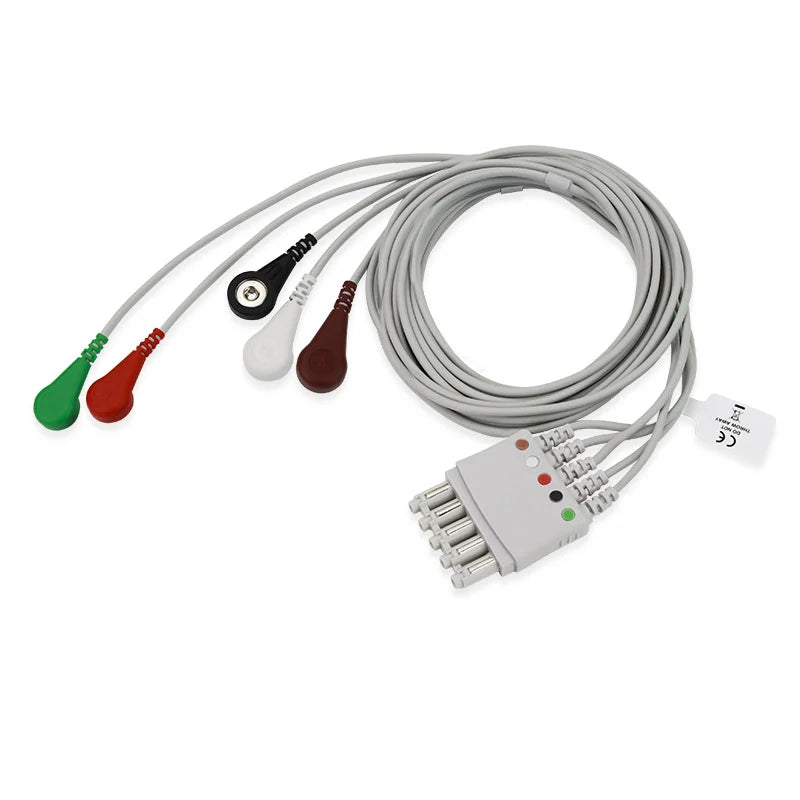
Signal quality is critical when interpreting such subtle findings — the cable shielding and impedance characteristics of your ECG leadwires directly affect how accurately these small voltage changes are captured.
Expected Normal Findings
In a normal posterior ECG:
- QRS complexes should be small (normal due to distance from heart)
- ST segments should be isoelectric or nearly so
- T waves typically small and upright
The Correlation with Anterior Leads
In posterior MI, you should see reciprocal relationship:
| Posterior Leads (V7-V9) | Anterior Leads (V1-V3) |
|---|---|
| ST elevation | ST depression (mirror) |
| Q waves | Tall R waves (mirror) |
| T wave inversion (evolving) | Upright T waves |
If posterior leads show ST elevation but V1-V3 don't show reciprocal depression, recheck electrode positioning—something may be off.
Combined Approach: Posterior + Right-Sided Leads
In many clinical scenarios, you'll need both posterior and right-sided leads. This is particularly true in inferior STEMI.
The Inferoposterior-RV MI Scenario
Inferior STEMI (II, III, aVF) can involve:
- Right ventricle (check V4R) — See our right-sided ECG lead placement guide
- Posterior wall (check V7-V9)
- Both
When you see inferior STEMI, the complete evaluation is:
- Standard 12-lead: Confirm inferior STEMI
- Right-sided leads (V4R minimum): Rule out RV involvement
- Posterior leads (V7-V9): If ST depression in V1-V3, confirm posterior involvement
The 15-Lead ECG Approach
A 15-lead ECG combines standard 12-lead with V4R and V7-V9, giving you comprehensive cardiac coverage. For the complete technique, see our 15-lead ECG placement guide.
Practical Workflow
When time is critical, here's my approach:
- Run standard 12-lead
- If inferior STEMI → immediately add V4R
- If V1-V3 show ST depression → add V7-V9
- Total additional time: ~3 minutes for complete evaluation
Common Mistakes in Posterior ECG Lead Placement
For a comprehensive list of ECG placement errors, see our 10 common ECG placement mistakes guide. Here are the posterior-specific errors:
Mistake #1: V7-V9 Not Horizontally Aligned
The problem: Each electrode is at a different height, not matching V6.
The consequence: Inaccurate ST segment assessment—you might miss a posterior MI or diagnose one that isn't there.
The fix: Mark V6's level and extend that line around to the back. Use a measuring tape if needed.
Mistake #2: Forgetting to Check Posterior Leads
The problem: ST depression in V1-V3 is noted but posterior leads aren't obtained.
The consequence: Posterior STEMI misdiagnosed as "non-STEMI" or "reciprocal changes." Treatment delayed.
The fix: Make it automatic: ST depression V1-V3 = posterior leads. No exceptions.
Mistake #3: Electrodes Too Close to Spine (V9)
The problem: V9 placed directly on the spinous processes instead of paravertebrally.
The consequence: Poor electrode contact, excessive artifact, unreliable reading.
The fix: V9 should be 2-3 cm lateral to the spine, over the paraspinal muscles.
Mistake #4: Not Labeling the Tracing
The problem: Posterior leads recorded but not clearly marked.
The consequence: Interpreting physician doesn't know which leads are which.
The fix: Write "V7, V8, V9 - Posterior Leads" directly on the ECG. Some machines can label automatically.
Mistake #5: Using Wrong ST Elevation Threshold
The problem: Applying the standard 1mm threshold to posterior leads.
The consequence: Missing posterior MI that has "only" 0.5-0.75mm of elevation.
The fix: Remember the threshold for posterior leads is ≥0.5mm, not 1mm.
Mistake #6: Degraded ECG Cables Affecting Signal Quality
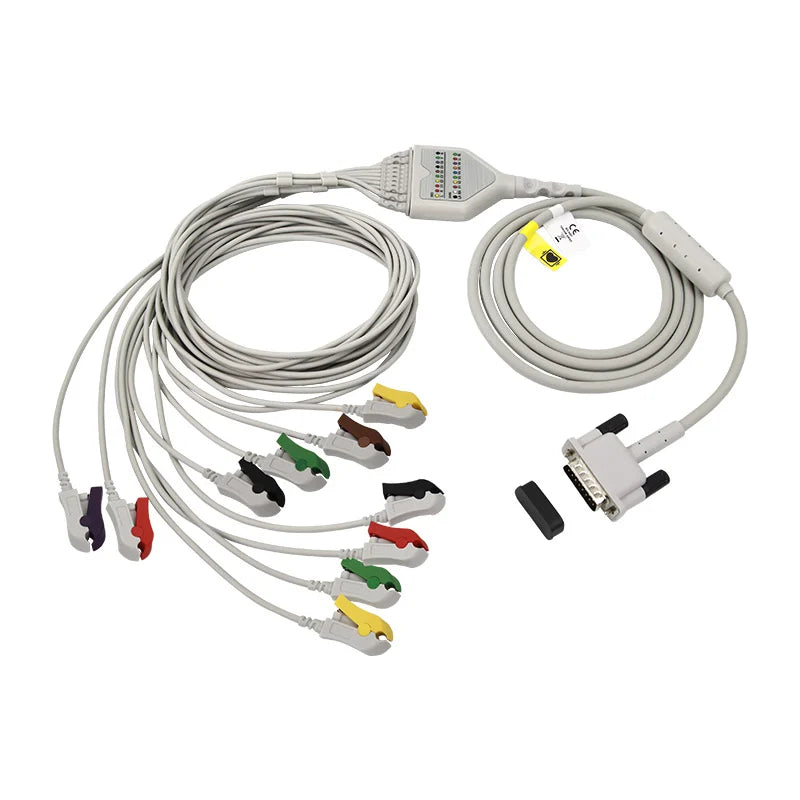
The problem: Worn or damaged ECG leadwires introduce noise that mimics or obscures subtle ST changes — especially critical when the diagnostic threshold is just 0.5mm.
The consequence: Artifact may be misinterpreted as ST elevation, or true posterior MI findings may be hidden by cable noise.
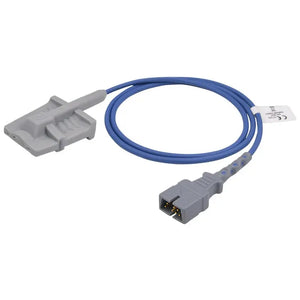
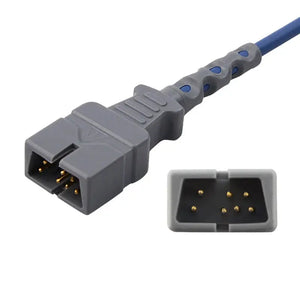
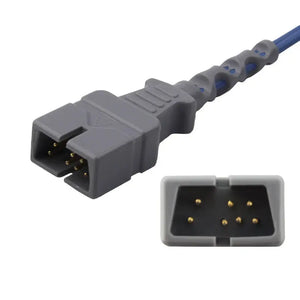
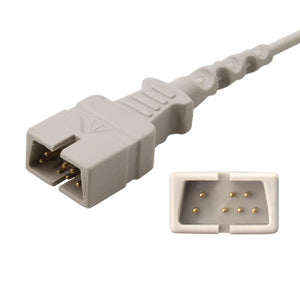
The fix: Ensure your department follows a regular cable inspection and testing schedule. Using the correct ECG cable connector type for your monitor also eliminates poor-contact artifacts. When cables need replacement, proper calibration of patient monitor accessories should follow.
Frequently Asked Questions: Posterior Leads on ECG
Q: Do I need all three posterior leads (V7, V8, V9)?
A: Ideally, yes. V8 is often considered the most sensitive single posterior lead, but using all three increases diagnostic accuracy. If you can only place one, V8 is the priority.
Q: Can I diagnose posterior MI from standard 12-lead alone?
A: You can suspect it from ST depression in V1-V3, but you cannot confirm it without posterior leads showing ST elevation. The standard 12-lead findings are indirect evidence only.
Q: Why is the ST elevation threshold lower for posterior leads?
A: Because posterior leads are farther from the heart, signal amplitude is naturally reduced. What would be 1-2mm of elevation if the lead were closer appears as 0.5-1mm at the posterior positions. The lower threshold accounts for this attenuation.
Q: Should I do posterior leads on every inferior STEMI?
A: If there's ST depression in V1-V3, absolutely. If V1-V3 are normal, it's less urgent but can still be informative. The combination of inferior STEMI + V1-V3 depression strongly suggests inferoposterior MI.
Q: What if the patient can't be repositioned at all?
A: Document your attempt and limitation. Use the V1-V3 ST depression as indirect evidence of posterior involvement. Treat based on clinical judgment and repeat when repositioning becomes possible.
Q: How do I know if my ECG cables are affecting posterior lead accuracy?
A: If you see excessive baseline wander, high-frequency noise, or inconsistent readings across V7-V9 that don't correlate with V1-V3, cable integrity may be the issue. Check for frayed insulation, loose connectors, or dried gel on reusable leads. It also helps to understand how connector fit, pinout, and signal stability are bench-verified, since a poor mechanical mate or unstable contact is a common hidden source of the noise that buries a 0.5mm finding. Your biomedical engineering team can verify cable performance — see our patient monitor preventive maintenance checklist for the standard testing protocol.
Mastering Posterior ECG Lead Placement
Posterior ECG lead placement is an essential skill for any clinician managing acute coronary syndromes. The standard 12-lead ECG has a significant blind spot—the posterior wall—and V7, V8, V9 are the only way to see it directly.
Remember these key principles of posterior ECG lead placement:
- When: ST depression in V1-V3, inferior STEMI, or whenever posterior MI is suspected
- Where: V7 at posterior axillary line, V8 below scapula tip, V9 paraspinal—ALL at V6 level
- Why: Posterior MI represents 15-20% of acute MIs and is frequently missed on standard ECG
- Threshold: ST elevation ≥0.5mm confirms posterior STEMI
- Critical rule: Horizontal alignment with V6 is non-negotiable
The extra 2-3 minutes it takes to obtain posterior leads on ECG can catch a STEMI that would otherwise be missed. That's time well spent for every patient who presents with concerning chest pain.
📚 This Guide is Part of a Series
Return to the main guide: 12 Lead ECG Placement: The Ultimate Guide
Related articles:

Clinical Education Team
Our clinical education team includes cardiologists and emergency medicine specialists with extensive experience in acute MI management. This guide reflects current AHA/ACC guidelines combined with practical clinical techniques.