Quick answer. Evaluate a patient-monitoring accessory supplier on four layers, in order: regulatory (is the company and device legitimate?), quality (is there an audited system behind every unit?), performance (is there real test data on equipment like yours?), and commercial / liability (financial backing, supply reliability and honest terms). Skip a layer and you have a gap that surfaces at the worst time. A "no" at Layer 1 ends the evaluation — price does not matter if the supplier cannot be verified.
Why a four-layer framework
Most accessory-supplier evaluations fail in one of two ways: they over-index on price and lead time and ignore everything that matters when something goes wrong, or they collect a pile of certificates without checking whether the certificates actually cover the device being bought.

The four-layer framework fixes both. Each layer answers a different question, and the layers are ordered so that a failure at a lower layer makes the higher layers moot.
- Layer 1 — Regulatory: is this a real, FDA-verifiable company selling a properly cleared / listed device?
- Layer 2 — Quality: is there an audited quality system, so the device you receive matches the device that was cleared?
- Layer 3 — Performance: does the device perform on equipment like yours, with data to prove it?
- Layer 4 — Commercial & Liability: is there financial backing, reliable supply and honest commercial conduct?
Layer 1 — Regulatory verification
The question: is the supplier and the device legitimate and verifiable?
| Check | Good answer | Red flag |
|---|---|---|
| Registered legal entity | Names its exact registered manufacturing entity; you can find it in the FDA database | Only a brand name; no traceable legal entity |
| FDA establishment registration | Active registration, verifiable in the FDA Establishment Registration & Device Listing database | No result; vague "FDA registered" with nothing to verify |
| Device listing / 510(k) | Listing or clearance covers the device category you are buying; product code matches | "FDA approved" language; clearance for a different device type |
| Correct regulatory language | Says "cleared" or "listed" accurately | Calls a Class II accessory "FDA approved" |
| Other-market marks (if relevant) | CE / UKCA / NMPA as appropriate, with verifiable basis | Claims marks it cannot document |
How to perform this layer: How to Verify a Medical Accessory Supplier on the FDA Database. If Layer 1 fails, stop here. An unverifiable supplier is a liability exposure no price justifies.

Layer 2 — Quality system verification
The question: is there an audited system ensuring every unit matches the cleared device?
| Check | Good answer | Red flag |
|---|---|---|
| ISO 13485:2016 certification | Current certificate with number, issuing body, scope and expiry — and the scope covers your device | "ISO certified," no number, no body, or expired |
| Certificate validates with the issuing body | Number confirms as genuine and active in the certifying body's online database | Cannot be validated; issuing body unnamed |
| Manufacturer vs trading company | Controls its own design, tooling and production | Rebrands whatever is cheapest; no manufacturing of its own |
| Per-unit / batch QC | Describes concrete QC steps (e.g. 100% electrical continuity testing per unit) | "We check quality" with no described process |
| Traceability & complaint handling | Lot traceability; a defined complaint / CAPA process | No traceability; no recall mechanism |
A certified QMS turns a quality claim into a quality process. For the manufacturer-vs-trader distinction from a BMET standpoint, see OEM vs compatible parts — a BMET perspective. Do not order if Layer 2 cannot be resolved.
Layer 3 — Performance evidence
The question: does the device perform on equipment like ours — with data, not adjectives?
| Check | Good answer | Red flag |
|---|---|---|
| Bench / clinical test data | Provides quantitative data and names the standard used (e.g. ISO 9919 / ISO 80601-2-61 for SpO2) | "It works great" with no numbers |
| Performance at hard conditions | Reports behaviour at low perfusion, motion or other stress conditions — not just normal perfusion | Only normal-condition data; silent on the hard cases |
| Equipment-specific validation | Data for monitor models and configurations like yours; willing to support your own validation | Generic claims; no equipment-specific evidence |
| Honest disclosure of limits | States what it does NOT test or guarantee | Claims to test everything; no stated limitations |
| Cross-brand honesty | If selling cross-brand, distinguishes native vs adapter performance clearly | "Works on everything" with no nuance |
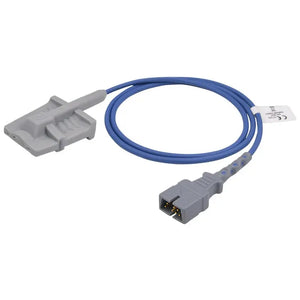
A supplier willing to publish honest test data — including limitations — is demonstrating exactly the transparency that signals a trustworthy source. For what such evidence looks like in practice, see how we test compatible SpO2 sensors before shipment and compatible vs OEM — what we actually test. As a concrete reference point, our Nellcor-compatible M1191T adult SpO2 sensor is specified to ISO 80601-2-61:2011 — the same standard named in the table above ($48, 20% off). Require data before ordering if Layer 3 cannot be demonstrated.
Layer 4 — Commercial and liability verification
The question: is there financial backing, reliable supply and honest commercial conduct?
| Check | Good answer | Red flag |
|---|---|---|
| Product liability insurance | Provides a Certificate of Insurance with insurer, policy number, limit and period | No COI; vague "we're insured" |
| Additional Insured endorsement | Will name your facility as Additional Insured on request | Refuses or cannot explain the endorsement |
| Corporate stability | Verifiable corporate history; public listing or auditable records | Untraceable entity; no operating history |
| Supply reliability | Documented lead times; in-stock vs made-to-order clarity; bonded / local inventory if relevant | Unpredictable lead times; no stock visibility |
| Warranty terms | Clear warranty length and process; honest about returns | Vague or unwritten warranty |
| Honest conduct | Will say "no" to an inappropriate request; admits limits | Agrees to everything; over-promises |
Layer 4 detail on the insurance question: What $5 Million Product Liability Insurance Covers. Warranty-law dimension: Magnuson-Moss Warranty Act and Compatible Medical Accessories. Company-level credentials and insurance: MedLinket FDA, ISO 13485 and product liability insurance explained.
On-site / deeper audit points — for high-volume or strategic suppliers
For a supplier you intend to make a major or long-term commitment to, the four-layer paper review can be extended:
- Facility verification — confirm the manufacturing site exists and operates as described (in person, by third-party audit, or by a credentialed auditor).
- Sample lot testing — test a received production lot against the supplier's stated specifications on your own equipment.
- Reference checks — speak with other hospitals using the supplier; ask specifically about failure rates and how the supplier handled problems.
- Second-source planning — confirm you have or can establish a qualified alternative so a single supplier is not a single point of failure.
BMET-oriented companion checklists: vendor qualification checklist for medical accessories and how to evaluate third-party medical accessories.
One-page decision summary
| Layer | Pass condition | If it fails |
|---|---|---|
| 1 — Regulatory | FDA-verifiable entity; device cleared / listed for your category | Stop. Do not order. |
| 2 — Quality | Current ISO 13485 covering your device; real per-unit / batch QC | Do not order until resolved |
| 3 — Performance | Quantitative data on equipment like yours; honest limits stated | Require data before ordering |
| 4 — Commercial & Liability | COI (ideally Additional Insured); stable, reliable, honest terms | Negotiate or treat as a risk |
A supplier that clears all four layers is a supplier you can build a clinical inventory on. A supplier that fails Layer 1 or 2 should not be in your monitor's signal chain at any price.
What this checklist does not do
- It is procurement guidance, not legal or regulatory advice.
- Passing the checklist does not remove your obligation to use accessories within their cleared intended use and to validate them on your equipment.
- It describes a U.S.-FDA-centric verification path; adapt the regulatory layer for your jurisdiction.
Frequently asked questions
What is the first thing to check when evaluating a medical accessory supplier?
Layer 1 — regulatory verification. Confirm the supplier is an FDA-verifiable legal entity and that the specific device you are buying is cleared or listed for your category. A "no" at this layer ends the evaluation regardless of price: an unverifiable supplier is a liability exposure no discount justifies. Work the layers in order, because a failure at a lower layer makes the higher ones moot.
Is "FDA approved" the correct term for a patient-monitoring accessory?
Usually not. Most monitoring accessories are cleared via 510(k) or simply listed — not "approved." "Approval" (PMA) is a separate, higher pathway for high-risk devices. A supplier describing a Class II accessory such as an SpO2 sensor as "FDA approved" is using the wrong term, which is a Layer 1 red flag. Verify the exact status yourself in the FDA databases.
Why evaluate the layers in a fixed order instead of scoring everything together?
Because the layers are dependent. If a supplier cannot be regulatory-verified (Layer 1) or lacks an audited quality system (Layer 2), strong performance data or attractive commercial terms are irrelevant — you cannot trust that the unit in the box matches what was tested. Ordering the layers stops teams from over-indexing on price and lead time, and from collecting certificates that do not actually cover the device being bought.
What commercial and liability documents should a supplier be able to provide?
At Layer 4, expect a Certificate of Insurance naming the insurer, policy number, coverage limit and period — ideally with your facility addable as an Additional Insured on request — plus clear written warranty terms and verifiable corporate stability (such as a public listing or auditable records). Vague "we're insured" with no certificate, or an unwritten warranty, are red flags.
About MedLinket. Founded 2004 in Shenzhen. NEEQ-listed (stock code 833505). Over 20 years specialising in patient-monitoring accessories. FDA 510(k), CE, MHRA, MDSAP, ISO 13485:2016 (TÜV), ISO 9001 certified. Class 100,000 cleanroom. Serving 2,000+ hospitals across 117 countries and regions. Product liability insurance carried with cover up to USD 5 million; hospital customers may request a certificate of insurance within the policy period.