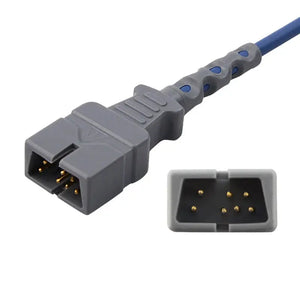
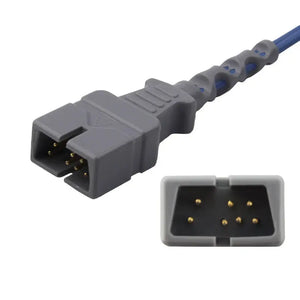
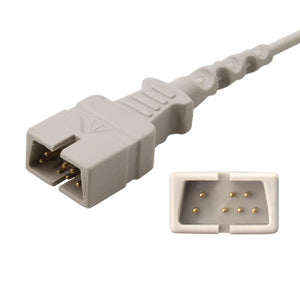
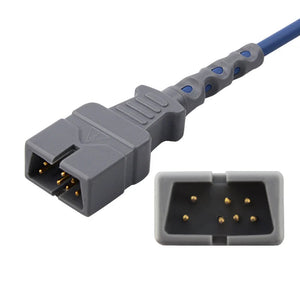
Quick answer. "Compatible" should mean four independently verifiable things: mechanical fit (the connector physically mates), electrical compatibility (signals and pinout match), functional equivalence (the accessory performs within published accuracy specifications), and regulatory clearance (independent authorisation for the intended use). If any one is missing, the claim is marketing language, not a specification — verify all four before you buy. This article gives you a decision framework and a procurement checklist.
Why this article exists
In a year of customer-service log review at MedLinket's Adapter Lab, we identified a recurring pattern in procurement disputes. A hospital buys an SpO2 sensor labelled "Philips-compatible." It plugs in; it produces readings. Six weeks later it fails, and the supplier says they never claimed it was Philips OEM-equivalent. A purchase department orders NIBP cuffs; they fit and inflate, then bladder micro-perforations contaminate the inflation pump.
An OR procurement officer buys IBP cables; the arterial line reads 5 mmHg low on systolic pressure — a near-miss during weaning from bypass.
In every case, "compatible" did one job in marketing and a completely different one in clinical practice. The buyers were not lied to, but they were not given enough information to make an informed decision. This is the gap this article addresses. For the BMET-side framing of the same trade-off, see OEM vs compatible parts — a BMET perspective.
The three meanings of "compatible" that get confused
Meaning 1 — Connector-compatible: "the plug fits"
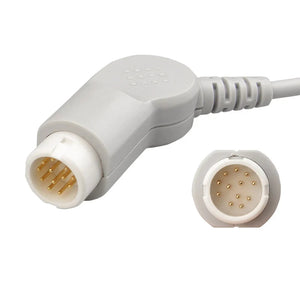
The accessory mechanically mates with the host device port. This is the minimum meaning of "compatible." A connector-only-compatible accessory might still have poor electrical contact, a wrong internal pin assignment, or no usable signal once connected. If the only verification a vendor offers is "the connector fits," you have connector-compatible — and nothing more.
Meaning 2 — Electrically compatible: "the signals work"
The accessory not only mechanically mates but also has the correct pinout, signal levels and signal characteristics for the host device. An electrically compatible accessory produces readings. But those readings may drift, may have unusual artifact characteristics, or may be systematically biased relative to the OEM reference.
Meaning 3 — Functionally validated: "the measurements meet published specifications"
The accessory has been bench-tested against published accuracy and safety specifications, with a documented protocol, sample size and reference standard. This is what "compatible" should mean in medical device procurement — and it is the meaning that requires real test infrastructure, real engineering documentation, and real regulatory clearance. At MedLinket, when we use "compatible," we mean this third definition, backed by bench data and clinical validation.
The four tests a real compatible accessory must pass
Test 1 — Mechanical fit
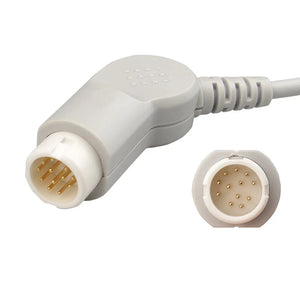
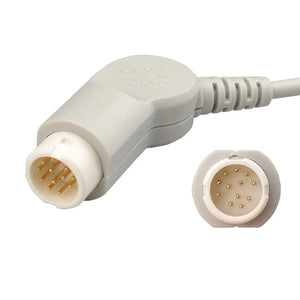
Ask the vendor for a photograph of the connector mated to the OEM device port, showing the keyway alignment and seating depth. A vendor who cannot produce this for the specific device you are asking about does not have confirmed mechanical fit. Our own fit-and-pinout verification routine is described in how we verify connector fit, pinout & signal stability.
Test 2 — Electrical compatibility
Ask the vendor to describe the pinout. For SpO2: what are the LED wavelength pairs and photodiode response curve? For ECG: what are the input impedance and CMRR specifications? For NIBP: what is the inflation pressure ceiling and deflation rate tolerance? A vendor who says "it's compatible, that's all you need to know" is working from a connector claim, not an electrical specification.
Test 3 — Functional equivalence
Ask the vendor for their bench-testing protocol, sample size, reference standard and documented accuracy specifications. Ask where those specifications are published. A legitimate manufacturer will provide a redacted validation report on request within a few days. If the vendor cannot produce this, the bench testing may not exist in documented form. For an example of a documented protocol, see how we test compatible SpO2 sensors before shipment and compatible vs OEM — what we test.
Test 4 — Regulatory clearance
Ask for the FDA 510(k) number, CE certificate, ISO 13485:2016 certificate from a named notified body, and product liability insurance carrier and coverage. Independent regulatory authorisation is the institutional confirmation that the device meets the safety and effectiveness bar for its intended use. Product liability insurance shows the vendor stands behind the product financially. Background: FDA, ISO 13485 & product liability insurance explained, and how to verify a supplier on the FDA database.
What "compatible" means across different accessory categories
SpO2 sensors
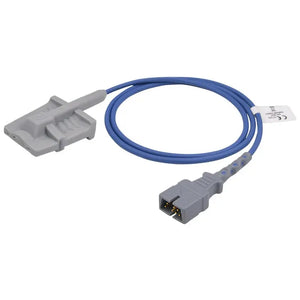
The most subtle category. A SpO2 sensor compatible with a Philips IntelliVue MX700 must mate to the correct connector (8-pin Philips, 9-pin OxiMax or 9-pin Masimo LNCS, depending on the monitor's SpO2 module), use LED wavelengths and photodiode characteristics that match what the host's algorithm expects, and meet SpO2 accuracy of ±2 SaO2 units across 70–100% per ISO 9919:2005. What "compatible" does not include for SpO2 is the host signal-processing algorithm. Masimo SET, Nellcor OxiMax, and GE TruSignal are licensed algorithms running in the monitor's processing board — not in the cable.

A compatible cable delivers the optical signal; the licensed algorithm in the host produces the SpO2 number. Any marketing language that implies a third-party sensor independently delivers SET-level performance is overstating what the cable can do. Connector families are mapped in the BMET SpO2 connector pinout reference; browse disposable SpO2 sensors or the Masimo LNCS / RD / rainbow hub.
ECG trunk cables and leadwires
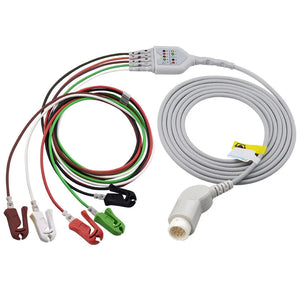
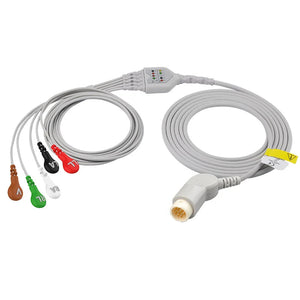
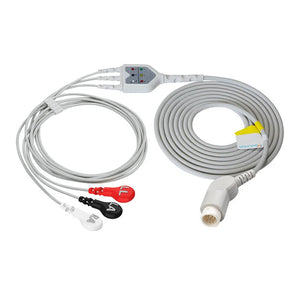
"Compatible" for ECG means the trunk physically mates and locks under cable tension; the internal pinout routes the correct lead signals to the correct monitor inputs; cable shielding meets IEC 60601-1 / IEC 60601-2-25 EMC requirements; and leadwires comply with either AHA or IEC colour-coding standards — specified explicitly, because AHA and IEC assign different colours to the same anatomical positions.
A vendor selling "compatible ECG cables" without specifying AHA or IEC has not described a complete product. Connector types are covered in the ECG cable connector types guide; see ECG cables & leadwires.
NIBP cuffs
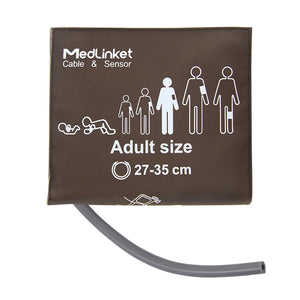
"Compatible" for NIBP must include the correct inflation connector, cuff sizing per AAMI / ESH / ISO 81060-2 (bladder width 40% of limb circumference, bladder length at least 80%), and bladder material and construction validated to maintain pressure within the monitor's leak-rate tolerance over its specified cycle count.

A cuff that connects and inflates but has too-rigid bladder material can produce a slightly elevated systolic reading — not a connector problem, but a material specification problem that only surfaces in careful AAMI / ESH bench testing. See reusable NIBP cuffs and the wider NIBP cuffs & hoses range.
IBP cables and pressure transducers
One of the most safety-critical categories, because IBP readings drive vasopressor titration, fluid management and surgical haemostasis decisions. "Compatible" for IBP means the cable connector and internal remapping are correct, the excitation voltage matches the host's expectation, sensitivity calibration (5 μV/V/mmHg per AAMI BP22) is preserved, and cable shielding and ground reference prevent pressure waveform offset.

A cable with wrong shielding can produce a 3–5 mmHg systolic offset — the waveform looks normal, but the offset is enough to bias marginal clinical decisions. The signal detail is in IBP cable pinout & signal specifications; see IBP cables and disposable transducers.
Temperature probes
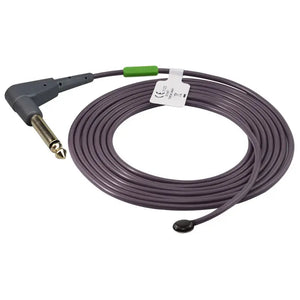
Temperature "compatible" must specify the thermistor standard — YSI-400 or YSI-700 — not just the connector. Both standards use the same connector; both have different resistance-temperature curves.

A YSI-700 probe in a YSI-400 monitor produces a reading wrong by several degrees Celsius, with no monitor alarm. See the YSI 400 vs YSI 700 compatibility test, the BMET YSI-400 vs YSI-700 reference, and our reusable temperature probes.
The Magnuson-Moss Warranty Act — why compatible accessories are legal in the U.S.
The Magnuson-Moss Warranty Act (15 U.S.C. § 2302(c)) explicitly prevents an OEM from conditioning their warranty on the use of OEM-branded accessories or services, unless the OEM provides those accessories for free or the FTC has granted a specific waiver. Most patient-monitor OEMs meet neither condition. Using a properly-validated compatible sensor does not void the monitor warranty.
The OEM can still deny warranty coverage for damage caused by a defective third-party accessory — that part is permitted. If the sensor is fine and the monitor independently fails, the OEM warranty still applies. Outside the U.S., similar protections exist under EU competition law and most major jurisdictions' consumer protection frameworks. The full explanation is in the Magnuson-Moss Warranty Act and compatible medical accessories.
Red flags that a "compatible" claim is marketing-only
- "100% equivalent to OEM." No third-party manufacturer can produce a 100%-equivalent OEM accessory without access to the OEM's proprietary specifications and tooling, which would typically require a licensing agreement. "100% equivalent" is a non-verifiable claim.
- "Completely no risk." Every medical device carries residual risk per ISO 14971. The meaningful claim is "residual risk evaluated and reduced to ALARP per ISO 14971."
- "Approved by FDA" for a 510(k)-cleared device. The FDA does not "approve" Class II devices through 510(k) — it grants clearance. "FDA-approved" is regulatorily imprecise for these products.
- "Compatible with all brands" without specifying models. Compatibility is brand-, model-, and generation-specific. A blanket claim typically means the vendor has not documented which specific configurations they have validated against.
- Unable to produce regulatory documentation on request. A legitimate manufacturer produces the 510(k) number, CE certificate and ISO 13485 certificate within 24–48 hours. If this takes weeks or is refused, the regulatory status is uncertain.
What MedLinket means when we say "compatible"
Four things, all documentable: mechanical fit verified through Adapter Lab bench testing on the specific OEM device; electrical compatibility verified through pinout reverse-engineering and signal-level measurement; functional accuracy validated through the 30-sensor / 6-week / 2,880-measurement bench protocol plus controlled hypoxia validation at Sun Yat-sen Memorial Hospital for SpO2 designs; and regulatory clearance through FDA 510(k), CE under EU MDR, MHRA registration, MDSAP certification, ISO 13485:2016 (TÜV), and product liability insurance with cover up to USD 5 million. What this looks like in practice is detailed in compatible vs OEM — what we test.
What we do not claim: OEM-equivalence; the ability to replicate licensed algorithms (SET, OxiMax, TruSignal, BIS); or generic "better than OEM" without specific testable evidence.
Our 12-month field-return data shows 51% of accessory failures originate from cable damage at the strain relief, 22% from connector pin damage, 12% from silicone tip degradation, 8% from reading drift, and 7% from other modes. These are real numbers from real returns, and they shape where our engineering investment goes.
Practical procurement checklist
Before placing the purchase order
- Vendor identified the specific OEM device model the accessory is validated against (not just the brand)
- Vendor provided photographs of the connector mated to the OEM device
- Vendor provided FDA 510(k) number, CE certificate or equivalent local regulatory clearance
- Vendor provided ISO 13485 certificate from a named notified body
- Vendor described bench-testing protocol with documented sample size and reference standard
- For SpO2: vendor referenced ISO 9919:2005 or ISO 80601-2-61 clinical validation
- For NIBP: vendor referenced AAMI / ESH / ISO 81060-2
- For IBP: vendor referenced AAMI BP22 sensitivity standard
- For temperature: vendor confirmed YSI-400 vs YSI-700 thermistor standard
- Vendor confirmed product liability insurance coverage with carrier name
On receipt and before clinical deployment
- BMET inspected the connector on the actual host monitor in your fleet
- BMET confirmed the host monitor recognises the accessory (no "Sensor not recognized" alarm)
- First-use clinical test against a stable patient or simulator before deploying to routine use
- Documentation filed in the biomedical inventory record alongside the OEM accessory record
Ongoing
- Track failure mode and root cause for any returns; share with vendor for improvement
- Confirm cleaning-cycle compliance — reusable accessories have validated cycle counts (200 cycles for most MedLinket reusables per IEC 60601-2-49)
- Replace at scheduled PM intervals, not reactively after failure
For a deeper supplier-side audit, pair this with the medical-accessory supplier evaluation checklist, the BMET vendor qualification checklist, and how to evaluate third-party medical accessories.
Frequently asked questions
Is "compatible" the same as "generic"?
No. Generic typically means an unbranded equivalent of a pharmaceutical or commodity item where the active ingredient is identical. Compatible medical accessories are independently designed and manufactured to be functionally equivalent at the device-interaction level — connector fit, electrical signal, accuracy specification. They are not "the same product without a brand."
Can a compatible sensor achieve the same low-perfusion performance as a Masimo SET sensor?
At the optical-signal layer, a well-built compatible sensor can deliver comparable signal-to-noise. SET-level performance — the low-perfusion SpO2 capability and motion-artifact rejection — comes from the licensed SET algorithm running on the host monitor's processing board, not from the cable. A compatible sensor plus a licensed SET board equals SET-level performance. A compatible sensor on a non-Masimo host delivers what that host's algorithm produces.
Why is OEM accessory pricing so much higher than compatible pricing?
OEM accessories are typically bundled with monitor service contracts; OEM R&D costs are spread across both monitor and accessory lines; and OEM distribution markup is significant. The actual manufacturing cost difference between OEM and a properly-validated compatible accessory is typically 15–30%. The marketed price difference is often 200–500%.
If MedLinket products meet FDA 510(k) and ISO 13485, why aren't they OEM-equivalent?
FDA 510(k) requires substantial equivalence to a predicate device for safety and effectiveness — not physical identicality to a specific OEM product. MedLinket compatible accessories meet the same regulatory bar and are validated to perform within the same accuracy specifications. They are independently designed and may use different materials, manufacturing processes or construction details. That is why they are called "compatible," not "equivalent" or "identical."
What is the most common compatibility-related procurement mistake?
Treating "compatible" as a single binary attribute when it is actually four independent dimensions — mechanical, electrical, functional and regulatory. A product can pass the mechanical test and fail the functional test. Verify all four.
About MedLinket. Founded 2004 in Shenzhen. NEEQ-listed (stock code 833505). Over 20 years specialising in patient-monitoring accessories. FDA 510(k), CE, MHRA, MDSAP, ISO 13485:2016 and ISO 9001 certified. Not affiliated with Philips, GE HealthCare, Mindray, Drägerwerk, Nihon Kohden, Covidien / Medtronic or Masimo. Compatibility claims are bench-validated and regulatory-cleared, not OEM-endorsed. Product liability insurance carried across the product line with cover up to USD 5 million; distributors may request a certificate of insurance within the policy period.