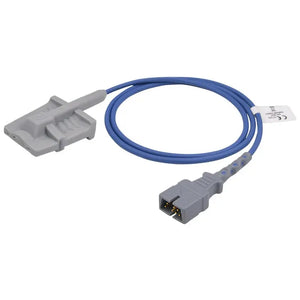
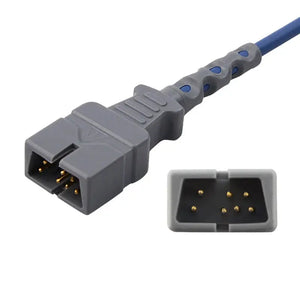
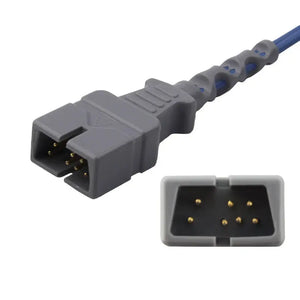
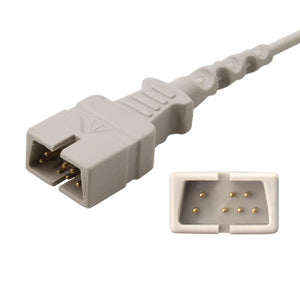
Quick Answer: YSI 400 and YSI 700 series temperature probes are electrically incompatible — using the wrong type causes inaccurate readings or silent errors without triggering an alarm. YSI 400 probes read ~2,252 Ω at 25 °C; YSI 700 probes read ~1,000 Ω. Most current patient monitors (Philips, GE, Mindray, Nihon Kohden) use YSI 400 series. This comparison covers resistance curves, connector differences, and monitor compatibility for both families.

This guide covers the technical comparison and selection between YSI 400 and YSI 700 temperature probe families. If you are troubleshooting a temperature probe that is already giving errors or inaccurate readings, see our temperature probe error troubleshooting guide — that page will refer you back here if the root cause turns out to be a YSI series mismatch. For multi-brand accessory compatibility checking, see our patient monitor accessory compatibility matrix.
1. What Are YSI 400 and YSI 700 Temperature Probes?
YSI (Yellow Springs Instrument) is the dominant thermistor standard used in clinical patient temperature monitoring. Nearly all patient monitors that measure temperature — whether bedside, transport, or anesthesia — use a thermistor element based on one of two YSI families: the 400 series or the 700 series.
The "400" and "700" designations refer to the thermistor's resistance-temperature curve — essentially, how the electrical resistance of the thermistor changes as temperature changes. The monitor's firmware contains a lookup table for one specific curve. When a probe with the correct thermistor is connected, the monitor reads the resistance, maps it against the lookup table, and displays an accurate temperature. When a probe with the wrong thermistor type is connected, the monitor still reads the resistance, still maps it against its lookup table — but produces an incorrect temperature because the resistance-to-temperature relationship is wrong.
2. Why YSI 400 and 700 Are Electrically Incompatible
The incompatibility is in the thermistor element itself — the physical component inside the probe tip whose resistance changes with temperature. YSI 400 series uses a thermistor with a nominal resistance of 2,252 Ω at 25 °C. YSI 700 series uses a thermistor with a nominal resistance of approximately 1,000 Ω at 25 °C.
Because the resistance values at every temperature point are different between the two series, a monitor calibrated for YSI 400 will misinterpret YSI 700 resistance values (and vice versa). The error is not linear — it varies across the temperature range, making simple offset correction impossible.
YSI 400 Series
Nominal resistance at body temperature (37 °C): ~1,463 Ω
Used by the majority of current-generation patient monitors
Also known as: YSI 400, 2.252kΩ NTC thermistor
YSI 700 Series
Nominal resistance at body temperature (37 °C): ~677 Ω
Found in older Datex-Ohmeda and some legacy Dräger equipment
Also known as: YSI 700, 1kΩ NTC thermistor
The key point: this is not a connector compatibility issue — it is an electrical characteristics issue. Even if you physically connect a YSI 400 probe to a YSI 700 input using an adapter cable, the readings will still be wrong. The adapter cable changes the plug shape, not the thermistor physics. For more on cable and connector electrical standards, see our medical cable specifications guide.
3. Resistance-Temperature Curves Compared
The following table shows the resistance values at clinically relevant temperature points for both YSI 400 and YSI 700 series. The magnitude of the difference at each point illustrates why cross-series substitution produces incorrect readings.
| Temperature (°C) | YSI 400 Resistance (Ω) | YSI 700 Resistance (Ω) | Difference | Clinical Context |
|---|---|---|---|---|
| 20 °C | 2,814 | ~1,250 | ~1,564 Ω | Room/ambient temperature check |
| 25 °C | 2,252 | ~1,000 | ~1,252 Ω | Standard calibration reference point |
| 30 °C | 1,814 | ~810 | ~1,004 Ω | Hypothermic patient monitoring |
| 37 °C | 1,463 | ~677 | ~786 Ω | Normal body temperature |
| 40 °C | 1,266 | ~590 | ~676 Ω | Fever / hyperthermia monitoring |
| 42 °C | 1,149 | ~540 | ~609 Ω | Malignant hyperthermia threshold |
| 45 °C | 1,011 | ~479 | ~532 Ω | Upper range / warming device safety |
4. Key Specifications: Side-by-Side Comparison
| Specification | YSI 400 Series | YSI 700 Series |
|---|---|---|
| Nominal Resistance at 25 °C | 2,252 Ω ± 1% | ~1,000 Ω ± 1% |
| Thermistor Type | NTC (Negative Temperature Coefficient) | NTC (Negative Temperature Coefficient) |
| Temperature Range (clinical) | 25 °C to 45 °C | 25 °C to 45 °C |
| Accuracy (typical) | ± 0.1 °C in clinical range | ± 0.1 °C in clinical range |
| Response Time (typical) | Depends on probe construction (skin vs esophageal) | Depends on probe construction (skin vs esophageal) |
| Market Prevalence | ~90% of current patient monitors | ~10% — legacy and anesthesia-specific |
| Common Part Numbers (reusable) | YSI 401, 409B, 409AG, 491B (adult); 400 series pediatric | YSI 701, 709B (adult); 700 series variants |
5. Monitor Compatibility by Brand and Model
The following table maps major patient monitor brands and model families to their YSI series requirement. Use this as a quick reference when ordering probes. For brand-specific accessory details beyond temperature, see our Philips & GE monitor service guide and Mindray monitor technical resources.
| Brand | Monitor Family | YSI Series | Notes |
|---|---|---|---|
| Philips | IntelliVue MX / MP series | YSI 400 | Via adapter cable 21082A or 5020411A |
| Philips | SureSigns / Efficia CM | YSI 400 | Same adapter cable family as IntelliVue |
| GE Healthcare | CARESCAPE B450/B650/B850 | YSI 400 | Via adapter 2016998-001 or 2021701-001 |
| GE Healthcare | DASH 3000/4000/5000 | YSI 400 | Marquette legacy — same YSI 400 standard |
| GE (Datex-Ohmeda) | S/5 Anesthesia modules | YSI 700 | Older Datex-Ohmeda platform — verify per module |
| Mindray | BeneVision / iPM / iMEC | YSI 400 | Via adapter MR420B |
| Nihon Kohden | BSM / Life Scope series | YSI 400 | Standard YSI 400 with NK-specific connector |
| Dräger | Infinity monitors | YSI 400 | Via adapter Dräger YSI 400 adapter |
| Dräger | Older anesthesia workstations | YSI 700 (some models) | Verify per specific model — transition period equipment |
| Biolight | All current models | YSI 400 | Biolight-specific connector |
| Comen | All current models | YSI 400 | Via Comen adapter cable |
| Edan | All current models | YSI 400 | Via Edan adapter cable |
6. How to Identify Which YSI Series Your Monitor Requires
There are three reliable methods to determine which YSI series a monitor uses, listed from most definitive to most practical:
Method 1: Service Manual Lookup
The monitor's service manual specifies the thermistor type in the temperature measurement section. Look for terms like "YSI 400 compatible," "2.252k NTC at 25 °C," or "YSI 700 compatible," "1k NTC at 25 °C." This is the authoritative source.
Method 2: Resistance Measurement
If you have a known-good probe that currently works correctly with the monitor, measure its resistance with a multimeter at room temperature (25 °C):
- ~2,252 Ω at 25 °C → YSI 400 series
- ~1,000 Ω at 25 °C → YSI 700 series
The measurement does not need to be exact — the two values are far enough apart that even an approximate reading clearly distinguishes the series. Use a digital multimeter on the 20kΩ range for best resolution.
Method 3: Adapter Cable Identification
The adapter cable between the monitor and the probe often indicates the YSI series in its part number or specification sheet. For example, Philips adapter cable 21082A is specified for YSI 400 probes. If the adapter cable documentation specifies a YSI series, use that as your guide.
7. Connector Types and Adapter Cable Considerations
Temperature probes connect to patient monitors through brand-specific adapter cables. The adapter cable has a monitor-end connector (proprietary to each brand) and a probe-end connector (typically a standard 2-pin or 1/4" phone-style jack). The YSI series is determined by the probe's thermistor, not by the adapter cable connector.
Standard Probe Connector Types
- 6.35mm (1/4") phone plug — Used by many YSI-standard reusable probes. Two-conductor connection.
- 2-pin mini connector — Used by Mindray, Comen, Edan, and some Dräger models.
- Brand-specific round connector — Nihon Kohden, Biolight, and some Philips direct-connect probes.
Adapter Cable Part Numbers by Brand
| Brand | Adapter Cable | YSI Series | Compatible Product |
|---|---|---|---|
| Philips | 21082A, 5020411A | YSI 400 | 21082A compatible, 5020411A compatible |
| GE Healthcare | 2016998-001, 2021701-001 | YSI 400 | 2016998-001 compatible, 2021701-001 compatible |
| Mindray | MR420B | YSI 400 | MR420B compatible |
| Dräger | YSI 400 adapter | YSI 400 | Dräger YSI 400 adapter |
| Nellcor/Covidien | 502-0410 | YSI 400 | 502-0410 compatible |
| Comen | 2-pin adapter | YSI 400 | Comen adapter |
| Edan | 2-pin adapter | YSI 400 | Edan adapter |
An adapter cable cannot convert between YSI 400 and YSI 700 compatibility. Adapter cables change the physical connector form factor only. If your monitor requires YSI 700 probes, you must use probes with YSI 700 thermistors — no cable will make a YSI 400 probe work correctly.
8. Reusable Probe Selection Guide by Brand
The following table lists compatible reusable temperature probes organized by monitor brand and probe type. All listed probes use YSI 400 series thermistors (the standard for current monitors).
| Brand | Adult Skin Surface | Adult Esophageal/Rectal | Pediatric Skin | Pediatric Esoph/Rectal |
|---|---|---|---|---|
| Philips | 21078A | 21075A | 21076A | — |
| GE | GE adult skin | GE adult esoph | GE ped skin | GE ped esoph |
| Mindray | MR401 adult skin | MR401B adult esoph | Ped skin | Ped esoph |
| Dräger | 4329822 adult skin | 4329848 | Ped skin | 4329889 |
| Biolight | 15-031-0005 | 15-031-0012 | Ped skin | Ped esoph |
| Comen | 040-000246-00 | 040-000385-00 | 040-000387-00 | 040-000386-00 |
| Edan | 01-15-040225-10 | Edan adult esoph | 01-15-040255 | Edan ped esoph |
| YSI Standard | 409B | 0206-02-0001 | 008-0756-00 | M1024251 |
MedLinket manufactures YSI 400 series compatible temperature probes for all major patient monitor brands — with ISO 13485 certification and full compatibility documentation.
Reusable Temperature Probes Temperature Adapter Cables9. Disposable Probe Selection Guide
Disposable temperature probes use the same YSI thermistor elements as reusable probes. They are used in operating rooms, ICUs, and situations where infection control requires single-patient use. The YSI series must match the monitor just as with reusable probes.
| Brand/Standard | Disposable Probe | YSI Series | Application |
|---|---|---|---|
| Philips | M1837A | YSI 400 | General purpose skin surface |
| GE (Datex-Ohmeda) | 8001642 | YSI 400 | Adult skin surface |
| GE (Datex-Ohmeda) | 8001646 | YSI 400 | Esophageal/rectal |
| GE (Datex-Ohmeda) | 8001644 | YSI 400 | Pediatric skin surface |
| Dräger (Air-Shields) | MU06951 | YSI 400 | Infant incubator skin |
| Dräger (Air-Shields) | MU06933 | YSI 400 | Neonatal skin surface |
| MedLinket | W0111E | YSI 400 | Universal skin surface |
For infant incubator and warmer-specific temperature probes, see our infant incubator temperature probe collection.
10. Common Mistakes and How to Avoid Them
Mistake 1: Assuming All Temperature Probes Are Interchangeable
This is the most common and most dangerous mistake. The probes look identical. They connect with the same cable. But if the thermistor series is wrong, the reading is wrong — silently. Always verify the YSI series before installing any temperature probe on a patient.
Mistake 2: Thinking an Adapter Cable Converts YSI Series
Adapter cables change the connector shape. They do not change the thermistor resistance curve inside the probe. A YSI 400 probe connected through any adapter cable to a YSI 700 monitor will still produce incorrect readings.
Mistake 3: Not Labeling Probes by YSI Series
In mixed-fleet hospitals (e.g., bedside monitors using YSI 400 and legacy anesthesia equipment using YSI 700), probes can migrate between departments. Label all probes with their YSI series using color-coded tags or permanent markers. This simple step prevents the most common temperature probe failure mode.
Mistake 4: Replacing Probes Without Checking the Monitor's Series
When a temperature probe fails, the technician replaces it with the nearest available probe from stock. If the stock includes both YSI 400 and YSI 700 probes (which can look identical), a mismatch can occur. Organize your probe inventory by YSI series and clearly separate the two types.
For a complete walkthrough of temperature probe troubleshooting — including wire damage, connector contact failures, and out-of-range readings — see our temperature probe error troubleshooting guide. For overall preventive maintenance procedures including temperature probe inspection, refer to our patient monitor PM checklist.
MedLinket's YSI 400 compatible temperature probes are manufactured in ISO 13485 certified facilities and available for Philips, GE, Mindray, Dräger, Nihon Kohden, Biolight, Comen, and Edan monitors.
Reusable Probes Disposable Probes Adapter CablesFrequently Asked Questions
Can I use a YSI 400 probe in a monitor that requires YSI 700?
No. YSI 400 and YSI 700 probes use different thermistor resistance curves and are electrically incompatible. A YSI 400 probe in a YSI 700 monitor will display grossly inaccurate temperature readings — typically several degrees off — without triggering an error code on most monitors. The monitor interprets the resistance value using the wrong curve, producing a plausible but incorrect temperature that could affect clinical decisions.
How do I tell if my monitor uses YSI 400 or YSI 700 temperature probes?
Check the monitor's service manual temperature specifications section for the thermistor type. You can also measure the probe resistance at 25 °C: a YSI 400 series probe reads approximately 2,252 ohms, while a YSI 700 series probe reads approximately 1,000 ohms. Most Philips, GE, Mindray, and Nihon Kohden bedside monitors use YSI 400 series. Some Dräger anesthesia workstations and older GE Datex-Ohmeda modules use YSI 700 series.
What is the resistance at 37 °C for YSI 400 versus YSI 700?
At body temperature (37 °C), a YSI 400 series thermistor reads approximately 1,463 ohms. A YSI 700 series thermistor reads approximately 677 ohms. This large difference is why the two series are incompatible — the monitor's firmware uses a fixed lookup table for one series, and applying it to the other produces incorrect temperature values.
Which patient monitor brands use YSI 400 series probes?
The majority of current-generation patient monitors use YSI 400 series, including Philips IntelliVue, GE CARESCAPE, Mindray BeneVision/iPM, Nihon Kohden BSM/Life Scope, Dräger Infinity, Biolight, Comen, and Edan monitors. YSI 700 series is primarily found in older GE Datex-Ohmeda anesthesia modules and some legacy Dräger equipment. For detailed brand compatibility, see the compatibility matrix.
Can an adapter cable convert between YSI 400 and YSI 700?
No. A passive adapter cable only changes the connector form factor — it cannot convert the thermistor resistance curve. The electrical incompatibility is in the probe's thermistor element itself, not in the connector. Using an adapter cable to physically connect a YSI 400 probe to a YSI 700 input will still produce incorrect readings. You must use a probe with the correct thermistor series.
Are disposable temperature probes also divided into YSI 400 and 700 series?
Yes. Disposable temperature probes use the same YSI thermistor elements as reusable probes and follow the same 400/700 series division. When ordering disposable probes, verify the YSI series compatibility just as you would for reusable probes. The probe packaging or specification sheet will indicate which series the disposable probe uses. Browse our disposable temperature probe collection.
Related BMET Resources
- Return to BMET Resource Hub — Complete technical library for patient monitor accessories
- Temperature probe error troubleshooting — Step-by-step diagnosis when probes give incorrect readings or errors
- Patient monitor accessory compatibility matrix — Cross-reference table for all brands and parameters
- Medical cable specifications — Shielding, impedance, and material requirements for probe cables
- SpO2 connector pinout reference — Wiring diagrams for SpO2 (another parameter with brand-specific tech)
- ECG cable connector types identification
- NIBP hose connector specifications
- Philips & GE patient monitor service guide — Brand-specific accessory compatibility
- Mindray patient monitor technical resources
- Patient monitor error codes troubleshooting — Master error code reference
- IBP transducer troubleshooting
- NIBP measurement errors troubleshooting
- Patient monitor PM checklist — Including temperature probe inspection steps
- Medical cable inspection and testing methods
- Calibration requirements — Including temperature accuracy verification
- BMET documentation and compliance — Record-keeping for probe replacements
- How to evaluate third-party medical accessories
- OEM vs compatible patient monitor accessories
- Vendor qualification checklist
- BMET cost-saving strategies