✍️ By MedLinket Clinical Engineering Team · 🔍 Reviewed by senior BMETs with 15+ years multi-brand service experience · 📅 Updated: March 2026 · 📖 21 technical guides | 5 resource categories
This hub is written specifically for biomedical equipment technicians (BMETs) and clinical engineers managing patient monitor accessories. For bedside clinical staff looking for monitor reading guidance, see our Hospital Monitor Reading Guide.

Quick Answer: This hub organizes every technical resource a BMET needs for patient monitor accessories — from troubleshooting error codes and PM checklists to connector pinout specs, multi-brand compatibility matrices, and procurement guidance — all in one searchable library. Whether you manage a single-brand fleet or a mixed Philips/GE/Mindray environment, start here to find the right guide for your task.
📋 Jump to Section:
A. Fault Diagnosis & Troubleshooting · B. Technical Specifications & Compatibility · C. Maintenance & Compliance · D. Procurement & Vendor Management · E. Brand-Specific Guides · About MedLinket · Key Terms Glossary · FAQ
|
21 Technical guides |
21+ Years MedLinket experience |
2,000+ Hospitals in 120+ countries |
ISO 13485 FDA · CE · MHRA · MDSAP |
Section A: Fault Diagnosis & Troubleshooting
Who this is for: BMETs responding to clinical calls, error alerts, or unexpected monitor behavior.
Field service data consistently shows that 65–70% of patient monitor service calls trace back to accessory issues rather than monitor hardware faults — a degraded SpO2 sensor, a cracked ECG lead, an NIBP hose with a slow air leak, or a temperature probe with YSI type mismatch (based on MedLinket internal support ticket analysis, 2023–2025, sample size: 12,000+ tickets across 14 countries). The foundational principle across all troubleshooting: use the swap test first — replace the suspected accessory with a known-good one. If the error clears, the accessory was the problem. If it persists, escalate to the monitor module.
- Patient Monitor Error Codes Troubleshooting Guide — Cross-brand error code database covering Philips IntelliVue, GE CARESCAPE, Mindray BeneVision/iPM, Dräger Infinity, and Nihon Kohden BSM series. Maps SpO2, ECG, NIBP, IBP, and temperature error messages to root causes with step-by-step fix procedures. Start here for any error code you don't recognize.
- NIBP Measurement Errors Troubleshooting — Systematic diagnosis for blood pressure timeout, overpressure, no-reading, and cuff leak errors. Covers pneumatic leak testing, cuff sizing errors, oscillometric measurement failures, and pump fault diagnosis. Links to NIBP hose connector specs for replacement part identification.
- Temperature Probe Errors Troubleshooting — Covers YSI type mismatch errors, thermistor wire damage, connector contact failures, and out-of-range readings. Includes resistance testing procedures and links to the YSI 400 vs 700 comparison for probe selection.
- IBP Transducer Troubleshooting — Arterial line and CVP monitoring fault diagnosis: failed zeroing, damped waveform, no signal, over-range errors, and cable signal integrity issues. Cross-references IBP cable pinout specifications for connector verification.
Related clinical guides: Patient monitor no-reading troubleshooting · SpO2 sensor accuracy troubleshooting · Monitor display problems · Patient monitor not turning on
If you need replacement accessories after diagnosis: SpO2 Sensors · ECG Cables · NIBP Cuffs & Hoses · IBP Cables & Transducers · Temperature Probes
Section B: Technical Specifications & Compatibility
Who this is for: BMETs ordering replacement cables, verifying accessory compatibility, or identifying connector types on a mixed-brand fleet.
Connector identification is one of the most frequent points of failure in accessory management. Physical connector fit does not guarantee electrical or protocol compatibility — a Nellcor OxiMax sensor physically fits many SpO2 ports, but will not function correctly on a Masimo SET module because the optical signal processing protocols are fundamentally different (see SpO2 connector pinout reference for technology family details). The guides below provide the pin-out data, brand-specific connector dimensions, and signal specifications needed to order the right accessory the first time.
- Patient Monitor Accessory Compatibility Matrix — Cross-reference table showing which SpO2, ECG, NIBP, IBP, and temperature accessories work with which monitor brands and models. Covers Philips, GE, Mindray, Dräger, Nihon Kohden, and others. Use this when managing a mixed fleet.
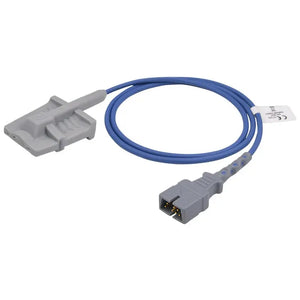
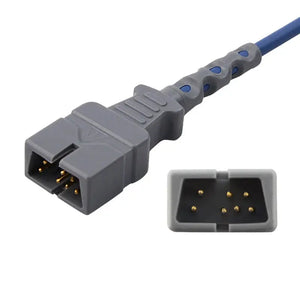
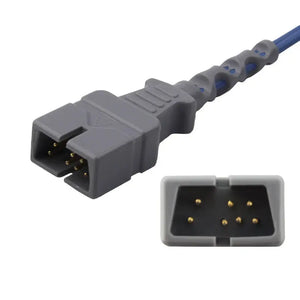
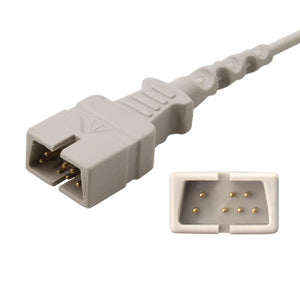
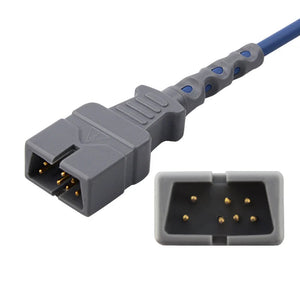
- SpO2 Connector Pinout Reference — Wiring diagrams and signal descriptions for Nellcor OxiMax (DB9), Masimo SET (LNCS), Philips FAST (round 8-pin), GE TruSignal (11-pin), and Mindray (6-pin) connectors. Includes technology compatibility matrix and adapter cable cross-reference.
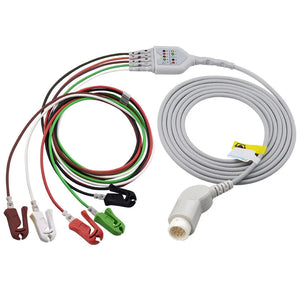
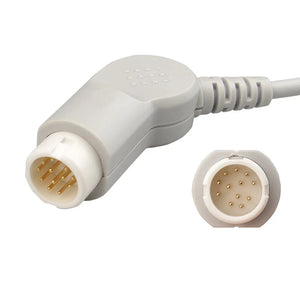
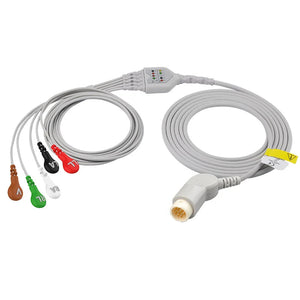
- ECG Cable Connector Types Identification Guide — Visual identification of trunk cable connectors across Philips, GE, Mindray, Nihon Kohden, and Schiller. Covers direct-connect vs. trunk-and-leadwire architectures, AHA vs. IEC color coding, 3/5/12-lead configurations, and snap vs. grabber vs. banana patient connectors.
- NIBP Hose Connector Specifications — Connector dimensions for luer-lock, bayonet, Dinaclick, SubMin, and proprietary NIBP hose fittings by monitor brand and model. Includes single-tube vs. dual-tube identification and cuff bladder compatibility by arm circumference range.
- IBP Cable Pinout & Signal Specifications — Excitation voltage requirements (4–8V DC typical), bridge resistance, signal sensitivity (5μV/V/mmHg reference), and pin assignments for Abbott, UTAH, Edwards, BD, B.Braun, and Argon Maxxim transducer interfaces.
- YSI 400 vs 700 Temperature Probe Comparison — Complete comparison of YSI 400-series (2252Ω at 25°C) and YSI 700-series (different R-T curve) NTC thermistor standards. Includes resistance values at key temperatures, connector dimensions, and which monitor brands use each standard.
- Medical Cable Specifications: Shielding, Impedance & Materials — Shielding types (braid, foil, spiral), impedance requirements by parameter, IEC 60601-1 insulation ratings, jacket materials (TPU vs. PVC vs. silicone), and bend-radius specifications per IEC 62353.
Related clinical guides: How to identify which cables your monitor needs · Patient monitor accessories guide
Section C: Maintenance, Calibration & Compliance
Who this is for: BMETs responsible for preventive maintenance programs, calibration schedules, and audit-ready documentation for Joint Commission, CMS, or equivalent accreditation bodies.
Maintenance documentation is where BMET departments are most frequently cited during accreditation surveys — not because the work wasn't done, but because the records don't show what was actually found and done. A common gap: PM records that document "inspected — passed" without noting the specific tests performed, measurements recorded, or "as-found" conditions observed. The guides in this section provide both the technical procedures (aligned with IEC 62353 and manufacturer service manuals) and the documentation frameworks that make your PM program audit-ready.
- Patient Monitor PM Checklist — Step-by-step preventive maintenance checklist for all patient monitor accessory types: visual inspection, electrical safety testing, calibration verification, and documentation. Covers SpO2, ECG, NIBP, IBP, and temperature accessories. Includes recommended PM intervals by usage intensity.
- Calibration Requirements for Patient Monitor Accessories — Calibration schedules, procedures, and documentation requirements for SpO2 functional checks, NIBP leak tests, IBP zero/span verification, and temperature accuracy checks. Intervals based on manufacturer specs, usage intensity, and IEC 62353 guidance.
- Medical Cable Inspection & Testing Methods — Three-phase cable inspection: visual inspection for jacket damage and connector wear, continuity and insulation resistance testing (≥2MΩ at 500V DC per IEC 62353), and leakage current measurement (≤500μA patient leakage limit for Type BF applied parts).
- BMET Documentation & Compliance Record Keeping — What to record (as-found condition, tests performed, measurements, as-left condition, parts replaced), how to organize records in your CMMS, and retention timelines for Joint Commission, CMS, and state regulatory compliance.
Related: Patient monitor accessory replacement schedule · When to call biomed vs troubleshoot yourself
Section D: Procurement & Vendor Management
Who this is for: BMET departments, procurement managers, and supply chain teams evaluating compatible alternatives, qualifying new vendors, and building cost-effective accessory sourcing strategies.
Accessory procurement in healthcare is a balancing act between clinical safety, budget constraints, and supply chain reliability. Compatible (third-party) accessories can deliver equivalent clinical performance at 40–60% lower cost than OEM — but only if they meet regulatory requirements (FDA 510(k), CE, ISO 13485), pass biocompatibility testing, and match the electrical and mechanical specifications of the original. The guides below walk you through the evaluation, qualification, and cost-optimization process step by step.
- How to Evaluate Third-Party Medical Accessories — Five-area evaluation framework covering regulatory compliance, material biocompatibility, electrical compatibility, connector fit, and clinical accuracy validation against OEM benchmarks. Start here before approving any compatible product.
- OEM vs Compatible Patient Monitor Accessories — Cost-quality analysis comparing OEM and compatible accessories on regulatory status, materials, clinical performance, and total cost of ownership. Written specifically from the BMET technical perspective, not the procurement department perspective.
- Vendor Qualification Checklist for Medical Accessories — Scoring template for evaluating and approving third-party accessory suppliers. Covers regulatory documentation, manufacturing quality systems, clinical testing evidence, supply chain reliability, and post-sale technical support.
- BMET Cost-Saving Strategies for Monitor Accessories — Practical strategies for reducing accessory spending 30–50% through compatible sourcing, PM-driven lifecycle extension, connector family standardization, and volume purchasing agreements.
Ready to evaluate MedLinket as a compatible accessory supplier? View our certifications and factory information · Browse our full product catalog
Section E: Brand-Specific Technical Guides
Who this is for: BMETs managing single-brand or mixed-brand monitor fleets who need brand-specific compatible accessory options, connector identification, and known service issues consolidated in one place.
- Philips & GE Patient Monitor Accessory Guide — Compatible accessories, connector types, common service issues, and replacement cross-references for Philips IntelliVue/SureSigns and GE CARESCAPE/Dash/Solar monitor families.
- Mindray Patient Monitor Technical Resources — Compatible SpO2, ECG, NIBP, IBP, and temperature accessories, connector identification, and model-specific compatibility notes for Mindray BeneVision, iPM, and iMEC series.
Browse accessories by compatible brand: Philips · GE Healthcare · Mindray · Dräger · Nihon Kohden · Nellcor · Masimo · Comen · Edan · Biolight
Browse accessories by parameter type: SpO2 Sensors & Cables · ECG Cables & Leadwires · NIBP Cuffs & Hoses · IBP Cables & Transducers · Temperature Probes · EtCO2 Accessories
About MedLinket — Why Trust These Guides
MedLinket (Shenzhen MedLinket Co., Ltd.) has manufactured patient monitor accessories since 2004. Our three factories — Shenzhen headquarters, Shaoguan (inland China), and Indonesia — produce 16,651+ product configurations across SpO2, ECG, NIBP, IBP, temperature, EtCO2, EEG, and surgical accessories using 3,500+ proprietary molds and a fully vertically integrated production chain (R&D → mold production → wire extrusion → cleanroom assembly → testing → warehousing).
Regulatory certifications: 33 Class II NMPA registrations · 19 FDA 510(k) clearances · 48 CE Class II certifications · 11 MHRA Class II registrations · 34 Brazil ANVISA registrations · 14 Australia TGA registrations · 6 Japan registrations · ISO 13485:2016 · ISO 9001:2015 · MDSAP quality management. Every product undergoes 100% factory testing before shipment. We pass annual on-site audits from NMPA, FDA, Brazil ANVISA, and OEM customers including Mindray and Philips.
Intellectual property: 45 utility model patents · 8 invention patents · 26 design patents · 1 PCT international patent · 13 software copyrights — covering structure, materials, algorithms, and product design.
These technical guides are written by our clinical engineering team and reviewed by senior BMETs with 15+ years of multi-brand service experience. The content is based on real field data, manufacturer specifications, and established industry standards (IEC 60601, IEC 62353, ISO 80601, AAMI/ANSI standards) — not marketing copy.
Product liability insurance: Up to $5 million USD per incident. We can issue individual insurance certificates naming distributors as "Additional Insured."
Key Terms Glossary
| Term | Definition |
|---|---|
| Direct-connect sensor | SpO2 sensor with an integrated cable that plugs directly into the monitor — no adapter cable needed. Brand and technology-specific. |
| Adapter cable | Intermediate cable between a short sensor (e.g., Nellcor MAX-N) and the monitor port. Determines which sensor technology is supported. |
| Trunk cable | Main ECG cable connecting the monitor to leadwires. Carries 3, 5, 6, or 12 channels depending on configuration. |
| Leadwire | Individual patient electrode cables that connect to the trunk cable. Available in snap, grabber (clip), or banana plug terminations. |
| YSI 400 series | Temperature probe standard using 2252Ω NTC thermistor at 25°C with 2-pin connector. Used by most Philips, older GE, and many third-party monitors. |
| YSI 700 series | Temperature probe standard with a different resistance-temperature curve than YSI 400. Used by newer GE monitors. Not interchangeable with YSI 400. |
| Nellcor OxiMax | Covidien/Medtronic SpO2 technology platform. Uses digital signal encoding. Not compatible with Masimo SET sensors. |
| Masimo SET | Masimo Signal Extraction Technology platform for SpO2. Uses proprietary optical processing. Not compatible with Nellcor OxiMax sensors. |
| IEC 62353 | International standard for recurrent testing and testing after repair of medical electrical equipment. Defines leakage current limits, insulation resistance requirements, and functional testing procedures. |
| Pinout | Diagram showing the function assigned to each pin in a multi-pin connector. Essential for verifying cable compatibility and diagnosing signal issues. |
Frequently Asked Questions
What is a BMET resource hub?
A BMET resource hub is a centralized technical library that organizes troubleshooting guides, connector specifications, preventive maintenance checklists, compatibility references, and procurement tools — everything a biomedical equipment technician needs to maintain patient monitoring equipment in one searchable location.
Are compatible (third-party) patient monitor accessories safe to use?
Yes, when they meet regulatory requirements (FDA 510(k), CE marking, ISO 13485 quality system) and pass clinical accuracy validation against OEM benchmarks. The key is to verify five areas before approving any compatible accessory: regulatory compliance, material biocompatibility, electrical compatibility, connector fit, and clinical accuracy. Our evaluation framework guide walks through each criterion in detail.
How often should patient monitor accessories be inspected?
Most hospitals follow a 6- or 12-month PM cycle for monitor accessories, depending on usage intensity and manufacturer recommendations. High-use ICU accessories may require quarterly visual inspection. Our PM checklist and calibration requirements guide detail recommended schedules by accessory type, with references to IEC 62353 and manufacturer service manual intervals.
Can I use Nellcor sensors on a Masimo-compatible monitor (or vice versa)?
No — Nellcor OxiMax and Masimo SET use fundamentally different optical signal processing protocols and are not cross-compatible, even when the physical connector appears to fit. Using the wrong sensor type will produce inaccurate SpO2 readings or trigger error codes. See our SpO2 connector pinout reference for technology family details and our compatibility matrix for a complete cross-reference.
How do I identify which NIBP hose connector my monitor needs?
NIBP hose connectors are brand-specific and not mechanically interchangeable. Common types include Philips's proprietary quick-connect, GE's Dinaclick, Mindray's luer-slip, Nihon Kohden's SubMin, and Dräger's bayonet connector. Our NIBP hose connector specifications guide covers dimensions, photos, and compatibility by monitor brand and model series.
What is the difference between YSI 400 and YSI 700 temperature probes?
YSI 400 and YSI 700 series use different resistance-temperature (R-T) curves: a YSI 400 probe reads 2252Ω at 25°C, while a YSI 700 probe has a different resistance curve at the same temperature. They are electrically incompatible — plugging a YSI 400 probe into a YSI 700 monitor (or vice versa) produces inaccurate temperature readings, typically off by 1–3°C. See our YSI 400 vs 700 comparison guide for complete specs, resistance tables, and a monitor compatibility chart.
Browse all patient monitor accessories: View Full Product Catalog
Need help identifying the right accessory for your monitor? Contact MedLinket technical support:
📧 shopify@medlinket.com · 💬 WhatsApp: +86 189 2972 7044