Why a Formal Qualification Process Matters
The compatible patient monitor accessory market spans a wide quality spectrum — from well-capitalized ISO 13485-certified manufacturers with clinical accuracy data, to unregistered distributors reselling uncertified product at low prices. Purchasing from the wrong end of this spectrum creates three categories of risk that BMET programs cannot afford:
Patient Harm Due to Device
by u/Ok-Savings5969 in BMET
Patient safety risk: Accessories that fail to deliver accurate readings or fail mechanically can directly affect clinical decisions. Inaccurate SpO2 readings, intermittent ECG signals, and NIBP measurement errors have all been documented with non-qualified compatible accessories. When a SpO2 connector pinout does not match the monitor's technology protocol, the sensor may appear to function while delivering unreliable saturation values — a failure mode that is difficult to catch without systematic qualification.

Compliance risk: Joint Commission surveyors and CMS inspectors increasingly ask whether HTM programs have documented processes for verifying that compatible accessories meet safety standards. Proper BMET documentation and compliance records must include evidence of supplier qualification — not just pricing comparison. "We checked the price and it looked good" is not an answer that survives audit.
Operational risk: High-failure accessories increase BMET corrective maintenance burden, increase clinical staff complaint volume, and create procurement chaos when product must be urgently replaced mid-contract. A well-structured preventive maintenance checklist can catch some of these failures early — but prevention through proper vendor qualification is far more effective than after-the-fact detection.
A formal vendor qualification checklist for medical accessories closes all three risk categories systematically, per the documentation requirements referenced in IEC 62353 (electrical safety testing for medical equipment) and ISO 13485:2016 Section 7.4 (purchasing controls for medical device manufacturers and healthcare facilities).

Phase 1: Initial Supplier Screening (5–10 Minutes)
Not every supplier inquiry requires a full qualification cycle. Use this initial screen to decide whether to proceed to full evaluation:
| Screen Criterion | Pass | Disqualify |
|---|---|---|
| Company registration / legal entity verifiable | Yes — registered business with physical address | Cannot verify legal entity; P.O. box only |
| Product-specific FDA registration claimed | Yes — specific registration or listing number provided | FDA registration claimed but no number provided; or "coming soon" |
| ISO 13485 certification claimed | Yes — with named certifying body and certificate number | ISO 9001 only; self-declared ISO 13485; no certificate number |
| Website and product catalog presence | Professional website with specific product specs and part numbers | No website; catalog of only generic images with no specifications |
| Market history | 3+ years in market; verifiable customer references | Newly established (under 12 months); no reference accounts |
Any disqualifying criterion should stop the evaluation. Time spent on an unqualified supplier is time taken from qualified suppliers and operational BMET work.
Phase 2: Document Collection & Verification
Pass initial screening? Request the following documents. Set a 5-business-day deadline — legitimate suppliers can produce these documents quickly because they maintain them as a normal part of their quality system.
📋 Required Document Request List
- FDA 510(k) clearance number(s) and/or FDA device establishment registration number
- Current ISO 13485 certificate — must include: issuing body name, certificate number, scope statement, validity dates
- CE Declaration of Conformity (for EU-compatible accessories or international-sourced product)
- Written compatibility statement for your specific monitor brands and models (Philips IntelliVue, GE CARESCAPE, Mindray BeneVision, Dräger Infinity, Nihon Kohden BSM series, etc.)
- Clinical accuracy or performance test data — for SpO2: vs. reference co-oximetry per ISO 80601-2-61; for NIBP: per AAMI/ISO 81060-2
- Warranty policy — duration, coverage, replacement procedure
- Product labeling samples — verify UDI if applicable, lot/serial traceability
- REACH/RoHS compliance documentation (biocompatibility and material safety)
- Reference accounts — minimum two facilities currently using the product in clinical settings
How to Verify the Documents You Receive
Receiving a document is not the same as verifying it. Falsified certificates are a real risk in the medical accessory market. Verify each critical document:

FDA Registration: Search the FDA Device Registration and Listing database using the supplier's establishment registration number. Verify the company name, address, and listed device types match what you were told.
ISO 13485 Certificate: Contact the issuing body (TÜV, BSI, SGS, DEKRA, etc.) directly or use their online certificate verification tool. Verify the certificate is current, not expired, and the scope covers the specific product categories you are purchasing. Scope language matters — "SpO2 sensors and cables" is meaningfully different from "monitoring accessories."
510(k) Clearance: Search the FDA 510(k) database using the K-number provided. Verify the intended use and device description match your application.
Reference Accounts: Actually call the references. Ask specifically about: failure rates vs. OEM, clinical staff acceptance, any compatibility issues, how the supplier responded to problems, and whether they would repurchase.
Download: Vendor Scoring Template (PDF) Ready to score your supplier? This printable scorecard includes the complete 4-phase workflow — initial screening pass/fail table, document collection checklist, weighted scoring framework (30%/25%/20%/15%/10%), red flag list, and ongoing monitoring metrics. Fill it out as you evaluate each vendor.
Phase 3: Technical Verification
Document verification confirms the supplier has a quality system. Technical verification confirms the specific product works with your specific monitors. These are different things, and both matter.
Connector and Interface Verification
Request product samples before committing to a purchase program. For each accessory type, verify:
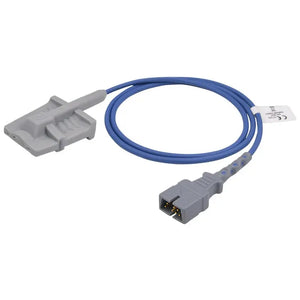
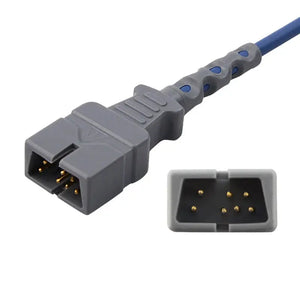
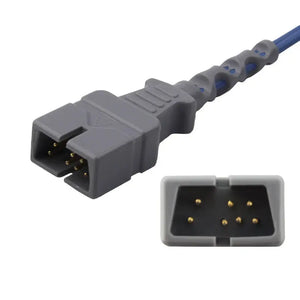
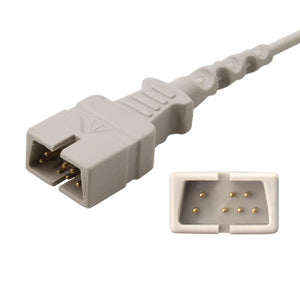
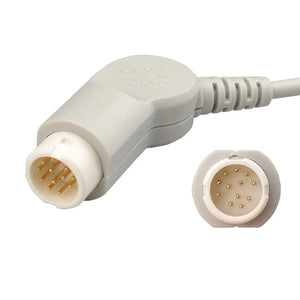
- Physical connector fit: Does the connector seat correctly in your monitor port without forcing? For SpO2 adapter cables, does the sensor end connect correctly to your SpO2 sensors? For NIBP hoses, does the monitor-end connector match your Philips, GE, or Mindray hose fitting?
- Technology compatibility: For SpO2, does the cable work with your monitor's SpO2 technology — Nellcor OxiMax, Masimo SET, Philips FAST, GE TruSignal? Physical connector fit does not guarantee technology compatibility. See SpO2 connector pinout reference for the technical details behind each technology's signal protocol.
- Measurement accuracy: Run the accessory on a known patient or simulator, compare readings against a calibrated reference. For SpO2, compare against a co-oximetry reference if possible; at minimum, cross-check against a verified OEM sensor simultaneously. Follow the calibration requirements for patient monitor accessories to ensure proper verification methodology.
- Error message behavior: Does the monitor display any error message or incompatibility warning? A monitor that accepts the physical connector but displays a sensor-not-recognized message indicates a technology or protocol incompatibility. See patient monitor error codes troubleshooting for common compatibility error codes by brand.
Use the multi-brand compatibility matrix as a starting cross-reference when verifying which accessory models work with which monitor families.

Durability and Mechanical Assessment
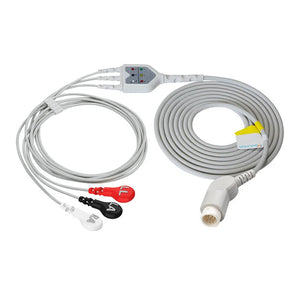
For reusable accessories (direct-connect SpO2 sensors, ECG trunk cables, IBP adapter cables), evaluate the mechanical build quality:
- Strain relief flexibility and durability — this is the most common failure point in cables
- Connector housing construction — molded vs. assembled; susceptibility to cracking
- Jacket material — TPU typically outperforms PVC for flexibility and chemical resistance per medical cable shielding and material specifications
- Cable diameter and handling — clinical staff preference matters for adoption
Refer to medical cable inspection and testing methods for the quantitative cable assessment protocol using continuity testing, insulation resistance measurement, and visual inspection criteria per IEC 62353.
Supplier Scoring Framework (Weighted Template)
Use this scoring matrix to compare suppliers objectively and document the basis for your approval decision. This template satisfies the documentation requirements referenced in ISO 13485:2016 Section 7.4 (purchasing controls):
| Criterion | Weight | Score 0–5 | Notes |
|---|---|---|---|
| FDA registration / 510(k) — verified | 20% | 5 = verified; 3 = pending; 0 = unverifiable | Non-negotiable for US facilities |
| ISO 13485 — verified, current, correct scope | 20% | 5 = verified TÜV/BSI/DEKRA; 3 = verified lesser body; 0 = unverifiable | Scope must cover your product categories |
| Clinical accuracy data — quantitative | 15% | 5 = independent clinical study; 3 = internal test data; 1 = claims only; 0 = none | SpO2 ±2–3% required per FDA guidance |
| Compatibility documentation — specific | 15% | 5 = written statement for your models; 3 = general brand statement; 0 = none | Get it in writing with model numbers listed |
| Technical verification — sample testing | 15% | 5 = passed all tests; 3 = minor issues resolved; 0 = failed test | Based on your own testing, not supplier claims |
| Reference accounts — verified positive | 10% | 5 = 2+ positive references contacted; 3 = 1 reference; 0 = none | Call the references; don't just collect names |
| Warranty and support quality | 5% | 5 = clear warranty, responsive support; 3 = adequate; 0 = no warranty | Test responsiveness during evaluation |
Scoring interpretation:
- ≥ 4.0 weighted score: Approve for pilot program
- 3.0 – 3.9 weighted score: Conditional approval — resolve gaps before pilot
- < 3.0 weighted score: Do not approve — insufficient quality infrastructure
Supplier Red Flags: When to Walk Away
- Cannot produce ISO 13485 certificate from a recognized certifying body
- Claims FDA registration but the number cannot be verified in FDA's public database
- Provides a certificate but scope does not cover the product type you are purchasing
- Certificate is expired or signed by an unrecognized internal "auditor"
- Refuses to provide reference accounts or only provides references that cannot be independently contacted
- Product samples fail compatibility or accuracy testing
- Claims CE marking but cannot produce the Declaration of Conformity
- Pricing is more than 80% below OEM list price with no plausible explanation — extreme price gaps typically indicate non-certified product
Softer Warning Signs That Warrant Caution
- Long response times to document requests (more than 5 business days for standard documents)
- Inconsistent product specifications between catalog, datasheet, and sample labeling
- No established US market presence or US-based customer service contact
- Distributor rather than manufacturer — ask who manufactured the product and request manufacturer documents, not just distributor documents
- Unwillingness to send samples before purchase commitment
- Aggressive claims of OEM equivalence with no supporting data — for an objective framework to evaluate such claims, see OEM vs compatible parts: a BMET's cost-quality analysis
Phase 4: Ongoing Supplier Monitoring
Approval is not a one-time event. Approved suppliers require periodic re-evaluation to ensure continued performance and document currency:
| Monitoring Activity | Frequency | Responsible Party |
|---|---|---|
| ISO 13485 certificate renewal verification | Annual (or at certificate expiry) | BMET / Procurement |
| FDA registration status check | Annual | BMET / Procurement |
| Failure rate review vs. baseline | Quarterly (first year); annual after | BMET |
| Clinical staff complaint log review | Quarterly | BMET |
| Re-evaluation on product changes | As triggered by spec change notification | BMET / Procurement |
| Full re-qualification | Every 3 years or after significant adverse event | BMET |
MedLinket: Pre-Qualified Vendor Documentation
MedLinket has been manufacturing compatible patient monitor accessories since 2004 — over 21 years. Our qualification documentation is maintained as an active part of our quality management system, not assembled on request.
For BMET teams using the framework in this guide, MedLinket can provide:
- FDA Registration: Establishment registration and 19 FDA 510(k) clearances on file and verifiable in FDA database
- ISO 13485 Certificate: Certified by TÜV (independent, recognized certifying body); current certificate with scope covering SpO2 sensors, ECG cables, NIBP accessories, temperature probes, and IBP accessories
- CE Documentation: 48 product categories with EU CE Class II certification; 16 categories CE Class I
- Manufacturing Scale: Three owned factories (Shenzhen, Shaoguan, Indonesia) with 3,500+ molds and full in-house manufacturing from R&D through cable extrusion to clean-room assembly
- Clinical Accuracy Data: SpO2 sensor accuracy validated at independent clinical institutions, consistent with FDA accuracy requirements of ±2–3% RMS difference vs. co-oximetry reference
- Written Compatibility Statements: Technical staff available to provide written confirmation for your specific monitor models across Philips, GE, Mindray, Dräger, Nihon Kohden, Biolight, EDAN, Comen, and others
- Product Liability Insurance: Coverage up to $5 million; can issue certificates naming your facility as additional insured
- Reference Accounts: BMET and HTM customers in 120+ countries including academic medical centers, community hospitals, and multi-site health systems — references available for contact
For IBP disposable transducers specifically, MedLinket's product covers compatibility with Abbott, Utah, Edwards/Baxter, BD/Ohmeda, Argon/MAXXIM, B.Braun, and PVB/SIMMS sensor interfaces — with connector-specific documentation available for each interface type.
Request MedLinket's Complete Vendor Qualification Package
FDA registration, ISO 13485 (TÜV-audited), clinical accuracy data, and written compatibility statements — all ready for your approved vendor file. Skip the 2-week document chase and get what you need in one request.
Frequently Asked Questions
What should I ask a third-party accessory supplier before buying?
Ask for seven things: (1) FDA registration or establishment listing number, (2) current ISO 13485 certificate with certifying body name, certificate number, scope, and expiry date, (3) CE Declaration of Conformity if applicable, (4) written compatibility statement for your specific monitor models and parameter technology, (5) clinical accuracy or performance test data, (6) warranty terms and replacement procedure, and (7) at least two reference accounts at facilities currently using the product. A legitimate supplier can provide all seven within 5 business days.
How do I verify an ISO 13485 certificate is legitimate?
Contact the issuing certification body directly using contact information from their official website — not from the supplier's certificate. TÜV, BSI, SGS, DNV, and DEKRA all have certificate verification tools or direct inquiry processes. Verify: the company name and address match the supplier, the certificate is current and not expired, the scope statement covers the specific product category you are purchasing, and the issuing body itself is accredited (check IAF MLA or UKAS registries for accredited certification bodies).
How long should a medical accessory vendor qualification process take?
Initial document collection and verification: 1–2 weeks. Technical verification with product samples: 2–4 weeks. Pilot program before full approval: 60–90 days. Total timeline from first contact to full approved vendor status: approximately 90–120 days for a thorough process. Shortcuts here routinely create more cost and risk than they save. For urgent needs, request samples quickly and run document verification concurrently while evaluating performance — but do not skip either step.
What are the biggest red flags when evaluating a compatible accessory supplier?
The most serious red flags are: inability to provide a verifiable ISO 13485 certificate from a recognized body; claiming FDA registration but no number that checks out in the FDA database; product samples that fail compatibility or accuracy testing; refusal to provide reference accounts; and pricing more than 80% below OEM with no explanation. Any one of these should disqualify the supplier regardless of price or sales presentation quality.
How do I verify FDA registration for a medical device supplier?
Search the FDA Device Registration and Listing database at fda.gov using the establishment registration number the supplier provides. Verify: the company name and address match, the registration is current (not lapsed), and the listed device types cover what you are purchasing. You can also search by company name if no number is provided — but be aware that multiple companies may have similar names. The specific registration number is the most reliable verification method.
How often should we re-evaluate approved medical accessory vendors?
At minimum: ISO 13485 certificate verification annually (or at certificate expiry), FDA registration status check annually, and failure rate review quarterly for the first year and annually thereafter. Full re-qualification every 3 years or after any significant adverse event involving the supplier's products. Also re-evaluate if the supplier notifies you of specification changes, manufacturing location changes, or ownership changes — any of these can affect product quality.
Build Your Approved Vendor List With Confidence
MedLinket's 21-year manufacturing history, TÜV-audited ISO 13485 certification, 19 FDA 510(k) clearances, and clinical validation data meet every criterion in this qualification checklist — with documentation ready for your compliance file.