Quick Diagnostic SOP: NIBP errors on patient monitors stem from four primary sources: pneumatic air leaks, cuff sizing errors, motion artifacts, or internal module faults. Troubleshoot in this order:
- Step 1 (Cuff Sizing & Placement): Verify arm circumference against cuff range. Undersized cuffs elevate SBP by 10–15 mmHg (up to +20 mmHg).
- Step 2 (Pneumatic Leak Test): Run built-in leak test at 200–250 mmHg for 20s. Isolate cuff vs. hose using a plugged hose test.
- Step 3 (Patient Physiology): Rule out motion, severe AFib arrhythmia, or extreme hypotension (<50 mmHg SBP).
- Step 4 (Module Diagnostics): Test internal inflation pump, dual-stage bleed valves, and 300 mmHg / 150 mmHg overpressure cutoffs.
📌 Article Scope: This is a BMET-level technical diagnostic guide for NIBP pneumatic system testing, error code interpretation, and component isolation.
For hose-to-monitor fitting specifications, see NIBP Hose Connector Specifications. For monitor-wide error codes, see the Patient Monitor Error Codes Guide.
📑 Table of Contents
- 1. How NIBP Measurement Works (Oscillometric Review)
- 2. Common NIBP Error Messages & Diagnostic Indications
- 3. Systematic 4-Step BMET Troubleshooting SOP
- 4. NIBP Cuff Sizing Matrix (3–50 cm) & Contamination Stats
- 5. Brand-Specific Error Code Tables (Philips, GE, Mindray)
- 6. NIBP Preventive Maintenance (PM) Checklist
- 7. Frequently Asked Questions
- 8. Related BMET Resources

1. How NIBP Measurement Works (Oscillometric Review)
Understanding oscillometric mechanics is vital for isolating NIBP errors. Modern patient monitors measure non-invasive blood pressure according to IEC 80601-2-30 (particular safety & performance for automated NIBP) and clinical accuracy standards under ISO 81060-2. The measurement sequence follows six steps:
- The monitor pump inflates the NIBP cuff above expected systolic pressure, occluding the brachial artery.
- The internal bleed valve deflates the cuff in controlled, stepwise decrements.
- As blood flow resumes, arterial pulsations generate micro-oscillations in cuff air pressure.
- The internal pressure transducer detects these oscillation amplitudes through the NIBP air hose.
- Peak oscillation amplitude = Mean Arterial Pressure (MAP) — the ONLY directly measured value.
- Systolic (SBP) and Diastolic (DBP) pressures are derived mathematically using proprietary algorithm envelopes (where baseline models approximate $SP = \text{MAP} / 0.55$ and $DP = \text{MAP} \times 0.85$).
Key BMET Insight: Because MAP is directly measured while SBP/DBP are derived estimates, MAP is the most stable parameter. When clinical staff report "inaccurate blood pressure readings," compare MAP values first. Algorithm calculation errors affect SBP/DBP far more frequently than physical MAP measurement errors. In sepsis care, maintaining MAP ≥65 mmHg is the primary perfusion target.
💡 Oscillometric Operating Limits (IEC 80601-2-30): Oscillometric NIBP modules fail or produce invalid data under specific physiological bounds: SBP <50 mmHg or >250 mmHg; Heart Rate <40 bpm or >240 bpm; severe shivering/tremor; or during cardiopulmonary bypass (lack of pulsatile flow). Always verify with manual auscultation if readings fall outside these boundaries.
2. Common NIBP Error Messages & Diagnostic Indications
| Error Message | Diagnostic Meaning | Root Cause | BMET Initial Action |
|---|---|---|---|
| "Measurement Failed" / "Unable to Measure" | Module failed to detect recognizable oscillation envelope | Undersized cuff; severe motion artifact; weak pulse amplitude; cuff over thick clothing | Apply MedLinket 3-Step Sizing SOP; check arm position at heart level; retry |
| "Cuff Leak" / "Pneumatic Error" / "NIBP Leak" | Pressure decay exceeded threshold during inflation hold | Punctured TPU bladder; hose crack; loose connector (A05/A26/A80); worn seal | Run built-in NIBP Leak Test; isolate cuff vs. hose using a plugged hose |
| "Over Pressure" / "Pressure Error" | Cuff pressure exceeded IEC 80601-2-30 safety limit (300 mmHg adult, 150 mmHg neonate) | Kinked hose preventing deflation; incorrect patient mode (Adult selected for Neonate); blocked exhaust valve | Verify patient mode setting; inspect hose for kinks; test exhaust valve solenoid |
| "Cuff Not Connected" / "Pump Error" | No pneumatic path detected or pump failed to generate pressure | Disconnected hose port; broken latch; internal pump diaphragm failure; open valve | Inspect hose connector; listen for pump motor drive; re-test with known-good hose |
| "NBP EQUIP MALF" / "Hardware Fault" | Module hardware self-test failure | A/D pressure sensor drift; internal EEPROM corruption; drive circuit fault | Run module service diagnostics; check power supply voltages; replace module if persistent |
3. Systematic 4-Step BMET Troubleshooting SOP
In hospital field service, pneumatic leaks and cuff sizing errors account for over 80% of reported NIBP service tickets. Swapping expensive NIBP modules without clearing the pneumatic chain leads to wasted inventory and unnecessary downtime. Follow this systematic 4-step SOP:
Step 1: Cuff Sizing, Application & 10–15 mmHg Error Mechanics
The cuff functions as the primary pneumatic transducer in NIBP measurement. Incorrect sizing distorts arterial compression dynamics. Clinical trials (including the Johns Hopkins Cuff(SZ) Trial published in JAMA Internal Medicine) and MedLinket engineering protocols confirm that applying an undersized or overly narrow cuff forces the monitor pump to generate extra pressure to collapse the brachial artery, causing falsely elevated blood pressure readings of 10–15 mmHg (and up to +20 mmHg).
⚠️ Clinical Hazard & Contamination Alert: Undersized cuffs lead to false hypertension diagnosis and inappropriate medication. Furthermore, surveillance studies reveal that 69.1% of in-use reusable BP cuffs harbor bacterial contamination (including MRSA). In OR, ICU, and isolation units, single-patient disposable non-woven cuffs (Y000D Series) or Yellow Isolation Cuffs (Y006D) are mandatory to eliminate HAI transmission.
MedLinket’s 3-Step Sizing SOP:
- Measure Mid-Arm Circumference: Measure at the midpoint between the shoulder (acromion) and elbow (olecranon). Never guess by visual estimate.
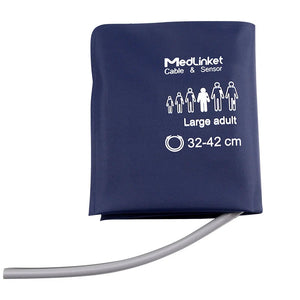
- 75% Bladder Coverage Rule: Verify that the cuff’s inflatable TPU bladder covers at least 75% to 80% of arm circumference.
- Size Up on Boundary: If circumference falls on a boundary measurement (e.g., 32 cm between Adult and Large Adult), always default to the larger cuff size.
Step 2: Pneumatic Air Leak Test & Hose Isolation
The NIBP leak test is the definitive diagnostic for pneumatic integrity. Perform this test during routine PM or whenever a "Cuff Leak" INOP occurs:
- Set monitor patient mode to Adult.
- Connect the NIBP air hose and cuff, wrapping the cuff tightly around a rigid cylinder (e.g., a section of 3-inch PVC pipe or rigid cylinder).
- Navigate to the service menu:
Main Menu ➔ Maintenance ➔ NIBP Leak Test(Mindray) orService Mode ➔ NIBP Pneumatic Test(Philips/GE). - Initiate the test. The module inflates to ~200–250 mmHg and holds pressure for 20 seconds.
- Pass/Fail Criteria: A pressure drop exceeding 5 mmHg over 60 seconds fails the test.
-
Component Isolation Protocol: Disconnect the cuff and plug the end of the air hose using a solid male luer plug. Re-run the leak test.
- If the hose-only test PASSES: The leak is located in the cuff bladder or cuff seam. Replace the cuff.
- If the hose-only test FAILS: The leak is located in the hose body, connector O-ring, or internal monitor manifold.
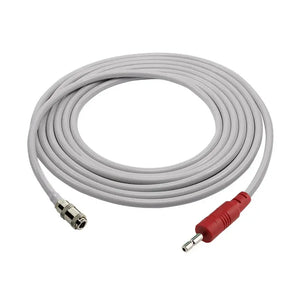
💡 Hose Connector Identifier (6mm vs 5mm Red Ring): Legacy Philips IntelliVue (MP20-90, MX400-800) uses 6mm A25 connectors (M1599B). Newer compact modules (MMX, X3, MX100) use 5mm ISO 80369-1 connectors with a distinctive RED collar ring (A80 / 989803209771). Force-fitting a 6mm hose into a 5mm port damages module socket seals and causes persistent leaks!
Step 3: Patient Physiological Artifacts
If pneumatics test airtight, evaluate patient physiological factors that exceed algorithm tolerances:
- Atrial Fibrillation / Severe Arrhythmia: Irregular cardiac intervals disrupt pulse period calculations. Switch to manual auscultation or IBP invasive arterial monitoring.
- Hypotension & Shock (SBP <50 mmHg): Weak arterial pulse wave amplitude fails to generate sufficient pressure oscillations.
- Shivering & Tremor: Muscle contractions create high-frequency pressure spikes that mask arterial oscillations. Support the limb away from bed rails.
Step 4: Internal Pump & Overpressure Safety Testing
If external accessories and patient factors are cleared, evaluate the monitor’s internal hardware:
- Pump Motor Drive: Verify 12V/24V drive voltage to the pump motor when inflation initiates. Listen for diaphragm binding.
- Linear & Exhaust Valves: Inspect dual-stage solenoid valves. Debris or lint in the valve seat prevents full closure during inflation. Purge the valve manifold using clean compressed air.
- Overpressure Cutoff Verification: Per IEC 80601-2-30, verify that mechanical overpressure safety switches actuate at 300 ±10 mmHg (Adult) and 150 ±5 mmHg (Neonate), immediately dumping cuff pressure. Document cutoff values per your facility's compliance procedures.
4. NIBP Cuff Sizing Matrix (3–50 cm) & Contamination Stats
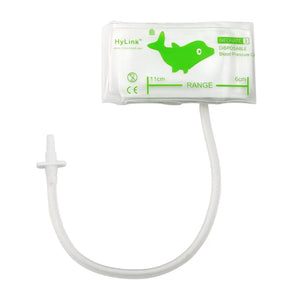
MedLinket manufactures an 11-scale arm circumference matrix covering all patient age groups. Neonatal disposable lines feature five distinct sub-sizes (3–15 cm) made from transparent TPU, allowing NICU nurses to inspect skin microcirculation without unwrapping.
| Patient Category | Arm Circumference (cm) | Recommended Cuff Material | MedLinket Part Number & Features |
|---|---|---|---|
| Neonatal #1 | 3–6 cm | Transparent Soft TPU | M1866A (Box of 24) · A26 connector |
| Neonatal #2 | 4–8 cm | Transparent Soft TPU | M1868A · Single-patient use, DEHP-free |
| Neonatal #3 | 6–11 cm | Transparent Soft TPU | M1870A (Box of 24) · Artery marker |
| Neonatal #4 / #5 | 7–15 cm | Transparent Soft TPU | M1872A / M1874A · Soft rounded edges |
| Child / Pediatric | 15–22 cm | Reusable Nylon / TPU | Pediatric Reusable Cuff |
| Small Adult | 17–25 cm | Reusable TPU Comfort | Small Adult TPU Cuff |
| Adult (Standard) | 24–32 cm | Reusable Nylon / Non-Woven | Adult Disposable (Y000D) / TPU Comfort |
| Adult Long | 28–37 cm | Reusable TPU Comfort | Adult Long Cuff · Extended bladder |
| Large Adult | 32–42 cm | Reusable TPU / Nylon | Large Adult Cuff · Prevents +15 mmHg error |
| Adult Thigh | 42–50 cm | Reusable Blue Nylon | Adult Thigh Cuff · Bariatric placement |
5. Brand-Specific Error Code Tables (Philips, GE, Mindray)
Philips IntelliVue INOP Error Codes
| INOP Message | Diagnostic Meaning | Action & Component Check |
|---|---|---|
NBP EQUIP MALF |
Internal pump, valve, or pressure transducer failure | Verify 12V pump drive; test M1599B hose; replace module if persistent |
NBP CUFF LEAK |
Pneumatic leak during hold test | Run leak test; check A26/A80 connector seals on 989803209771 hose |
NBP INTERRUPTED |
Cycle aborted due to motion or manual stop | Settle patient; support limb at heart level; restart cycle |
CUFF NOT CONNECTED |
Open pneumatic circuit detected | Inspect hose latch connection at module front panel |
GE Healthcare (Critikon / Carescape) Error Codes
| Error Message | Diagnostic Meaning | Action & Component Check |
|---|---|---|
NIBP – MEASUREMENT FAILED |
Weak oscillation signal detected | Verify GE Critikon cuff size; check artery marker alignment |
NIBP – AIR LEAK |
System leak detected | Run pneumatic test; inspect DinaClick connector hose (2058203-002) |
NIBP – CUFF OVERPRESSURE |
Pressure exceeded safety threshold | Verify patient mode setting; inspect hose for kinks |
Mindray (BeneView / Passport) Error Codes
| Error Message | Diagnostic Meaning | Action & Component Check |
|---|---|---|
NIBP PUMP LEAKING |
Leak detected during automated test | Run built-in test (Main Menu ➔ Maintenance ➔ NIBP Leak Test); check Mindray hose (6200-30-09688)
|
NIBP CUFF TYPE ERROR |
Cuff size mismatched with patient mode | Re-assign patient mode (Adult / Pediatric / Neonate) in monitor software |
6. NIBP Preventive Maintenance (PM) Checklist
Perform these NIBP checks during regular 6-month or 12-month PM cycles. Document all safety cutoff values per Joint Commission / CMS compliance standards:
| ✓ | PM Task | Frequency | Pass Criteria & Action |
|---|---|---|---|
| ☐ | Visual Cuff Inspection | 6 Months | No TPU bladder delamination, seam splitting, or worn velcro. Replace worn cuffs. |
| ☐ | Air Hose & Connector Inspection | 6 Months | Inspect TPU jacket for cracks/kinks. Verify firm locking click on A05/A12/A26/A80 connectors. |
| ☐ | Pneumatic Leak Hold Test | 6 Months | Holds pressure at 200–250 mmHg within <5 mmHg drop over 60 seconds. |
| ☐ | Overpressure Safety Cutoff Test | 12 Months | Safety valve dumps pressure at 300 ±10 mmHg (Adult) and 150 ±5 mmHg (Neonate) per IEC 80601-2-30. |
| ☐ | Static Calibration Verification | 12 Months | Pressure sensor accuracy within ±3 mmHg against calibrated reference manometer across 0–250 mmHg range. |
Need Reliable NIBP Replacement Accessories for Your Hospital Fleet?
MedLinket manufactures OEM-compatible NIBP cuffs, air hoses, and connectors for Philips, GE Healthcare, Mindray, Draeger, Nihon Kohden, Welch Allyn, and Spacelabs — 100% factory pressure-tested, ISO 13485 certified, and FDA 510(k) cleared.
7. Frequently Asked Questions
Why does NIBP consistently fail on certain ICU patients?
Oscillometric NIBP algorithms rely on detecting consistent arterial pressure pulsations. Severe arrhythmias (such as Atrial Fibrillation) produce irregular oscillations; extreme hypotension (SBP <50 mmHg) fails to generate sufficient signal amplitude; and excessive patient movement creates mechanical noise exceeding algorithm tolerances. In these cases, manual auscultation or invasive arterial pressure (IBP) monitoring is clinically indicated per IEC 80601-2-30.
How do I perform an NIBP cuff and hose leak test?
Set patient mode to Adult. Connect the NIBP hose and cuff to the monitor, wrapping the cuff tightly around a rigid cylinder (e.g., PVC pipe). Navigate to Main Menu ➔ Maintenance ➔ NIBP Leak Test (or equivalent service mode). The monitor inflates to ~200-250 mmHg and holds pressure for 20-30 seconds. A drop exceeding 5 mmHg over 60 seconds indicates a pneumatic leak. Isolate whether the leak is in the cuff, hose, or internal module valve by re-testing with a plugged hose.
How much does an incorrect cuff size skew blood pressure readings?
Using an undersized or overly narrow cuff forces the monitor pump to over-inflate to collapse the brachial artery, causing falsely elevated blood pressure readings by 10 to 15 mmHg (and up to +20 mmHg). Conversely, an oversized cuff yields falsely low readings. Clinicians should follow MedLinket's 3-step sizing SOP: measure mid-arm circumference, verify ≥75% bladder coverage, and default to the larger cuff size on boundary measurements.
What is the difference between legacy 6mm and ISO 80369-1 5mm Philips NIBP hoses?
Legacy Philips IntelliVue monitors (MP20-90, MX400-800) use a 6mm single-tube connector (MedLinket A25 / M1599B). Newer compact modules (IntelliVue MMX, X3, MX100) feature a 5mm bore port conforming to ISO 80369-1, distinguished by a RED collar/ring on the plug (MedLinket A80 / 989803209771). Force-fitting a 6mm hose into a 5mm port damages module socket seals and causes pressure leaks.
8. Related BMET Resources
About MedLinket
MedLinket (Shenzhen Med-link Electronics Tech Co., Ltd, est. 2004; Stock Code: 833505) manufactures compatible reusable NIBP cuffs, adult disposable non-woven cuffs, transparent TPU neonatal disposable cuffs, NIBP air hoses, and NIBP gas connectors for major patient monitor brands. Operating a 10,000+ m² manufacturing footprint with 2,822 sets of precision molds, MedLinket products are ISO 13485 certified, NMPA registered (No. 20243072401), FDA 510(k) cleared, and CE MDR marked. MedLinket serves 2,000+ hospital clients across 117+ countries, backed by up to $5 Million USD in global product liability insurance.
Contact: shopify@medlinket.com · WhatsApp: +852 6467 3105
References & Standards
- IEC 80601-2-30:2018 — Medical electrical equipment: particular requirements for basic safety and essential performance of automated non-invasive sphygmomanometers.
- ISO 81060-2:2018 — Non-invasive sphygmomanometers — Part 2: Clinical investigation of automated measurement type.
- ISO 80369-1:2018 — Small-bore connectors for liquids and gases in healthcare applications (5mm red-ring NIBP connector standard).
- Ishigami J, et al. Effects of Cuff Size on the Accuracy of Blood Pressure Readings: The Cuff(SZ) Randomized Crossover Trial. JAMA Intern Med. 2023;183(10):1061–1068.
- Joint Commission Standards for Medical Equipment Maintenance (EC.02.04.01 / EC.02.04.03).
Disclaimer: This guide is intended for biomedical engineering and healthcare technical personnel education. It does not replace specific manufacturer device service manuals or facility infection control policies. MedLinket manufactures compatible patient monitoring accessories, not original diagnostic host monitors. Third-party brand names (Philips, GE, Mindray, Draeger, Nihon Kohden) are referenced for compatibility mapping purposes only.