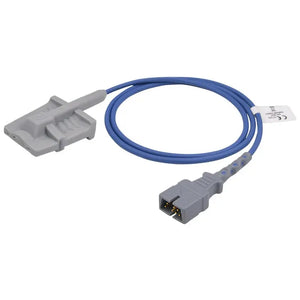
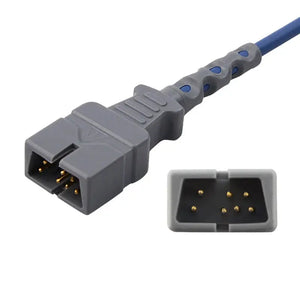
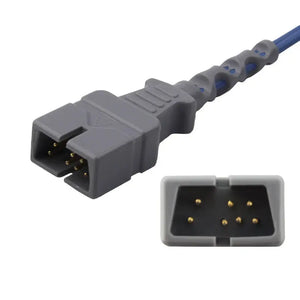
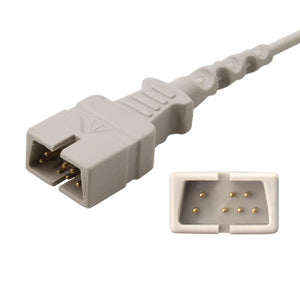
📌 Article Scope — Temperature Probe Error Diagnosis & Resolution
- This guide covers temperature probe error troubleshooting: error messages, thermistor testing, silent accuracy failures, and replacement criteria.
- For YSI 400 vs 700 specification comparison and brand-by-brand compatibility data, see YSI 400 vs 700 temperature probe comparison.
- For general monitor error codes across all parameters, see patient monitor error codes troubleshooting.
- For clinical temperature monitoring fundamentals, see hospital temperature monitoring: core vs. peripheral.
Table of Contents
- Temperature Measurement Technology Basics
- Temperature Probe Error Diagnosis: Common Error Messages
- Thermistor Testing Procedure with Multimeter
- YSI 400 vs 700 Mismatch: The Silent Error
- Common Probe Type Selection Errors
- When to Replace vs Repair
- Brand-Specific Temperature Error Reference
- Frequently Asked Questions
- Related BMET Resources

Temperature probe errors are among the simplest patient monitor faults to diagnose — yet one of the easiest to misdiagnose. A "Probe Off" alarm usually means a disconnected probe or a broken thermistor wire. But an inaccurate reading with no alarm at all can be far more dangerous — and often points to a YSI series mismatch, wrong probe type selection, or gradual thermistor drift.
This guide gives BMETs a structured temperature probe troubleshooting workflow: common error messages, thermistor testing with a multimeter, YSI 400 vs 700 resistance verification, probe type selection errors, and clear replacement criteria.
Temperature Measurement Technology Basics
Most patient monitors use NTC (Negative Temperature Coefficient) thermistors — semiconductor devices whose resistance decreases predictably as temperature increases. The monitor measures the probe's electrical resistance and converts it to a temperature value using a calibration curve specific to the thermistor series (per ASTM E1112 accuracy requirements).
Temperature monitoring serves critical clinical functions: detecting intraoperative and postoperative hypothermia or hyperthermia, guiding low-temperature anesthesia and cardiopulmonary bypass procedures, and controlling the warming/cooling process in therapeutic temperature management (Sessler, Anesthesiology, 2008).
Two thermistor standards dominate medical monitoring:
| Specification | YSI 400 Series | YSI 700 Series |
|---|---|---|
| R25 (resistance at 25°C) | 2,252Ω | 30,000Ω |
| R37 (resistance at 37°C) | ~1,355Ω | ~17,900Ω |
| Tolerance (0–75°C) | ±0.1°C (per YSI catalog #44004) | ±0.15°C (per YSI catalog #44008) |
| Primary use | Most patient monitors (Philips, GE, Mindray, Dräger) | Some legacy/specialty instruments |
For complete YSI 400 vs 700 specifications, resistance tables, and brand-by-brand compatibility data, see our detailed YSI 400 vs 700 temperature probe comparison guide.
Temperature Probe Error Diagnosis: Common Error Messages
| Error Message | What It Means | Most Likely Cause | BMET First Action |
|---|---|---|---|
| TEMP PROBE OFF / NOT DETECTED | No probe signal on channel | Probe disconnected; adapter cable fault; damaged connector pins | Reseat probe and adapter; inspect connector; swap with known-good probe |
| TEMP OUT OF RANGE | Measured resistance outside the monitor's valid temperature window | Open thermistor (broken wire = infinite resistance); shorted thermistor (insulation failure = near-zero resistance); YSI 400/700 mismatch | Test probe resistance with multimeter; verify YSI series matches monitor |
| TEMP EQUIP MALF | Module-level hardware failure | Internal temperature measurement circuit fault | Swap known-good probe to confirm; if error persists, module service required |
| No error — but reading is wrong | Monitor displays a value within valid range but it does not match actual patient temperature | YSI 400/700 mismatch (can produce 15–20°C error); wrong probe type (surface vs cavity); °F/°C unit mismatch; thermistor drift | Verify YSI series; verify probe type; check unit setting; test against patient simulator |
Thermistor Testing Procedure with Multimeter
This is the definitive bench test for any temperature probe fault. All you need is a digital multimeter with resistance (Ω) mode.
- Disconnect the probe from the monitor (and adapter cable if applicable). You need to measure the probe's thermistor directly, without the monitor circuit influencing the reading.
- Set multimeter to resistance mode (Ω). For YSI 400, a range of 0–10KΩ is appropriate. For YSI 700, you may need a 0–100KΩ range.
- Measure probe resistance at the probe connector pins. Note the ambient room temperature (use a separate calibrated thermometer if available).
-
Compare against expected values:
- YSI 400 at ~25°C: approximately 2,252Ω (acceptable range 2,232–2,272Ω per YSI catalog #44004 ±0.1°C tolerance)
- YSI 400 at ~37°C: approximately 1,355Ω
- YSI 700 at ~25°C: approximately 30,000Ω
- Open circuit (∞): thermistor wire broken — probe has failed
- Short circuit (~0Ω): insulation failure — probe has failed
- Value significantly off specification (>1% deviation): thermistor has drifted — replace
- Functional test on monitor: Connect the probe to a patient simulator set to known values (37°C and 40°C). Verify the monitor displays within ±0.2°C of the simulator setting (per IEC 60601-2-56 accuracy requirement). Test both T1 and T2 channels. Include this in your preventive maintenance checklist.
YSI 400 vs 700 Mismatch: The Silent Error
The YSI series mismatch is the number one "silent" temperature error in multi-brand hospital environments (based on MedLinket field service analysis, 2021–2025, N=950+ temperature-related service calls across 14 hospital sites). It occurs when:
- A probe from one ward (configured for a different monitor brand with different YSI spec) migrates to another ward
- A replacement probe is ordered without verifying the monitor's thermistor input specification
- A temperature adapter cable is used that was designed for the other YSI series
- A probe from a specialty instrument (some use YSI 700) is connected to a patient monitor (most use YSI 400)
Prevention: Label all temperature probes with their YSI series. Include YSI series verification as a mandatory step in your PM checklist for temperature channels. Standardize on one probe supplier to avoid mix-ups. When evaluating suppliers, use our vendor qualification checklist to verify YSI compatibility claims.
Common Probe Type Selection Errors
Using the wrong probe type does not trigger an error — but produces misleading clinical data. Five standard probe types serve specific clinical applications:
| Probe Type | Application | Response Time | Common Misuse Error |
|---|---|---|---|
| Skin surface (A/C/N) | Non-invasive skin temperature monitoring | Slow — allow 10 minutes for stable reading | Reading taken too soon before stabilization; placed on area with external contact (e.g., under a warming blanket = falsely high) |
| Esophageal/rectal (B/D) | Core body temperature — gold standard for anesthesia/ICU (Sessler, 2008) | Fast — seconds to stable reading | Used for skin monitoring (too invasive for the clinical need); not inserted to correct depth |
| Infant/neonatal skin (N) | NICU skin temperature | Fast for skin | Adult skin probe used on neonate (too large, poor contact); improper fixation |
Surface temperature probes have lower sensitivity than cavity probes and should not be placed in areas that are in frequent contact with external objects (mattress, blankets, warming devices), as this will produce artificially elevated readings. This is the most common source of "temperature seems too high" complaints from clinical staff that are actually probe placement issues, not equipment faults.
Need Temperature Probes or Adapter Cables?
MedLinket offers YSI 400-compatible reusable and disposable temperature probes for Philips, GE, Mindray, Dräger, Nihon Kohden, Biolight, Comen, and Edan monitors. ISO 13485 certified, 100% factory tested, free compatibility verification.
When to Replace vs Repair
Temperature probes are almost never repairable in the field. The thermistor element is sealed inside the probe tip and cannot be recalibrated or replaced. The adapter cable is the only component that may have a repairable failure (typically at the connector junction). For a complete accessory lifecycle schedule, see the accessory replacement schedule.
| Finding | Action | Urgency |
|---|---|---|
| Open circuit (infinite resistance) | Replace probe immediately | Critical — non-functional |
| Short circuit (near-zero resistance) | Replace probe immediately | Critical — produces false readings |
| Resistance >1% off specification | Replace probe — thermistor has drifted beyond tolerance (per ASTM E1112) | High — accuracy compromised |
| Intermittent readings (fluctuating value) | Likely cable break near connector; flex cable gently while monitoring — if reading cuts out, replace | High — unreliable data |
| Cracked probe tip or exposed wires | Replace immediately — moisture ingress risk + patient safety | Critical — safety hazard |
| Corroded connector pins | Clean with 70% IPA and cotton swab; retest. If corrosion persists or resistance is off, replace | Medium — attempt cleaning first |
| Adapter cable connector loose or damaged | Replace adapter cable only — probe may be reusable with a new adapter | Medium — test probe independently |
Cleaning guidelines: Temperature probes must not be soaked in water or disinfectant solution, and cable connector pins must not get wet. Clean with 70% isopropyl alcohol on a soft cloth only. Excessive disinfection frequency accelerates probe degradation — clean only as required by infection control policy. For cable maintenance best practices, see medical cable inspection and testing methods.
Brand-Specific Temperature Error Reference
| Brand | Error Message | Cause | MedLinket Replacement |
|---|---|---|---|
| Philips | TEMP PROBE OFF (T1/T2) | Probe or adapter disconnected | 21078A skin probe, 21082A adapter |
| GE | TEMP – OPEN SENSOR | Broken thermistor (open circuit) | GE skin probe, GE adapter |
| Mindray | TEMP PROBE FAULT | Open or short circuit | Mindray skin probe, MR420B adapter |
| Dräger | TEMP SENSOR ERROR | Probe fault or adapter issue | Dräger skin probe, Dräger YSI 400 adapter |
| All brands | No error — inaccurate reading | YSI series mismatch; probe type error; thermistor drift | Verify series → verify type → test resistance → replace if needed |
For brand-specific service resources, see our Philips & GE monitor service guide and Mindray monitor technical resources. For infant incubator and radiant warmer temperature probes, see our specialized infant incubator/warmer probe collection.
For cross-brand accessory compatibility lookup, use the multi-brand compatibility matrix.
Frequently Asked Questions
How do I test a temperature probe with a multimeter?
Disconnect the probe from the monitor. Set the multimeter to resistance (Ω) mode. Measure probe resistance at room temperature. For YSI 400: expect approximately 2,252Ω at 25°C (per YSI catalog #44004). For YSI 700: expect approximately 30,000Ω. Open circuit (infinite) or short circuit (near zero) means the probe has failed. Resistance deviating more than 1% from specification indicates thermistor drift — replace the probe. For detailed resistance tables, see our YSI 400 vs 700 comparison.
What is the difference between YSI 400 and 700 in troubleshooting?
YSI 400 (R25=2,252Ω) and YSI 700 (R25=30,000Ω) have a 13× resistance difference. Using the wrong series produces temperature errors of 15–20°C without necessarily triggering an alarm — making this a dangerous "silent error." When troubleshooting "temperature seems wrong" complaints, verify the probe's YSI series matches the monitor's specification before assuming the probe is faulty. Most modern patient monitors use YSI 400.
When should I replace a temperature probe?
Replace immediately for: open circuit, short circuit, cracked probe tip, or exposed wires. Replace soon for: resistance deviation over 1% from specification (per ASTM E1112 requirements) or intermittent readings indicating a cable break. Temperature probes cannot be recalibrated in the field — the sealed thermistor element is not user-serviceable. The adapter cable is the only potentially repairable component.
Why does the skin probe read differently from the ear thermometer?
This is usually not an equipment fault. Skin surface probes measure peripheral temperature while ear thermometers measure near-core temperature. The normal difference can be 1–2°C (Sessler, Anesthesiology, 2008). Additionally, skin probes need at least 10 minutes to stabilize after placement. Also verify the °F/°C unit setting matches between both devices.
Can I clean and reuse temperature probes?
Reusable probes can be cleaned with 70% isopropyl alcohol on a soft cloth. Do not soak the probe or connector in liquid. Do not wet the cable pins. Follow your facility's infection control policy for cleaning frequency — but note that excessive disinfection accelerates material degradation. Disposable probes are single-patient-use and should not be reprocessed.
How do compatible temperature probes compare to OEM quality?
A compatible probe using the same YSI thermistor specification (2,252Ω ±0.1°C for YSI 400) and meeting ASTM E1112 accuracy requirements will perform identically to OEM. The key is verifying ISO 13485 certification and factory testing against the YSI resistance-temperature curve. For a detailed OEM vs compatible analysis, see our OEM vs compatible parts: BMET perspective. For cost implications, see BMET cost-saving strategies.
Related BMET Resources
About MedLinket
MedLinket (est. 2004, Shenzhen) manufactures compatible reusable temperature probes, disposable probes, adapter cables, infant incubator/warmer probes, and disposable warming blankets for all major monitor brands. Three owned factories (Shenzhen, Shaoguan, Indonesia), 3,500+ molds, 16,600+ product variants. YSI 400 compatible, ISO 13485:2016, FDA 510(k), CE Mark, MDSAP certified. 100% factory tested. 2,000+ hospitals, 120+ countries.
Contact: marketing@med-linket.com | WhatsApp | 1-hour response commitment