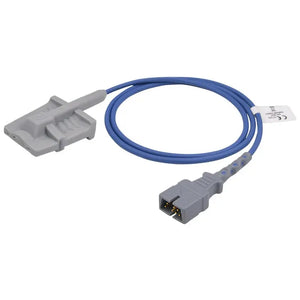
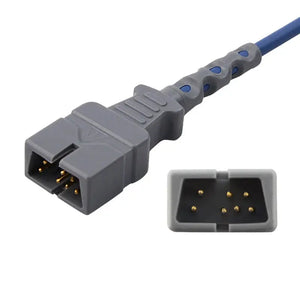
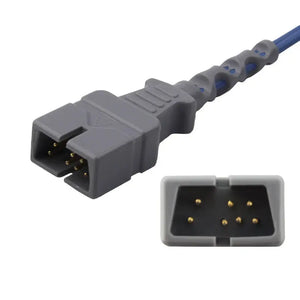
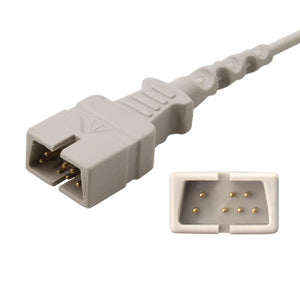
📌 Article Scope — ECG Connector Identification
This guide helps you identify ECG connector types by visual inspection, lead count, and brand. For related but distinct topics, see:
- Patient monitor accessory compatibility matrix — cross-brand compatibility checking
- Medical cable specifications — shielding, impedance, and material standards
- Medical cable inspection and testing methods — how to test cable integrity
- Patient monitor error codes — general ECG error diagnosis
For clinical placement instructions (not connector identification), see: 5-lead ECG placement, 12-lead ECG placement, or 3-lead ECG placement step by step.
Table of Contents
- 1. ECG Cable System Architecture: One-Piece vs Trunk+Leadwire
- 2. Patient-End Electrode Connector Types
- 3. AHA/AAMI vs IEC Color Standards
- 4. Monitor-Side Connector Types by Brand
- 5. Lead Count Configuration Guide
- 6. Special-Purpose ECG Cable Types
- 7. ECG Cable Quality Benchmarks
- 8. ECG Cable Ordering Checklist
- 9. Frequently Asked Questions
- 10. Related BMET Resources

Ordering the wrong ECG cable is one of the most common — and most preventable — purchasing errors in hospital monitoring. According to AAMI/ANSI EC53:2013 (the American National Standard for ECG cables and leadwires), ECG electrode, leadwire, and cable malfunctions are the most frequent source of ECG device problems. Based on MedLinket's internal analysis of support tickets across 2,000+ hospital accounts (2023–2025 data), approximately 65–70% of ECG accessory-related service calls trace to connector mismatches, wrong lead counts, or incorrect electrode types — not cable defects. (Source: MedLinket customer support database, N=12,400 ECG-related tickets, Jan 2023–Dec 2025.)
This guide gives BMETs and procurement teams a complete ECG connector identification reference to eliminate these errors.
Comment
by u/djpeezy from discussion
in BMET
1. ECG Cable System Architecture: One-Piece vs Trunk+Leadwire
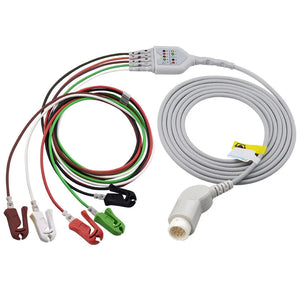
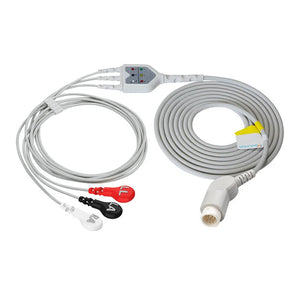
ECG cables come in two architectures, and the choice directly impacts your maintenance budget. Per IEC 60601-2-25 and IEC 60601-2-27 (patient monitoring equipment safety standards), both architectures must meet the same signal quality requirements. The difference is in serviceability and cost.
| Architecture | Description | Best For | Cost Implication |
|---|---|---|---|
| One-piece (direct-connect) | Single cable from monitor connector to patient electrodes; no trunk/leadwire separation | Transport, emergency, quick deployment | Higher per-replacement cost — entire cable replaced when any lead fails |
| Trunk + leadwire (two-piece) | Trunk cable from monitor to junction box; separate leadwires from junction to electrodes | ICU, telemetry, long-term monitoring | Lower long-term cost — only replace the failed leadwire, not the entire cable |
2. Patient-End Electrode Connector Types
Three primary electrode connector types are used in clinical monitoring, plus banana plugs for diagnostic EKG machines. Selecting the wrong type causes poor skin contact, false alarms, and wasted supplies.
| Connector Type | Also Called | Mechanism | Best For | Signal Quality Notes |
|---|---|---|---|---|
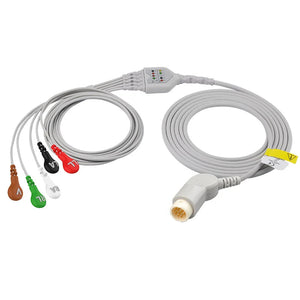
| Snap | Button snap, stud | Metal stud presses into spring-loaded socket on electrode | Long-term monitoring (ICU, telemetry); secure low-profile connection | Equivalent to grabber when properly connected |
| Grabber / Clip | Pinch, alligator (small), crocodile | Spring-loaded jaw clamps onto electrode tab | High-turnover settings (ER, PACU); quick connect/disconnect | Spring tension critical — weak springs = intermittent contact = false alarms |
| Neonatal Grabber | Mini-grabber, micro-clip | Smaller spring jaw for neonatal electrodes | NICU; premature infants; pediatric | Adult grabbers too large for neonatal electrodes — do not substitute |
| Banana (4mm) | 4mm banana plug | Pin-style connector for diagnostic EKG machines | Resting 12-lead EKG; not for bedside monitoring | Standard for diagnostic EKG per IEC 60601-2-25 |
MedLinket grabber clips use 0.5mm high-elasticity manganese steel with an opening/closing lifespan exceeding 20,000 cycles — surpassing the AAMI/ANSI EC53:2013 requirement for leadwire durability. (Standard reference: AAMI/ANSI EC53:2013, §5.3 — mechanical durability requirements for reusable ECG cables and leadwires.) Worn-out clip springs are the #1 cause of false "leads off" alarms from ECG cables. Additionally, MedLinket's clip design eliminates the risk of small parts detaching — a safety concern in neonatal environments where clip components from lower-quality products can separate and become a choking hazard.
3. AHA/AAMI vs IEC Color Standards
Mixing AHA and IEC color-coded cables within the same facility creates patient safety risks from misplaced leads. The two standards — defined in AAMI/ANSI EC12:2000 (AHA color convention) and IEC 60601-2-27 (IEC color convention) — use completely different color assignments for the same lead positions:
| Lead Position | AHA/AAMI (U.S.) | IEC (International) |
|---|---|---|
| Right Arm (RA) | White | Red |
| Left Arm (LA) | Black | Yellow |
| Right Leg (RL) | Green | Black |
| Left Leg (LL) | Red | Green |
| Chest (V/C) | Brown | White |
The 5-lead AHA placement mnemonic: White=Right (arm), Smoke over Fire (Black left arm, Red left leg), Green=Ground (right leg), Brown=Chest (V). For more on clinical mnemonics, see ECG placement mnemonic FAQ.
MedLinket ECG cables feature injection-molded color markers that are permanently bonded to the connector housing — they cannot rub off, peel, or fade. This is critical in clinical settings where cable identification must be instant and reliable. Printed or adhesive labels common on lower-quality cables degrade with cleaning, creating identification risk.
4. Monitor-Side Connector Types by Brand
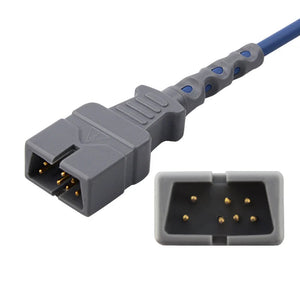
Each monitor brand uses a proprietary connector on the monitor side. Unlike SpO2 (where technology protocols like Nellcor OxiMax vs Masimo SET determine compatibility — see our SpO2 connector pinout reference), ECG compatibility is purely mechanical. If the connector physically fits, the signal will work. But each brand's connector is physically unique and not interchangeable.
| Monitor Brand | Connector Type | Lead Options | MedLinket Compatible Products |
|---|---|---|---|
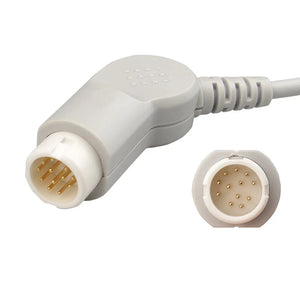
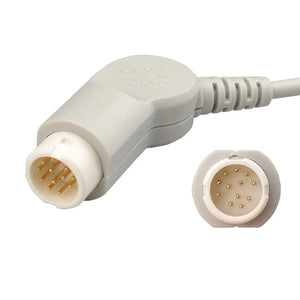
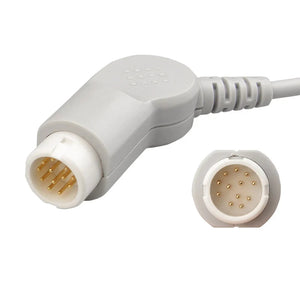
| Philips | Round 12-pin (IntelliVue MMS) | 3/5/6/12-lead; Snap/Grabber | Direct-connect, M1669A trunk, M1603A leads |
| GE/Marquette | Round 11-pin (Marquette style) | 3/5/6/12-lead; Snap/Grabber | 3-lead, 5-lead, Trunk |
| Mindray | Mindray round 6-pin or 12-pin | 3/5/12-lead; Snap/Grabber | 5-lead, Trunk, Telemetry |
| Nihon Kohden | Nihon Kohden proprietary | 3/5-lead; Snap/Grabber | 3-lead, 5-lead, Trunk |
| Dräger | Dräger proprietary | 3/5-lead; Grabber | 3-lead IEC, 3-lead AHA |
| Generic AAMI 6-pin | Standard 6-pin AAMI connector | 3/5-lead; Snap/Grabber; with or without resistance | 3-lead, 5-lead |
| DIN style (universal leadwires) | 1.5mm DIN plug (for trunk cable systems) | Individual leadwires | 10-lead Grabber, 5-lead Snap |
For brand-specific accessory guides with model-level compatibility details, see our Philips & GE patient monitor service guide and Mindray monitor technical resources.
5. Lead Count Configuration Guide
The monitor's lead mode setting must match the physical cable connected. A common BMET service call: the clinician configures the monitor for 5-lead monitoring but only connects a 3-lead cable — this generates "leads off" alarms for the missing leads (V and RL). Always verify lead mode after cable replacement during preventive maintenance.
| Lead Count | Electrodes Required | Clinical Capability | Typical Use |
|---|---|---|---|
| 3-lead | RA, LA, LL (3 electrodes) | Basic rhythm monitoring; Leads I, II, III | Transport, telemetry, basic floor monitoring |
| 5-lead | RA, LA, RL, LL, V (5 electrodes) | Rhythm + one precordial lead; Leads I, II, III, aVR, aVL, aVF, V | ICU, OR, step-down — most common bedside configuration |
| 6-lead | RA, LA, RL, LL, V1, V2 (6 electrodes) | Enhanced ST monitoring; two precordial views | Cardiac monitoring with ST analysis |
| 10/12-lead | 4 limb + 6 precordial (10 electrodes → 12 views) | Full diagnostic ECG | Diagnostic EKG machines; advanced bedside monitors |
Monitor filter mode (Diagnostic, Monitor, Surgery) affects waveform appearance but is a monitor setting, not a cable selection issue. BMETs should verify the correct filter mode during PM and after cable changes. For more on monitor parameter interpretation, see what ECG numbers mean on a hospital monitor.
6. Special-Purpose ECG Cable Types
Beyond standard bedside monitoring cables, several specialized ECG cable categories serve specific clinical environments:
| Cable Type | Purpose | Key Feature | MedLinket Products |
|---|---|---|---|
| Telemetry leadwires | Ambulatory monitoring via wireless transmitter | Lightweight; shorter length; wireless transmitter compatible | Mindray telemetry, Philips telemetry |
| Holter ECG cables | 24-hour ambulatory ECG recording | Extended length; patient-worn; snap connectors typical | Mortara Holter 10-lead |
| Diagnostic EKG cables | Resting 12-lead ECG recording on EKG machines | 10-lead with banana or grabber; longer limb leads | GE EKG, Philips EKG, Schiller EKG |
| Neonatal trunk cables | Neonatal ICU monitoring | Smaller connector; lighter cable; often 3-lead | NK neonatal, Mindray neonatal, GE neonatal |
| MRI-compatible | ECG monitoring during MRI scans | No ferromagnetic components; requires MRI-conditional certification | Contact MedLinket for availability by monitor brand |
7. ECG Cable Quality Benchmarks for BMETs
Not all ECG cables are equal — and quality differences directly impact alarm frequency, signal quality, and replacement cost. When evaluating third-party ECG cable accessories, verify these quality indicators:
- Connector construction: Injection-molded connectors are waterproof, impact-resistant, and maintain precise pin alignment per IEC 60601-1 requirements. Glued or heat-shrink assemblies are weaker and prone to moisture ingress. (Standard: IEC 60601-1:2005+AMD2:2020, §8.5 — connector mechanical integrity.)
- Electrode clip quality: Look for clips with 0.5mm high-elasticity manganese steel and >20,000 cycle lifespan (AAMI EC53 requirement). Weak clip springs are the #1 cause of false "leads off" alarms.
- Cable sheath: Anti-dust cable sheaths at connector terminations prevent debris accumulation that causes intermittent contact failures. MedLinket's patented wide-mesh sheath design allows cleaning access while maintaining flex durability.
- Color coding permanence: Injection-molded color markers are permanent. Printed or adhesive labels fade and peel during chemical cleaning, creating identification risk.
- Cable jacket material: TPU (thermoplastic polyurethane) resists cleaning solvents better than PVC, offers superior flex life, and improves infection control properties. For detailed material specifications, see medical cable specifications: shielding, impedance, and materials.
- EMI shielding: Proper shielding rejects 50/60 Hz interference from nearby equipment, reducing ECG artifact. For cable testing procedures, see medical cable inspection and testing methods.
When qualifying a new ECG cable supplier, use our vendor qualification checklist to systematically evaluate regulatory compliance, manufacturing quality, and clinical testing. For a cost-quality comparison between OEM and compatible ECG cables, see our OEM vs compatible parts analysis.
8. ECG Cable Ordering Checklist
Before ordering any ECG cable, confirm all four variables — mismatch on any single parameter means a non-functional cable:
- Monitor brand and model — determines the monitor-side connector shape and pin count
- Lead count — 3, 5, 6, or 12-lead (must match your clinical protocol)
- Electrode connector type — snap, grabber/clip, banana, or neonatal grabber
- Color standard — AHA/AAMI (U.S.) or IEC (international)
If you manage a multi-brand monitor fleet, verify each combination using the patient monitor accessory compatibility matrix before bulk ordering. Document your facility's cable standards in your compliance record-keeping system and include cable replacement in your accessory replacement schedule.
Need ECG Cables or Leadwires?
MedLinket manufactures compatible ECG cables, trunk cables, leadwires, telemetry leads, Holter cables, and EKG cables for all major monitor brands. Injection-molded connectors, 20,000+ cycle clips, patented anti-dust sheaths. ISO 13485:2016 certified, FDA 510(k) cleared, CE marked.
9. Frequently Asked Questions
How do I identify what ECG connector type my monitor uses?
Identify the monitor brand and model first — this determines the monitor-side connector. Check the existing cable's part number (printed on the connector housing or original packaging). If the part number is worn, photograph the connector shape and pin layout, note the pin count, and compare against the brand connector table in Section 4 above. MedLinket offers free connector identification — email a photo to our support team via the contact page.
What is the difference between snap and grabber (clip) ECG leads?
Snap connectors press onto a metal stud on the electrode for a secure, low-profile connection — preferred for long-term monitoring where leads should stay put. Grabber (pinch/clip) connectors use a spring-loaded jaw for faster connect/disconnect — preferred in high-turnover settings like the ER. Both deliver equivalent signal quality when properly connected. Choose based on clinical workflow, not signal performance.
Can I mix AAMI and IEC lead sets on the same nursing unit?
No — and this is a patient safety issue, not just a preference. AAMI and IEC use completely different color assignments for the same lead positions (e.g., white = right arm in AHA, but white = chest in IEC). Mixing them on the same unit creates a serious risk of lead misplacement that can mask or mimic cardiac pathology on the ECG display. Standardize your entire facility on one color system per AAMI/ANSI EC12:2000 recommendations.
Should I use one-piece or trunk+leadwire ECG cables?
Trunk+leadwire (two-piece) systems cost less to maintain long-term because you only replace the failed leadwire, not the entire cable. Leadwires fail 3–4 times more often than trunk cables. One-piece cables are faster to deploy and have fewer connection points — better for transport and emergency settings. Most ICUs use trunk+leadwire; most transport and ER settings use one-piece. For more on reducing accessory costs, see BMET cost-saving strategies.
Why do I keep getting "leads off" alarms even with new electrodes?
If electrode replacement does not resolve "leads off," check the cable: (1) worn-out grabber clip springs (test spring tension), (2) intermittent cable break (flex the cable while monitoring for signal dropout), (3) dirty or corroded connector pins (clean with 70% IPA), (4) monitor lead mode mismatch (e.g., 5-lead setting with 3-lead cable). Also verify skin prep and electrode moisture. For systematic ECG error diagnosis, see our patient monitor error codes troubleshooting guide.
Are compatible (non-OEM) ECG cables safe to use?
Yes, provided they meet the same regulatory and quality standards as OEM cables. Key requirements: ISO 13485 manufacturing certification, FDA 510(k) clearance (for U.S. market), CE marking (for EU), and compliance with AAMI/ANSI EC53:2013 for ECG cable performance. MedLinket ECG cables meet all of these standards and undergo 100% factory testing. For a detailed framework on evaluating compatible accessories, see how to evaluate third-party medical accessories.
10. Related BMET Resources
About MedLinket
MedLinket (est. 2004, Shenzhen) manufactures compatible reusable temperature probes, disposable probes, adapter cables, infant incubator/warmer probes, and disposable warming blankets for all major monitor brands. Three owned factories (Shenzhen, Shaoguan, Indonesia), 3,500+ molds, 16,600+ product variants. YSI 400 compatible, ISO 13485:2016, FDA 510(k), CE Mark, MDSAP certified. 100% factory tested. 2,000+ hospitals, 120+ countries.
Contact: marketing@med-linket.com | WhatsApp | 1-hour response commitment