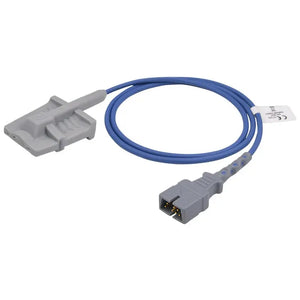
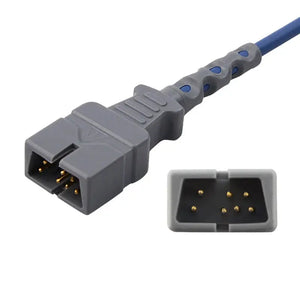
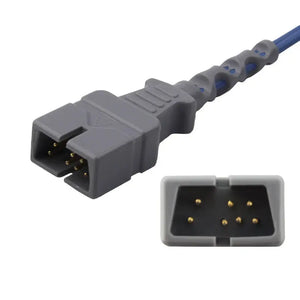
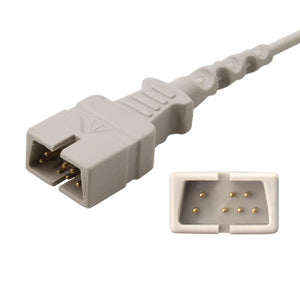
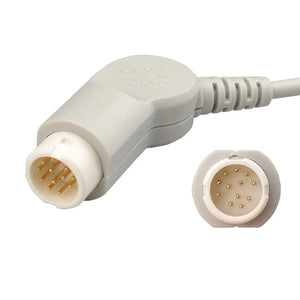
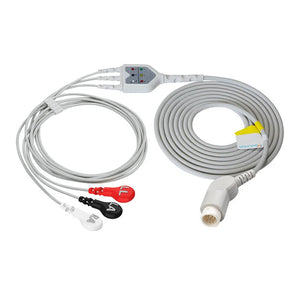
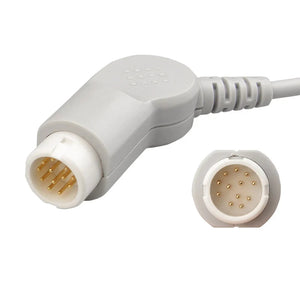
Quick answer: mostly yes — IBP is the most cross-brand-friendly parameter on the monitor, but the interface cable is what makes or breaks it. Invasive blood-pressure transducers are built to a near-universal electrical standard: a Wheatstone bridge with 5 µV/V/mmHg sensitivity and 5 V excitation, defined by ANSI/AAMI BP22. Because almost every monitor brand designed its IBP input around BP22, an Edwards TruWave transducer can drive a Philips, GE, Mindray or Dräger monitor accurately — if you use the correct brand-specific interface cable. The transducer is standardised; the cable connector is not. In our 5.5-week test, every brand reading stayed within ±2 mmHg of reference once the right cable was fitted.
Why IBP is different from SpO2 and ECG
In our SpO2 Adapter Lab studies, the failure mode was always algorithmic — a foreign sensor confusing a brand-specific oximetry algorithm. IBP does not have that problem. An invasive pressure transducer is a passive resistive bridge. It contains no LED, no photodiode, no algorithm signature and no proprietary ID.

ANSI/AAMI BP22 fixes the two numbers that matter: sensitivity at 5 µV per volt of excitation per mmHg of pressure, and excitation nominally at 5 V. Because Philips, GE, Mindray, Dräger, Nihon Kohden and others all designed their IBP front ends to BP22, the monitor and transducer already "agree" on the physics. There is no algorithm to mismatch. What does not agree across brands is the connector on the monitor's IBP module and the pinout of the interface cable that joins transducer to monitor. The real cross-brand question for IBP is therefore not "will the transducer work" — it is "do I have the right interface cable, and is it wired correctly." The engineering detail is in the BMET reference on IBP cable pinout & signal specifications.
Test setup
| Equipment | Specification |
|---|---|
| Reference monitors | Philips IntelliVue MX800; GE CARESCAPE B650; Mindray BeneVision N17; Dräger Infinity Delta (each with native IBP module) |
| Pressure reference | Calibrated deadweight / pressure-column rig + Fluke ProSim 8 IBP channel (calibrated Dec 2025) |
| Transducers tested | Edwards TruWave disposable (single and dual), Edwards TruWave PX-series; BD/Becton DPT-series (cross-check) |
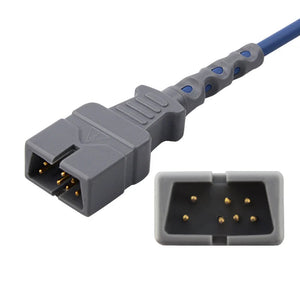
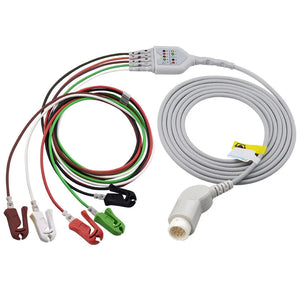
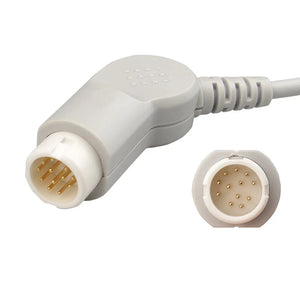
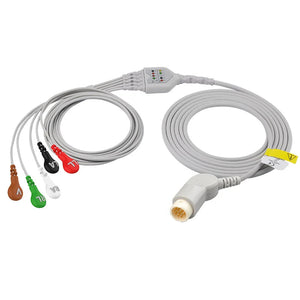
| Interface cables | MedLinket brand-specific IBP cables — Edwards-style transducer end to Philips / GE / Mindray / Dräger monitor connector |
| Test conditions | Static accuracy at 0 / 50 / 100 / 200 / 300 mmHg; zero-drift over 4 hours; dynamic step response |
| Pass criterion | Static error ≤ ±2 mmHg or ±2% (whichever greater); zero drift ≤ 1 mmHg over 4 hours |
| Marginal | Error 2–4 mmHg or zero drift 1–2 mmHg over 4 hours |
| Fail | Error > 4 mmHg, drift > 2 mmHg, unstable waveform, or "transducer not detected" |
Results: Edwards TruWave + correct interface cable → each brand monitor
| Monitor brand | Static accuracy (0–300 mmHg) | 4-hour zero drift | Step response | Overall |
|---|---|---|---|---|
| Philips IntelliVue MX800 | Pass — max error 1.3 mmHg | Pass — 0.6 mmHg | Pass | Clinically usable |
| GE CARESCAPE B650 | Pass — max error 1.5 mmHg | Pass — 0.7 mmHg | Pass | Clinically usable |
| Mindray BeneVision N17 | Pass — max error 1.4 mmHg | Pass — 0.5 mmHg | Pass | Clinically usable |
| Dräger Infinity Delta | Pass — max error 1.7 mmHg | Pass — 0.9 mmHg | Pass | Clinically usable |
With the correct brand interface cable, the Edwards TruWave reads accurately on all four brands. Maximum static error stayed under 2 mmHg everywhere; 4-hour zero drift stayed under 1 mmHg. This is the expected outcome when the physics is standardised: the monitor applies its zero and BP22-based scaling, and the transducer delivers the linear bridge voltage the standard specifies. IBP genuinely is cross-brand compatible at the transducer level.

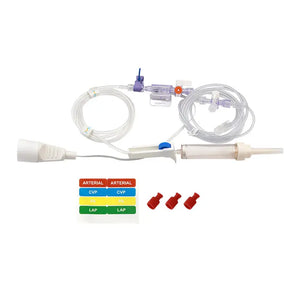
The matching cable for each monitor is the only brand-specific part. A standard Edwards-connector disposable transducer ($12.80, single channel, sterile) pairs with: Philips Edwards interface cable (896083021, $40), GE dual-Edwards cable (2021197-003, $48), Mindray Edwards cable (0010-21-12179, $40), Dräger Edwards cable (MS22147) and Nihon Kohden Edwards cable (JP-902P).
Results: what happens with the wrong interface cable
| Wrong-cable scenario | What happened | Why |
|---|---|---|
| Connector physically forced into a non-matching port | "Transducer not detected" / no waveform | Pinout does not align; excitation and signal lines not on the monitor's expected pins |
| Cable with mismatched excitation / sense wiring | Waveform present but scaled wrong; static error 8–20 mmHg | Monitor excitation reaches the bridge but the signal return is on the wrong pin pair; monitor scales an out-of-spec voltage |
| Cable missing the transducer-detect line | Monitor intermittently drops the IBP channel | Some monitors require a detect line to keep the channel active |
| "Universal" cable with unknown internal wiring | Unpredictable — sometimes accurate, sometimes 5–15 mmHg off | Internal wiring not verified against the target monitor's pinout |

Four things that still matter even when IBP "just works"
1. Excitation voltage is not identical across all monitors
BP22 fixes sensitivity at 5 µV/V/mmHg but monitors do not all use exactly 5 V excitation. A monitor using a different excitation voltage scales its input accordingly — which is fine as long as the transducer's sensitivity is the BP22-standard 5 µV/V/mmHg. A transducer that is not actually 5 µV/V/mmHg will read wrong on every monitor. Confirm the transducer's sensitivity specification.
2. Zeroing is still mandatory and monitor-specific
Cross-brand compatibility does not remove the need to zero the transducer to atmosphere at the phlebostatic axis. Each monitor has its own zero procedure and zero-drift behaviour. A transducer that passes static accuracy can still give a wrong number if it was zeroed at the wrong height or not re-zeroed after a position change.
3. Single vs dual transducer cables
Edwards TruWave ships in single and multi-channel configurations. The interface cable must match the channel count and the monitor's multi-channel IBP wiring. A dual transducer on a single-channel cable will only populate one pressure label.
4. Disposable transducer hygiene and single-patient use
TruWave disposable transducers are single-patient devices. Cross-brand electrical compatibility says nothing about reprocessing — a disposable transducer is still disposable regardless of which monitor it connected to.
Study limitations
- All testing used a calibrated pressure rig and ProSim 8 IBP channel, not in-vivo arterial pressure.
- One model per brand tested; other models in each family share the IBP standard but were not individually verified.
- Pulmonary artery and specialised catheter setups were not characterised.
- 5.5 weeks of bench use is not 6 months of clinical flexing.
The full data set is available on request — email biomed@med-linket-corp.com.
What this means for procurement and BMET
- IBP transducer standardisation is a real opportunity. A hospital can standardise on one disposable transducer family (for example, Edwards TruWave) across a mixed Philips / GE / Mindray / Dräger fleet — provided the BMET department stocks the correct brand-specific interface cable for each monitor type. Disposable transducers are in the IBP disposable transducers collection.
- Budget the cables, not just the transducers. The recurring procurement error is buying transducers in bulk and treating the interface cable as an afterthought. The cable is the brand-specific, failure-prone, reusable component. Inventory and label cables by monitor brand; replace cables on a wear schedule. Browse IBP cables and IBP adapter cables.
- Verify "universal" cable claims. Ask which monitor pinouts the cable is verified against and request the pinout map. A cable verified against your specific monitors is safe; a cable of unknown internal wiring is a 5–20 mmHg error waiting to happen.
One Edwards transducer family drives a mixed fleet — pair it with the verified interface cable for each brand

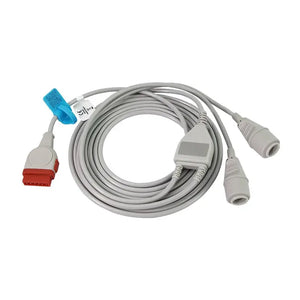
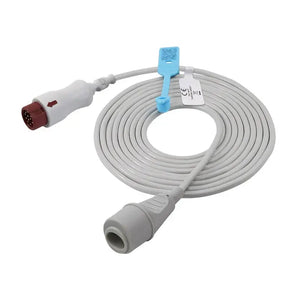
Three brand-specific cables ≈ $128 — equips Philips, GE and Mindray monitors to share one Edwards transducer family. Dräger (MS22147) and Nihon Kohden (JP-902P) Edwards cables are also available.
- Match channel count. Order single / dual / triple interface cables to match both your transducer configuration and the monitor's multi-pressure capability.

Frequently asked questions
Can I use an Edwards TruWave transducer on a different brand of monitor?
Yes, in most cases — IBP is the most cross-brand-friendly parameter on the monitor. Invasive pressure transducers follow ANSI/AAMI BP22 (5 µV/V/mmHg sensitivity, nominally 5 V excitation), so an Edwards TruWave reads accurately on Philips, GE, Mindray and Dräger monitors — within ±2 mmHg in our testing — provided you use the correct brand-specific interface cable. The transducer is standardised; the cable connector and pinout are not.
Why does IBP work across brands when SpO2 often does not?
Because an IBP transducer is a passive resistive (Wheatstone) bridge with no LED, no photodiode, no algorithm signature and no proprietary ID. BP22 fixes the physics, so the monitor and transducer already agree on how voltage maps to pressure. SpO2 failures are algorithmic — a foreign sensor confusing a brand-specific oximetry algorithm — but IBP has no algorithm to mismatch. The only brand-specific element is the interface cable.
What goes wrong if I use the wrong IBP interface cable?
Several failure modes: a non-matching connector gives "transducer not detected" or no waveform (pinout misaligned); a cable with mismatched excitation/sense wiring shows a waveform but scaled wrong by 8–20 mmHg; a cable missing the transducer-detect line makes the monitor intermittently drop the channel; and a "universal" cable of unknown internal wiring reads unpredictably, sometimes 5–15 mmHg off. The cable must be verified end-to-end against the specific monitor's pinout. For example, an Edwards-connector transducer pairs with the brand-matched cable — Philips 896083021 ($40), GE 2021197-003 ($48) or Mindray 0010-21-12179 ($40).
Do I still need to zero the transducer if it is cross-brand compatible?
Yes. Cross-brand compatibility does not remove the need to zero the transducer to atmosphere at the phlebostatic axis. Each monitor has its own zero procedure and zero-drift behaviour, and a transducer that passes static accuracy can still read wrong if it was zeroed at the wrong height or not re-zeroed after a position change.
About MedLinket. Founded 2004 in Shenzhen. NEEQ-listed (stock code 833505). Over 20 years specialising in patient-monitoring accessories. FDA 510(k), CE, MHRA, MDSAP, ISO 13485:2016 (TÜV) certified. Class 100,000 cleanroom. Serving 2,000+ hospitals across 117 countries and regions. Product liability insurance carried with cover up to USD 5 million; hospital customers may request a certificate of insurance within the policy period. "Edwards," "TruWave," "Philips," "IntelliVue," "GE," "CARESCAPE," "Mindray," "BeneVision," "Dräger," "Infinity," "BD" and related names are trademarks of their respective owners, used solely to indicate cross-reference compatibility under the U.S. Magnuson-Moss Warranty Act. MedLinket is not affiliated with, endorsed by, or licensed by any of these companies.