Quick answer: it depends entirely on which SpO2 module your BeneVision has. Mindray BeneVision N-series monitors are offered with a Mindray SpO2 module, a Masimo SET module, or a Nellcor OxiMax module. On a BeneVision with the Nellcor OxiMax module, a Nellcor sensor is a native match and works as designed. On a BeneVision with the Mindray or Masimo module, a Nellcor sensor through an adapter is a cross-algorithm configuration — acceptable at normal perfusion, unreliable below PI 0.3. In our 6-week test, the deciding variable was never the sensor; it was always the module.
Why this question trips up BMET departments
BeneVision is one of the most module-flexible monitor platforms on the market. Two N17 monitors sitting side by side in the same ICU can have different SpO2 oximetry inside because they were ordered in different configurations or different years.

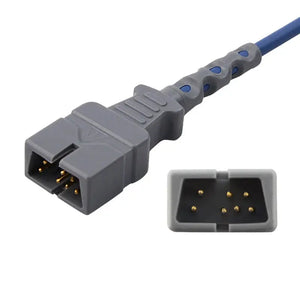
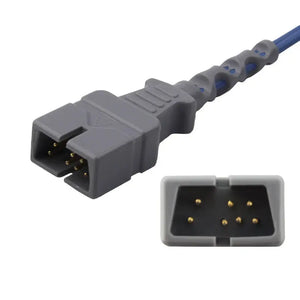
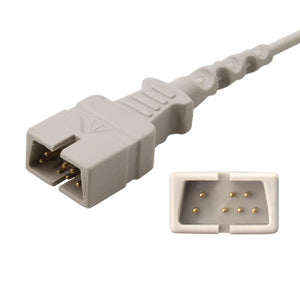
"Can I use Nellcor sensors on BeneVision?" is genuinely three separate questions: physical (does the connector fit — no; an adapter is required), electrical (does the adapter carry the right signals — yes, a correctly built adapter does), and algorithmic (does the installed SpO2 module correctly interpret a Nellcor sensor's signal — only if that module is the Nellcor OxiMax module).

A connector adapter solves the first two; it cannot solve the third. The signal-layer detail is in the BMET reference on SpO2 connector pinout reference.
Test setup
| Equipment | Specification |
|---|---|
| Reference monitor 1 | Mindray BeneVision N17 with Mindray SpO2 module |
| Reference monitor 2 | Mindray BeneVision N15 with Nellcor OxiMax module |
| Reference monitor 3 | Mindray BeneVision N12 with Masimo SET module |
| Algorithm reference | Nellcor N-595 standalone (OxiMax algorithm reference) |
| Simulator | Fluke ProSim 8 (calibrated Dec 2025) |
| Sensors tested | Nellcor MAX-A, MAX-N, MAX-I, MAX-P, DS-100A, OxiMax DB9 reusable |
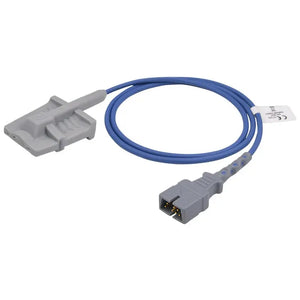
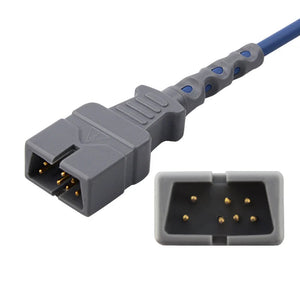
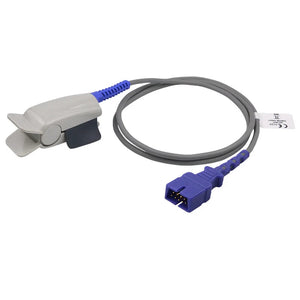
| Adapter (Mindray / Masimo module units) | S0031MU-M (Nellcor DB9 → Mindray SpO2, 0.65 m) |
| Conditions | 30 samples × 4 perfusion levels (PI = 2.5 / 1.0 / 0.3 / 0.05) |
| Pass criterion | ARMS ≤ 3.0%; Marginal 3.0–4.0%; Fail > 4.0% or sustained dropout |
Results: Nellcor sensor + adapter → BeneVision with Nellcor OxiMax module
The native-algorithm case. The adapter bridges the connector; the algorithm is the one the sensor was designed for.
| Sensor | PI 2.5 | PI 1.0 | PI 0.3 | PI 0.05 | Overall |
|---|---|---|---|---|---|
| MAX-A (adult adhesive) | Pass 1.9% | Pass 2.1% | Pass 2.6% | Marginal 3.3% | Clinically usable |
| MAX-N (neonate / adult wrap) | Pass 2.0% | Pass 2.3% | Pass 2.8% | Marginal 3.6% | Clinically usable |
| MAX-I (infant) | Pass 2.1% | Pass 2.4% | Marginal 3.0% | Marginal 3.8% | Usable; confirm at very low PI |
| MAX-P (pediatric adhesive) | Pass 2.2% | Pass 2.5% | Pass 2.7% | Marginal 3.5% | Clinically usable |
| DS-100A (reusable adult clip) | Pass 1.8% | Pass 2.2% | Pass 2.5% | Marginal 3.4% | Clinically usable |
| OxiMax DB9 reusable | Pass 2.0% | Pass 2.3% | Pass 2.6% | Marginal 3.5% | Clinically usable |
When the BeneVision has the Nellcor OxiMax module, the only degradation is the normal low-signal marginal behaviour at PI = 0.05 that OxiMax shows on a native Nellcor monitor too.

No algorithm-mismatch failure mode because the algorithm matches the sensor.
Results: Nellcor sensor + adapter → BeneVision with Mindray SpO2 module
| Sensor | PI 2.5 | PI 1.0 | PI 0.3 | PI 0.05 | Overall |
|---|---|---|---|---|---|
| MAX-A | Pass 2.5% | Marginal 3.2% | Marginal 3.9% | Fail (no reading) | Marginal — avoid critical care |
| MAX-N | Pass 2.6% | Marginal 3.4% | Fail 4.3% | Fail | Not recommended |
| MAX-P | Pass 2.7% | Marginal 3.5% | Fail 4.6% | Fail | Not recommended |
| DS-100A | Pass 2.4% | Marginal 3.3% | Marginal 4.0% | Fail | Marginal — avoid critical care |
The Mindray SpO2 module computes its ratio-of-ratios assuming Mindray's own sensor LED wavelengths. A Nellcor MAX sensor emits at approximately 890 nm IR; the Mindray module's calibration curve does not expect that emission.

At normal perfusion the error stays inside ±3% — the numbers look fine. As perfusion drops, the calibration mismatch diverges from reality, and below PI 0.3 readings are unreliable.
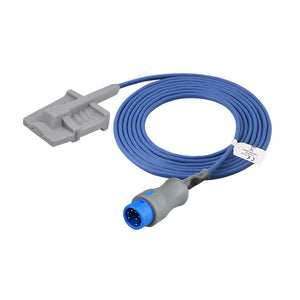
Results: Nellcor sensor + adapter → BeneVision with Masimo SET module
| Sensor | PI 2.5 | PI 1.0 | PI 0.3 | PI 0.05 | Overall |
|---|---|---|---|---|---|
| MAX-A | Pass 2.7% | Marginal 3.5% | Fail 4.8% | Fail | Not recommended |
| DS-100A | Pass 2.6% | Marginal 3.6% | Fail 4.9% | Fail | Not recommended |
A Masimo SET module is built around Masimo's own sensors and signal-processing model. Feeding it a Nellcor sensor's signal is a double mismatch — wrong LED wavelength assumptions and a signal-extraction algorithm tuned for a different sensor's noise characteristics. This produces the worst results of the three module types at low perfusion.
The pattern across all three modules
| BeneVision module | Nellcor sensor result | Why |
|---|---|---|
| Nellcor OxiMax | Clinically usable across perfusion range | Native algorithm — sensor and algorithm match |
| Mindray SpO2 | Usable at normal PI; unreliable below PI 0.3 | Cross-algorithm — Mindray calibration applied to Nellcor emission |
| Masimo SET | Usable at normal PI only; worst at low PI | Double mismatch — Masimo algorithm and Masimo-tuned extraction |
The sensor never changed. The module decided the outcome every time.

This is the single most important takeaway for any BeneVision fleet, and it mirrors what we found testing Nellcor sensors on Philips IntelliVue and Masimo LNCS on GE CARESCAPE.
How to identify your BeneVision's SpO2 module
- SpO2 numeric label on screen: a Masimo SET unit typically shows a "Masimo SET" mark; a Nellcor-module unit shows a "Nellcor" or "OxiMax" indicator; a Mindray-module unit shows neither third-party mark.

- Service / configuration menu: the installed SpO2 module is named explicitly — the definitive check.
- Module label and patient cable: the plug-in SpO2 module and matching patient cable carry the technology name.
Study limitations
- All testing used the Fluke ProSim 8 simulator; no hypoperfused patients.
- Tested N12, N15 and N17 only — N1, N19 and N22 share the platform but were not individually verified.
- Sensors came from 3 production lots; lot-to-lot variation could differ.
- 6 weeks is not 6 months; adapter contact resistance can drift.
The full data set is available on request — email biomed@med-linket-corp.com.
What this means for procurement and BMET
- BeneVision with Nellcor OxiMax module: Nellcor sensors are a native match. Adult clip: DS-100A compatible sensor ($48); adhesive family: MAX-A (adult), MAX-P (pediatric), MAX-I (infant), MAX-N (neonate / adult). Browse the full Nellcor SpO2 sensor range.
- BeneVision with Mindray or Masimo module: do not run Nellcor sensors through an adapter for ICU / OR / NICU. Stock the sensor type matching the module — Mindray SpO2 sensors or Masimo sensors respectively.
- Mixed fleet: inventory the SpO2 module per unit, label each monitor, and stock the matching sensor for each. The multi-brand compatibility matrix is a useful planning aid.
- If a vendor says their Nellcor sensors "work on Mindray": ask which BeneVision module they tested. The claim is true on OxiMax-module units and misleading on the others. Background: understanding SpO2 sensors — Masimo, Nellcor & neonatal options.
Frequently asked questions
Can I use Nellcor sensors on a Mindray BeneVision monitor?
It depends entirely on which SpO2 module your BeneVision has. On a unit with the Nellcor OxiMax module, a Nellcor sensor is a native match and works as designed across the perfusion range. On a unit with the Mindray SpO2 or Masimo SET module, a Nellcor sensor through an adapter is a cross-algorithm configuration — acceptable at normal perfusion but unreliable below PI 0.3. The module, not the sensor, decides the outcome.
How do I find out which SpO2 module my BeneVision has?
Three checks: the on-screen SpO2 label (a Masimo SET or Nellcor/OxiMax mark; a Mindray module shows neither third-party mark), the service / configuration menu (which names the installed module — the definitive check), and the plug-in SpO2 module plus patient cable label. Because BeneVision modules are field-swappable, re-verify after any service event that touched the SpO2 parameter.
Why does the same Nellcor sensor read fine at normal perfusion but fail at low perfusion on the wrong module?
At normal perfusion the calibration mismatch stays inside about ±3% and the number looks fine. As perfusion drops, a Mindray or Masimo module's ratio-of-ratios calibration — tuned for its own sensors' LED wavelengths and noise characteristics — diverges from the roughly 890 nm emission of a Nellcor MAX sensor, so below PI 0.3 the readings become unreliable. A Masimo SET module is the worst case because it is a double mismatch (wrong wavelength assumptions and a signal-extraction model tuned for a different sensor).
Does a connector adapter make Nellcor sensors fully compatible with any BeneVision?
No. An adapter solves the physical layer (connector fit) and the electrical layer (routing the right signals), but it cannot change which algorithm the installed SpO2 module runs. Only the Nellcor OxiMax module interprets a Nellcor sensor's signal natively; on a Mindray or Masimo module the adapter delivers a clean signal to the wrong algorithm, which an adapter cannot fix.
About MedLinket. Founded 2004 in Shenzhen. NEEQ-listed (stock code 833505). Over 20 years specialising in patient-monitoring accessories. FDA 510(k), CE, MHRA, MDSAP, ISO 13485:2016 (TÜV) certified. Class 100,000 cleanroom. Serving 2,000+ hospitals across 117 countries and regions. Product liability insurance carried with cover up to USD 5 million; hospital customers may request a certificate of insurance within the policy period. "Mindray," "BeneVision," "Nellcor," "OxiMax," "Masimo" and related model names are trademarks of their respective owners, used solely to indicate cross-reference compatibility under the U.S. Magnuson-Moss Warranty Act.