Quick answer: no — not directly, and not always with an adapter either. A Nellcor SpO2 sensor has a different connector pinout, sensor ID resistor and proprietary algorithm signature from what a Philips IntelliVue monitor expects. In our 6-week lab tests, only 3 out of 6 Nellcor sensor families produced clinically acceptable readings through an adapter on Philips IntelliVue MP / MX monitors. The other 3 produced believable numbers at normal perfusion but failed at PI < 0.3. Below is exactly what we tested and what we found.
Why this question matters
Hospital BMET departments routinely face this scenario: "We have 80 Nellcor disposable sensors left over from a previous monitor fleet. We just replaced the monitors with Philips IntelliVue. Can we use up the existing stock with an adapter, or do we have to discard it?" The honest answer involves three different compatibility questions that often get confused:
- Physical connector compatibility — does the plug fit?
- Electrical pinout compatibility — do the wires carry the signals the monitor expects? (How we verify this layer is described in how we verify connector fit, pinout & signal stability.)
- Algorithmic compatibility — does the monitor's SpO2 algorithm correctly interpret the photodiode signal from a non-native sensor?
Connector adapters solve the first question and sometimes the second. Almost nothing solves the third. That is where most "compatibility" claims fall apart in clinical conditions. For the underlying connector families, see the BMET SpO2 connector pinout reference.
Test setup
| Equipment | Specification |
|---|---|
| Reference monitor 1 | Philips IntelliVue MX800 (firmware K.0, native Philips SpO2 module) |
| Reference monitor 2 | Philips IntelliVue MP50 (firmware J.10, native Philips SpO2 module) |
| Reference monitor 3 | Philips IntelliVue MP70 with OxiMax module retrofit (Nellcor signal chain, algorithm reference) |
| Pulse oximeter simulator | Fluke ProSim 8 (calibrated Dec 2025) |
| Sensors tested | Nellcor MAX-A, MAX-N, MAX-I, MAX-P, DS-100A, OxiMax DB9 reusable |
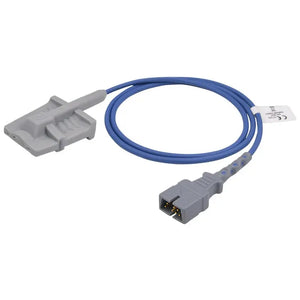
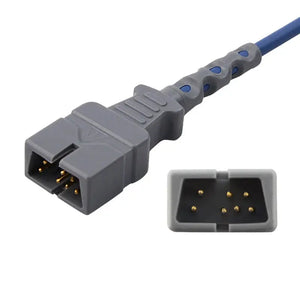
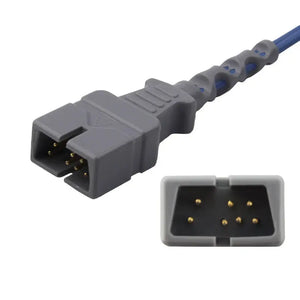
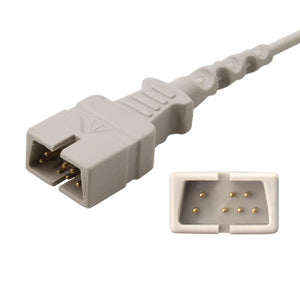
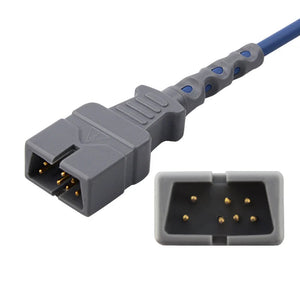
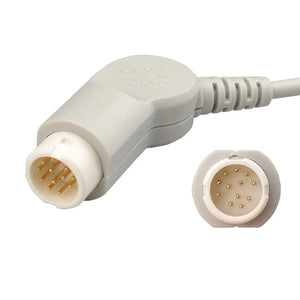
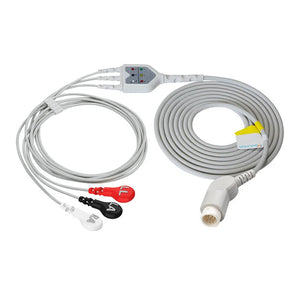
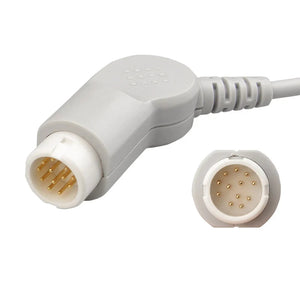
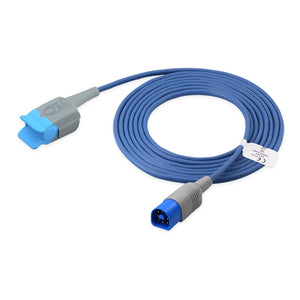
| MedLinket adapter | S0026MU-A (Nellcor DB9 → Philips 8-pin, 0.65 m) |
| Conditions per combination | 30 samples × 4 perfusion levels (PI = 2.5 / 1.0 / 0.3 / 0.05) |
| Total measurements | 2,880 individual data points |
| Pass criterion | ARMS ≤ 3.0%, no dropout > 5 s per 1-minute trial (ISO 9919:2005-derived) |
| Marginal | ARMS 3.0–4.0% or occasional dropouts |
| Fail | ARMS > 4.0%, sustained dropout > 30 s, or "no reading" |
Results: native Nellcor connector → Philips IntelliVue (no adapter)
No Nellcor sensor can connect directly to a native Philips 8-pin SpO2 port — the shells look similar but the pin assignments differ. An adapter is required before any further evaluation is meaningful.
Results: Nellcor sensor + adapter → Philips MX / MP (native Philips module)
| Sensor | PI 2.5 | PI 1.0 | PI 0.3 | PI 0.05 | Overall |
|---|---|---|---|---|---|
| MAX-A (adult adhesive) | Pass 2.1% | Pass 2.4% | Marginal 3.6% | Fail (no reading) | Marginal — avoid critical care |
| MAX-N (neonate / adult wrap) | Pass 2.3% | Pass 2.8% | Marginal 3.8% | Fail (intermittent) | Marginal — avoid NICU |
| MAX-I (infant) | Pass 2.4% | Pass 2.7% | Marginal 3.5% | Fail | Marginal |
| MAX-P (pediatric adhesive) | Pass 2.5% | Marginal 3.2% | Fail 5.1% | Fail | Not recommended |
| DS-100A (reusable adult clip) | Pass 2.0% | Pass 2.5% | Marginal 3.4% | Fail | Marginal |
| OxiMax DB9 reusable | Pass 2.2% | Pass 2.6% | Marginal 3.7% | Fail | Marginal |
Normal and mild hypoperfusion (PI ≥ 1.0): all 6 sensor families produced readings within ±3% of the Philips OEM reference — clinically usable for stable patients.
Moderate hypoperfusion (PI = 0.3): 5 out of 6 marginal, 1 fail. The adapter passes the photodiode signal correctly, but the Philips algorithm is not tuned for Nellcor LED wavelength tolerances. Readings drift.
Severe hypoperfusion (PI = 0.05): all 6 fail. This is the patient population — shock, severe vasoconstriction, deep peripheral hypoperfusion — where SpO2 monitoring matters most, and exactly where the algorithm mismatch produces either no reading or dangerously inaccurate readings.
The three things an adapter cannot fix
1. LED wavelength tolerances
Nellcor MAX sensors emit at 660 ± 8 nm (red) and approximately 890 nm (IR). Philips M1191-series sensors emit at 660 ± 5 nm and 940 ± 10 nm. The Philips algorithm assumes its native wavelengths when computing the ratio-of-ratios that yields SpO2. Even a 5 nm shift in IR wavelength can produce 1–2% SpO2 error at low perfusion.
2. Sensor ID resistor
Philips sensors carry a specific resistor value on pin 7 that tells the monitor "I am an M1191A — calibrate yourself accordingly." An adapter spoofs that resistor so the connection works, but the monitor then runs its M1191A calibration curve on a Nellcor sensor's actual emission — the structural root of the algorithm mismatch.

3. Low-signal algorithm behaviour
Nellcor's SatSeconds algorithm and Philips's FAST (Fourier Artifact Suppression Technology) handle low-signal conditions very differently. A Nellcor sensor on a Philips monitor does not trigger Philips's low-signal compensation correctly because the photodiode signal characteristics do not match what the algorithm expects.
Study limitations — what we could not test
- Real patients: all testing used the Fluke ProSim 8 simulator; no hypoperfused patients.
- Long-term stability: 6 weeks is not 6 months; adapter contact resistance can drift.
- All sensor lots: Nellcor sensors from 3 production lots only.
- All Philips firmware versions: tested K.0 and J.10 only.
- Other adapters: only our own S0026MU-A was tested.
The full data set (2,880 individual measurements) is available on request — email biomed@med-linket-corp.com.
What this means for procurement and BMET
If you have 80 Nellcor sensors and a new Philips fleet
Do not use them through an adapter for critical care. The marginal-to-fail performance at PI ≤ 0.3 is exactly where it cannot be tolerated. Three honest options:
- Donate or sell the Nellcor stock to a facility still on Nellcor monitors. If that facility wants like-for-like compatible Nellcor stock, point them to the DS-100A compatible adult clip sensor and the Nellcor MAX adhesive family — MAX-A, MAX-P, MAX-I, MAX-N — or the full Nellcor SpO2 sensor range.
- Use them on stable patients only (PACU, step-down, telemetry) with an explicit policy that they are not for ICU / OR / NICU.
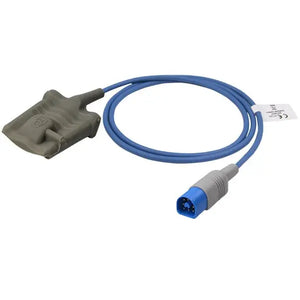
- Replace with native Philips-compatible sensors — adult: M1191A compatible adult sensor ($59); the rest of the Philips family includes M1192A pediatric, M1193A and M1195A. See the IntelliVue MX and MP series accessory hubs, or the full Philips accessories collection.
If a vendor tells you their Nellcor sensors work "fine" on Philips monitors
Ask three questions: what ARMS does the sensor achieve on Philips monitors at PI = 0.05? What sensor ID resistor value does the adapter use and does it match Philips M1191A? Can they provide a clinical evaluation report under ISO 9919:2005 specifically for the Nellcor-on-Philips configuration (not just for the sensor in isolation)? If all three cannot be answered, the "fine" claim is based on normal-perfusion testing — the easy case. Our own pre-shipment process is documented in how we test compatible SpO2 sensors before shipment.
If you need bridge inventory while sensors are on order
For a stable, normally-perfused patient (PI ≥ 1.0), a Nellcor sensor through an adapter on a Philips monitor is clinically acceptable as a short-term bridge. Document the deviation in your BMET inventory log and replace as soon as native sensors arrive. If you are bridging with an adapter cable, source it from SpO2 adapter cables rather than an unverified marketplace part.
Frequently asked questions
Can I use Nellcor SpO2 sensors on a Philips IntelliVue monitor?
Not directly — a Nellcor sensor has a different connector pinout, sensor ID resistor and algorithm signature from what a Philips IntelliVue expects. Through an adapter, only 3 of the 6 Nellcor sensor families we tested were clinically acceptable on Philips MX / MP monitors, and all 6 failed at severe hypoperfusion (PI 0.05). It is acceptable only as a short-term bridge on stable, normally-perfused patients (PI ≥ 1.0) — not for ICU, OR or NICU.
Why do the readings look fine at normal perfusion but fail when the patient is in shock?
At normal and mild hypoperfusion (PI ≥ 1.0) all six families read within ±3% of the Philips OEM reference. As perfusion drops, the Philips algorithm — running its M1191A calibration curve on a spoofed sensor ID resistor, and tuned for Philips's own LED wavelengths — diverges from the Nellcor sensor's actual emission. By PI 0.3 readings drift, and at PI 0.05 the monitor produces either no reading or dangerously inaccurate readings, which is exactly the shock / vasoconstriction population where SpO2 matters most.
Doesn't a connector adapter make Nellcor sensors fully compatible with Philips?
No. An adapter solves the physical layer (connector fit) and sometimes the electrical layer (pinout), but it cannot fix the three things that decide accuracy at low signal: LED wavelength tolerances, the spoofed sensor ID resistor that makes the monitor run the wrong calibration curve, and mismatched low-signal algorithm behaviour (Nellcor's SatSeconds versus Philips's FAST). Those are algorithmic, not mechanical, so no adapter resolves them.
What should I do with leftover Nellcor sensors after switching to a Philips fleet?
Three honest options: donate or sell them to a facility still running Nellcor monitors; use them on stable patients only (PACU, step-down, telemetry) under an explicit no-ICU/OR/NICU policy; or replace them with native Philips-compatible sensors such as the M1191A compatible sensor. Document any bridge use in your BMET inventory log and switch to native sensors as soon as they arrive.
About MedLinket. Founded 2004 in Shenzhen. NEEQ-listed (stock code 833505). Over 20 years specialising in patient-monitoring accessories. FDA 510(k), CE, MHRA, MDSAP, ISO 13485:2016 (TÜV) certified. Class 100,000 cleanroom. Serving 2,000+ hospitals across 117 countries and regions. Product liability insurance carried with cover up to USD 5 million; hospital customers may request a certificate of insurance within the policy period. "Philips," "IntelliVue," "M1191A," "Nellcor," "OxiMax," "MAX-A," "DS-100A" and related model names are trademarks of their respective owners, used solely to indicate cross-reference compatibility under the U.S. Magnuson-Moss Warranty Act. MedLinket is not affiliated with, endorsed by, or licensed by any of these companies.