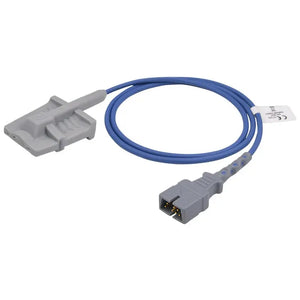
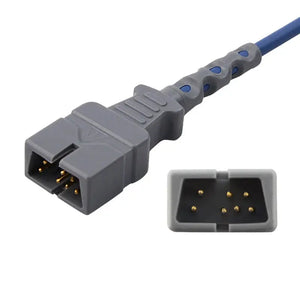
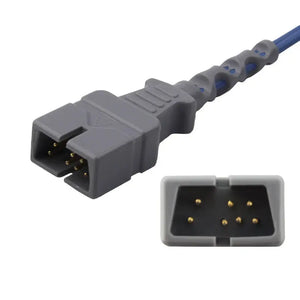
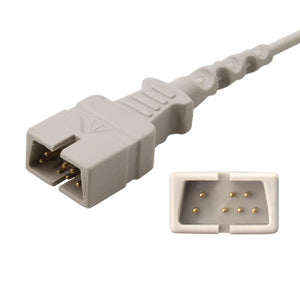
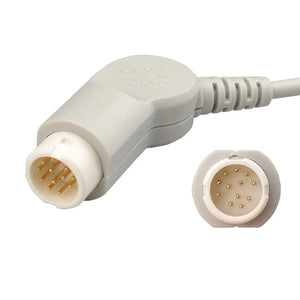
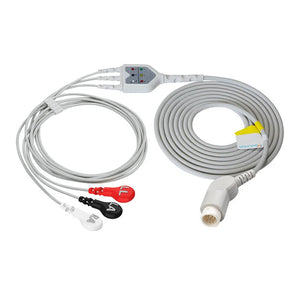
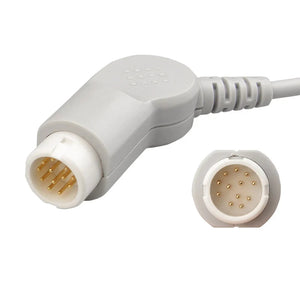
Quick answer. M1191A–M1195A are not connector types — they are Philips OEM part numbers that mix patient type (adult / pediatric / neonate) with cable length. What actually decides fit is the connector generation: 7-pin OxiSmart, 8-pin Philips, or 9-pin (OxiMax or Masimo). Identify the connector generation first, then the patient type. The decision tree and the full OEM-number map are below.
Why people search "M1191A vs M1192A" — and what they actually need
In twelve months of customer-service log review at MedLinket's Adapter Lab, the most common reasons people search this phrase are:
- A BMET has a damaged sensor in hand with the label faded. The connector cable says "M1191A" but the website returns dozens of "M1191A-compatible" products. Which one matches?
- A procurement officer received a quote listing "M1193A" for a hospital using an IntelliVue MX700, and is not sure that is correct.
- A clinical engineer is consolidating multi-vendor sensor inventory and wants to know if M1191A and M1194A are interchangeable.
All of these people are asking the right question for the wrong reason. "M1191A vs M1192A" is a symptom — the underlying question is "which connector generation, and which patient type does that connector serve?" Philips OEM part numbers have shifted across multiple platform generations. Connector generation is stable. The companion piece what "compatible" actually means covers why this distinction matters for procurement.
Why the M119xA numbers are confusing
Philips' part numbers evolved over more than 20 years across CMS, MP and MX platforms and several connector standards. As a result, the same "M1191A" code appears in different catalogue contexts referring to different cable and connector configurations. Several conclusions that procurement teams often miss:
- "M1191A" is not "the Philips adult sensor" — it has appeared in at least three connector and cable configurations. When someone says "we need M1191A," the right next question is "what connector pin count and what cable length?"
- M1192A and M1195A both refer to pediatric sensors in different catalogue contexts. They are not always interchangeable.
- The "A" suffix does not mean adult. M1191A is adult; M1193A is neonate. The "A" is simply Philips' part-number suffix.
- The numbers do not follow a clean patient-age progression: M1191A (adult) → M1192A (pediatric) → M1193A (neonate) → M1194A (adult ear) → M1195A (pediatric / infant short).
The real decision tree — which connector generation do you have
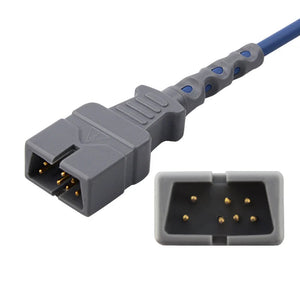
There are three Philips IntelliVue SpO2 connector generations in clinical use today. They are visually similar enough to cause procurement mistakes, and electrically incompatible enough that the wrong sensor produces a "Sensor not recognized" alarm immediately. The pin-by-pin detail is in the BMET SpO2 connector pinout reference.
Generation A — 7-pin OxiSmart (legacy)
Found on Philips IntelliVue MP-series early units (MP20 through MP70, some configurations), Philips CMS series, and certain Philips Anesthesia Workstation derivatives. Round 7-pin connector. Most Philips fleets still running 7-pin OxiSmart are pre-2010 platforms in step-down or transport roles.
Generation B — 8-pin Philips (the dominant generation, 2005–2018)
Found on the majority of IntelliVue MP-series and on MX-series first wave (MX400 through MX700). Round 8-pin connector. If your Philips IntelliVue is from 2008–2020, this is most likely your connector. This generation covers M1191BL, M1192A, M1193A, M1194A, M1196A and M1196S.

Generation C — 9-pin (OxiMax or Masimo, when monitor specified with licensed third-party SpO2)
Found on later MX-series (MX550 through MX850) or on earlier units specified at order time with Nellcor OxiMax or Masimo SET SpO2 boards. A 9-pin connector — the OxiMax variant has the Nellcor pin assignment; the Masimo variant has the LNCS pin assignment with the characteristic purple keyway. These monitors use Nellcor-compatible or Masimo LNCS-compatible sensors respectively — not the Philips 8-pin family. For the Masimo path see the Masimo LNCS / RD / rainbow hub.
OEM number to patient type and cable length — the full map
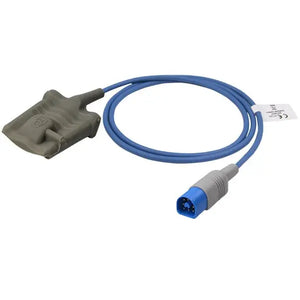
Adult sensors
| Patient | Connector | Cable | Philips OEM | Clinical use | MedLinket compatible |
|---|---|---|---|---|---|
| Adult | 8-pin | 3 m long | M1196A / M1191BL | Standard ICU / OR adult finger clip | M1191BL direct-connect adult sensor |
| Adult | 8-pin | 0.9 m short | M1196S | Short-cable with module-mounted extension | M1191A short-cable adult sensor |
| Adult | 7-pin OxiSmart | 0.9 m short | M1191A (legacy) / M1191T | Legacy 7-pin platforms | 7-pin OxiSmart adult sensor (legacy) |
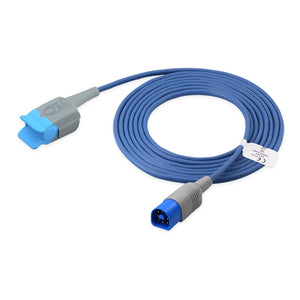
| Adult soft tip | 8-pin | 3 m long | M1191BL | OR with low-perfusion patient, cardiac surgery | M1191BL adult soft-tip sensor |
| Adult ear clip | 8-pin | 3 m long | M1194A | Finger inaccessible — drape, position, cold extremity | M1194A compatible ear clip |
Pediatric sensors
| Patient | Connector | Cable | Philips OEM | Clinical use | MedLinket compatible |
|---|---|---|---|---|---|
| Pediatric (10–40 kg) | 8-pin | 3 m long | M1192A | Pediatric ICU, pediatric ward | M1192A compatible pediatric sensor |
| Pediatric | 8-pin | 0.9 m short | M1195A (8-pin variant) | Pediatric with module-mounted extension | M1195A short-cable pediatric sensor |
| Pediatric | 7-pin OxiSmart | 0.9 m short | M1195A (legacy 7-pin) | Legacy 7-pin pediatric | 7-pin OxiSmart pediatric sensor (legacy) |
| Infant (3–10 kg) soft tip | 8-pin | 0.9 m short | M1195A (8-pin infant variant) | NICU step-down, pediatric ward | Infant silicone soft-tip sensor |
Neonate sensors
| Patient | Connector | Cable | Philips OEM | Clinical use | MedLinket compatible |
|---|---|---|---|---|---|
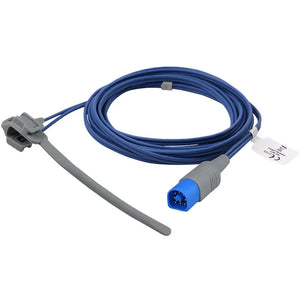
| Neonate (under 3 kg) | 8-pin | 3 m long | M1193A | NICU adhesive silicone wrap, foot / hand site | M1193A compatible neonatal sensor |
| Neonate | 7-pin OxiSmart | 0.9 m short | M1193T | Legacy 7-pin NICU | M1193T neonate soft sensor |
| Neonate, OxiMax | 9-pin | 0.9 m short | OXI-A/N | Philips with Nellcor-licensed SpO2, NICU | DS-100A compatible OxiMax sensor |

Why adapter cables exist — and when they make sense
Many hospitals run mixed-generation Philips fleets. Adapter cables solve the mismatch between sensor inventory and monitor connector generation. A common example: an MP70 from 2009 (8-pin Philips) sitting next to an MX700 from 2017 (also 8-pin most often, but possibly 9-pin if ordered with Masimo). Adapter cables are not technically inferior to direct-connector sensors — they are designed bridges with electrical pin remapping. They add a connection point, and connection points are a mechanical failure mode, so for fixed-bedside high-cycle use a direct-connector sensor is cleaner. For mixed-fleet standardisation where the alternative is duplicating inventory, adapter cables are usually the right answer — browse SpO2 adapter cables.
The five most common procurement mistakes
- Ordering by OEM number without confirming connector. "Send me 50 M1191A-compatible sensors" sounds precise, but M1191A exists in both 7-pin and 8-pin variants. Every PO line for Philips SpO2 must specify the connector pin count and, if 9-pin, the technology (OxiMax or Masimo).
- Assuming MX-series is always 9-pin. Philips IntelliVue MX-series can ship with 8-pin Philips, 9-pin OxiMax, or 9-pin Masimo. The chassis is the same; the SpO2 module determines the connector. An MX400 may have an 8-pin module while an MX700 in the same hospital has a 9-pin Masimo module. Always audit per monitor, not per platform.
- Confusing M1193A (neonate) with M1192A (pediatric). The numbers look almost identical but serve different patient populations. M1192A is the pediatric finger clip; M1193A is the neonate silicone wrap. A pediatric clip will not fit a neonate foot, and a neonate wrap on a pediatric patient will not provide consistent optical contact.
- Ordering a 3 m long-cable sensor when the monitor uses a module-mounted extension. Some Philips configurations use a 0.9 m short sensor plus a fixed 2.4 m extension on the patient module. A 3 m direct sensor creates a 5+ m cable assembly that bunches at the bedside. Check the existing cable layout before ordering.
- Treating Philips OxiMax 9-pin and Masimo LNCS 9-pin as the same connector. The 9-pin shell looks similar, but the pin assignments differ. A Masimo LNCS sensor in a Philips Nellcor port (or vice versa) produces a "Sensor not recognized" alarm. When a port is 9-pin, always identify the technology as well as the shell.
How MedLinket validates Philips-compatible sensors
Every MedLinket Philips-compatible SpO2 sensor design goes through controlled hypoxia validation at Sun Yat-sen Memorial Hospital with healthy volunteers — ISO 9919:2005 / ISO 80601-2-61 protocol, across SaO2 70–100% — before release to production. Adapter Lab bench testing runs 30 sensors per OEM equivalent through 2,880 reference measurements over 6 weeks on a calibrated Philips IntelliVue test host. Pass criteria: SpO2 reading within ±2 SaO2 units of the reference across the full range. Every production unit shipped goes through 100% electrical continuity QC on all connector pins. Validation supports the "compatible" claim — it is not an OEM endorsement, and Philips has not endorsed these products. See how we test compatible SpO2 sensors before shipment for the full methodology.
When to use OEM vs compatible — an honest framing
OEM Philips sensors are the right choice when hospital procurement policy requires OEM-only accessories, when the monitor is under an active Philips warranty that conditions accessories, or when a specific clinical protocol requires OEM validation evidence. Compatible accessories are appropriate when procurement policy permits equivalently-validated third-party accessories, when the monitor is out of OEM warranty, and when procurement cost matters and the OEM premium is not justified by specific clinical evidence. The Magnuson-Moss Warranty Act (15 U.S.C. § 2302(c)) explicitly prevents OEMs from voiding monitor warranties simply because compatible accessories are used — the OEM can only deny coverage for damage caused by a defective third-party accessory, not for the act of using one. The full legal explanation is in the Magnuson-Moss Warranty Act and compatible medical accessories.
Frequently asked questions
Is M1191A the same as M1191BL?
No. M1191A has appeared in both 7-pin and 8-pin variants over the years. M1191BL is specifically the 8-pin adult silicone soft-tip 3 m long-cable sensor. Different connector, different sensor body.
My Philips IntelliVue MX450 has a 9-pin port — which M119x sensor do I order?
None of them — the M119x family is 7-pin and 8-pin. Your MX450 with a 9-pin port was ordered with either Nellcor OxiMax or Masimo SET SpO2. Identify which, then order OxiMax-compatible (DS-100A family) or Masimo LNCS-compatible sensors. See the Philips IntelliVue MX series hub for the full identification steps.
Can I use an M1192A pediatric sensor on an adult patient in an emergency?
The mechanical fit may work on a small adult finger, but the optical path is calibrated for pediatric tissue thickness — signal quality will be degraded and readings less reliable. Use only as a genuine emergency bridge, not as routine practice.
Are 7-pin Philips OxiSmart and 7-pin Dräger OxiSmart the same connector?
Mechanically yes, and electrically very similar — both follow the OxiSmart 7-pin standard that was broadly licensed in the 2000s. A 7-pin OxiSmart-compatible sensor will physically connect to both. MedLinket tests on both platforms before publishing a compatibility claim, but OEM-by-OEM bench testing is the correct verification step before standardising inventory.
How long does a reusable Philips-compatible sensor last?
MedLinket reusable sensors are validated to 200 cleaning cycles per IEC 60601-2-49. In practice, the limiting factor is typically cable damage at the strain relief, not cleaning cycle count. With reasonable handling, expect 12–18 months of bedside service.
About MedLinket. Founded 2004 in Shenzhen. NEEQ-listed (stock code 833505). Over 20 years specialising in patient-monitoring accessories. FDA 510(k), CE, MHRA, MDSAP, ISO 13485:2016 and ISO 9001 certified. Not affiliated with Philips, Covidien / Nellcor or Masimo — compatibility claims are bench-validated, not OEM-endorsed. Product liability insurance is carried across the product line, with cover up to USD 5 million.