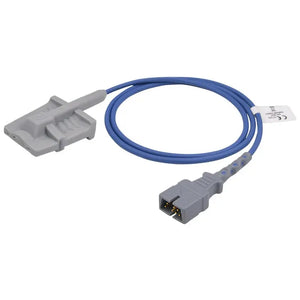
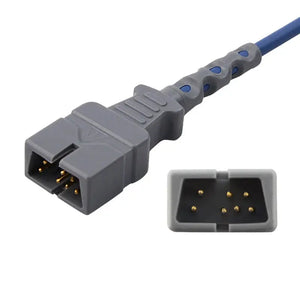
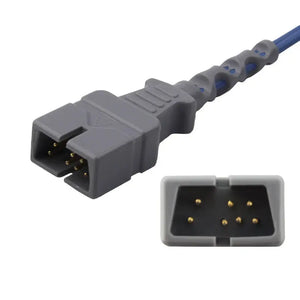
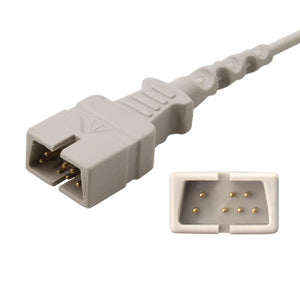
Quick answer: usually yes — but only because GE ships some CARESCAPE monitors with a genuine Masimo SET board inside. When a CARESCAPE B650 has the Masimo SET parameter board, a Masimo LNCS sensor is talking to a Masimo algorithm, not a foreign one. That changes everything — but only if you have confirmed which SpO2 board is actually in your specific unit. On CARESCAPE monitors configured with GE's own TruSignal SpO2, an LNCS sensor through an adapter behaves like every other cross-algorithm mismatch we have documented: fine at normal perfusion, unreliable below PI 0.3.
Why this question is different from the others in the series
In the Nellcor-on-Philips study, the core problem was algorithmic: a foreign sensor confusing a brand-specific oximetry algorithm. That mismatch is unfixable by any adapter. GE CARESCAPE is the exception that proves the rule.
GE does not build its own SpO2 oximetry algorithm for the high end of the CARESCAPE line — it licenses and integrates Masimo SET as an OEM parameter board.

A CARESCAPE B650 with a Masimo board running a Masimo LNCS sensor is not a cross-brand configuration at the algorithm level at all. It is a Masimo sensor on a Masimo algorithm, inside a GE chassis. That single fact changes everything — but only for units that actually have that board.
Test setup
| Equipment | Specification |
|---|---|
| Reference monitor 1 | GE CARESCAPE B650 (firmware 2.x) with Masimo SET SpO2 board |
| Reference monitor 2 | GE CARESCAPE B450 (firmware 2.x) with Masimo SET SpO2 board |
| Reference monitor 3 | GE CARESCAPE B125 with GE TruSignal (OxiMax-based) SpO2 board |
| Algorithm reference | Masimo Radical-7 standalone (Masimo SET reference) |
| Pulse oximeter simulator | Fluke ProSim 8 (calibrated Dec 2025) |
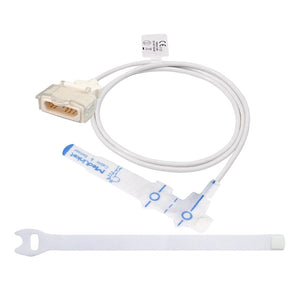
| Sensors tested | Masimo LNCS DCI (reusable adult), LNCS Adtx (adhesive adult), LNCS Pdtx (pediatric), LNCS Neo (neonatal), LNCS DCI-P (pediatric reusable) |
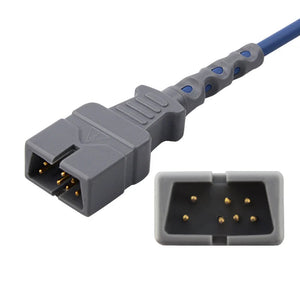
| Native path | LNCS sensor → Masimo SET board (no adapter; CARESCAPE Masimo port accepts the Masimo patient cable directly) |
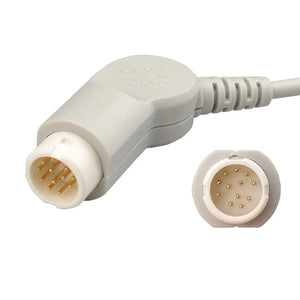
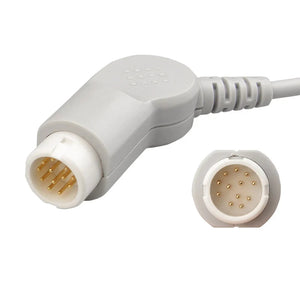
| Adapter used on TruSignal boards | S0029MA-G (Masimo LNCS → GE 11-pin SpO2) |
| Conditions | 30 samples × 4 perfusion levels (PI = 2.5 / 1.0 / 0.3 / 0.05) |
| Pass criterion | ARMS ≤ 3.0%; Marginal 3.0–4.0%; Fail > 4.0% or sustained dropout |

Results: LNCS sensor → CARESCAPE with Masimo SET board (native path)
This is the configuration most CARESCAPE B450 / B650 fleets have.
| Sensor | PI 2.5 | PI 1.0 | PI 0.3 | PI 0.05 | Overall |
|---|---|---|---|---|---|
| LNCS DCI (reusable adult) | Pass 1.8% | Pass 2.0% | Pass 2.5% | Marginal 3.4% | Clinically usable, all settings |
| LNCS Adtx (adhesive adult) | Pass 1.9% | Pass 2.2% | Pass 2.7% | Marginal 3.6% | Clinically usable |
| LNCS Pdtx (pediatric) | Pass 2.1% | Pass 2.4% | Pass 2.8% | Marginal 3.7% | Clinically usable |
| LNCS Neo (neonatal) | Pass 2.2% | Pass 2.5% | Marginal 3.1% | Marginal 3.9% | Usable; confirm with clinical assessment at very low PI |
| LNCS DCI-P (pediatric reusable) | Pass 2.0% | Pass 2.3% | Pass 2.6% | Marginal 3.5% | Clinically usable |
This is the cleanest result set in the Adapter Lab series — because it is not really a cross-brand test. The LNCS sensor is hitting the Masimo SET algorithm it was designed for.

The only mild degradation appears at PI = 0.05, the same low-signal marginal behaviour SET shows on a native Radical-7 at the very bottom of the perfusion range. There is no algorithm-mismatch failure mode because there is no algorithm mismatch.
Results: LNCS sensor + adapter → CARESCAPE with GE TruSignal board
This is the configuration BMET departments get burned by — the monitor looks identical from the front.
| Sensor | PI 2.5 | PI 1.0 | PI 0.3 | PI 0.05 | Overall |
|---|---|---|---|---|---|
| LNCS DCI (reusable adult) | Pass 2.6% | Marginal 3.3% | Fail 4.7% | Fail (no reading) | Not recommended |
| LNCS Adtx (adhesive adult) | Pass 2.7% | Marginal 3.5% | Fail 4.9% | Fail | Not recommended |
| LNCS Pdtx (pediatric) | Marginal 3.1% | Marginal 3.8% | Fail | Fail | Not recommended |
When the CARESCAPE has a GE TruSignal (OxiMax-derived) board, a Masimo LNCS sensor through an adapter is a foreign sensor on a foreign algorithm. The TruSignal board expects an OxiMax-class sensor's LED wavelength and drive characteristics. An LNCS sensor's emission profile is close enough to produce believable numbers at normal perfusion — and that is exactly the trap.

By PI = 0.3 the readings are unreliable; at PI = 0.05 the board cannot lock on at all. The lesson is not "LNCS sensors are bad" — the same sensor is safe on one CARESCAPE and unsafe on another with the same model number. On a TruSignal unit, stock a TruSignal-matched sensor such as the GE TruSignal TS-AP-25 adult adhesive instead.
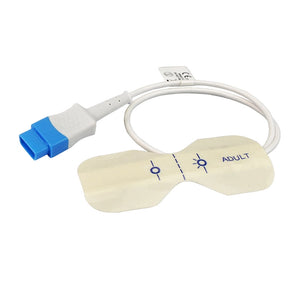
How to tell which SpO2 board your CARESCAPE has
- Monitor SpO2 label: a Masimo-configured CARESCAPE displays a "Masimo SET" or "Masimo rainbow SET" mark near the SpO2 numeric. A TruSignal unit shows "TruSignal" or "GE SpO2."
- Service menu: in the monitor's service or configuration menu, the installed SpO2 parameter board is listed by name — the definitive check. GE board-identification steps are collected in the Philips & GE monitor service guide.

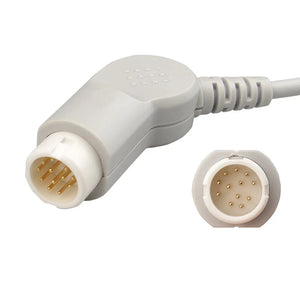
- Physical SpO2 port and patient cable: a Masimo-configured CARESCAPE uses the Masimo patient cable plugging into a Masimo-style port; a TruSignal unit uses GE's own 11-pin TruSignal port. Connector-generation detail is in the SpO2 connector pinout reference.
Three things that still matter even on the native Masimo path
- Connector generation: LNCS vs LNOP vs RD. An LNCS sensor fits an LNCS patient cable; it does not fit an RD port without the correct Masimo-defined transition. Confirm your CARESCAPE's Masimo cable generation before ordering LNCS stock — the older LNOP DCI compatible sensor is a different generation again.
- Rainbow parameters are not included. A standard LNCS sensor measures SpO2 and pulse rate only — not SpHb, SpCO, SpMet or PVi. If your CARESCAPE has a Masimo rainbow SET board and your protocol uses those parameters, a plain LNCS sensor will not populate those numerics. That is expected behaviour, not a fault.
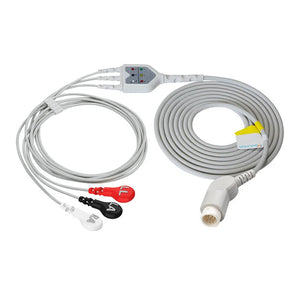
- Patient cable condition is part of the signal chain. The LNCS sensor connects through a reusable Masimo patient cable. A frayed or high-resistance patient cable degrades signal quality independent of the sensor — browse SpO2 adapter cables for replacements.
Study limitations
- All testing used the Fluke ProSim 8 simulator; no hypoperfused patients.
- Rainbow parameter accuracy was not characterised.
- Tested current-generation CARESCAPE firmware (2.x) only.
- 5.5 weeks of testing is not 6 months; contact resistance can drift over time.
The full data set is available on request — email biomed@med-linket-corp.com.
What this means for procurement and BMET
- Masimo-configured CARESCAPE fleet: you are in the good case. Compatible LNCS sensors are clinically usable across the perfusion range — a like-for-like decision, not a compromise. Adult: LNCS-compatible adult (1864); pediatric: Masimo-compatible pediatric (1860); neonatal: LNCS Neo compatible. Full range in the Masimo SpO2 collection.

- TruSignal-configured CARESCAPE fleet: do not run LNCS sensors through an adapter for critical care. The TruSignal board wants an OxiMax-class sensor — for example the TS-AP-25 adult or TS-AF-25 neonate / adult. See the GE CARESCAPE B-series accessories hub.
- Mixed fleet: establish a per-unit board inventory, label each monitor's SpO2 type, and stock the matching sensor for each. A mixed fleet with one undifferentiated sensor bin is an error waiting to happen. The multi-brand compatibility matrix helps map it.
- If a vendor says their LNCS sensors "work on CARESCAPE": ask which board configuration was tested. The claim is true on Masimo-configured units and misleading on TruSignal units. A vendor who cannot distinguish the two has tested only the easy case. Background: compatible Masimo SpO2 sensors for multi-brand monitors.
Frequently asked questions
Can I use Masimo LNCS sensors on a GE CARESCAPE monitor?
Usually yes — but only because GE ships some CARESCAPE monitors with a genuine Masimo SET parameter board. On those units an LNCS sensor is a Masimo sensor talking to a Masimo algorithm (native), and it is clinically usable across the perfusion range. On a CARESCAPE configured with GE's own TruSignal SpO2 board, an LNCS sensor through an adapter is a cross-algorithm configuration — fine at normal perfusion but unreliable below PI 0.3. Confirm which board your specific unit has before deciding.
How do I tell whether my CARESCAPE has a Masimo SET or a GE TruSignal board?
Three checks: the on-screen SpO2 label (a Masimo SET or Masimo rainbow SET mark versus "TruSignal" or "GE SpO2"), the service / configuration menu (which names the installed parameter board — the definitive check), and the physical SpO2 port plus patient cable (a Masimo-style port and cable versus GE's own 11-pin TruSignal port). A single hospital fleet often contains both, so check unit by unit or at least by purchasing batch.
Why is this study's "good" result not really a cross-brand test?
Because GE licenses and integrates Masimo SET as an OEM parameter board for the high end of the CARESCAPE line. An LNCS sensor on a Masimo SET board is a Masimo sensor on a Masimo algorithm inside a GE chassis — there is no algorithm mismatch to fail. That is why the only mild degradation we saw was the normal low-signal marginal behaviour at PI 0.05, the same thing Masimo SET shows on a native Radical-7.
Do LNCS sensors report rainbow parameters (SpHb, SpCO, SpMet, PVi) on CARESCAPE?
No. A standard LNCS sensor measures SpO2 and pulse rate only. If your CARESCAPE has a Masimo rainbow SET board and your protocol uses rainbow parameters, a plain LNCS sensor will not populate those numerics — that is expected behaviour, not a fault. Also confirm connector generation before ordering: LNCS, LNOP and RD are different generations and an LNCS sensor needs an LNCS-generation cable or the correct Masimo-defined transition.
About MedLinket. Founded 2004 in Shenzhen. NEEQ-listed (stock code 833505). Over 20 years specialising in patient-monitoring accessories. FDA 510(k), CE, MHRA, MDSAP, ISO 13485:2016 (TÜV) certified. Class 100,000 cleanroom. Serving 2,000+ hospitals across 117 countries and regions. Product liability insurance carried with cover up to USD 5 million; hospital customers may request a certificate of insurance within the policy period. "GE," "CARESCAPE," "TruSignal," "Masimo," "SET," "LNCS," "rainbow" and related model names are trademarks of their respective owners, used solely to indicate cross-reference compatibility under the U.S. Magnuson-Moss Warranty Act. MedLinket is not affiliated with, endorsed by, or licensed by any of these companies.