Quick Answer: How to Choose a Suitable Blood Pressure Cuff
- Measure Mid-Arm Circumference: Measure at the midpoint between the shoulder (acromion) and elbow (olecranon). Never guess by visual estimate or body weight.
- Follow MedLinket's 3-Step Sizing SOP: (1) Measure mid-arm circumference; (2) Ensure inflatable TPU bladder covers ≥75% of arm circumference; (3) On boundary measurements (e.g., 32 cm), always default to the larger cuff size.
- 10–15 mmHg Error Warning: Undersized or overly narrow cuffs force monitor pumps to over-inflate, generating falsely elevated blood pressure readings by 10–15 mmHg (and up to 20 mmHg). Oversized cuffs yield falsely low readings.
- 11-Scale Arm Circumference Matrix: Spans 3 cm (Premature Neonate #1) to 50 cm (Adult Thigh). Neonatal Hylink series (#1–#5) offers 5 distinct sizes (3–15 cm).
- Infection Control Alert: Reusable cuffs harbor up to 69.1% bacterial contamination (including MRSA). Use single-patient disposable non-woven (Y000D) or Yellow Isolation cuffs (Y006D) in OR, ICU, and isolation wards.
Key Takeaways
- An improperly fitted cuff distorts oscillometric NIBP algorithms, causing up to 20 mmHg measurement deviation.
- Department workflows dictate cuff selection: ICU requires soft TPU comfort cuffs with removable bladders; ER needs wipe-clean nylon; OR/NICU require disposable sterile options.
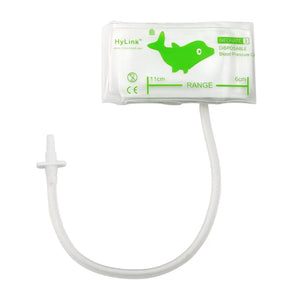
- MedLinket disposable neonatal Hylink cuffs (#1–#5) feature transparent TPU for direct visual skin inspection without unwrapping.
- Cuff compatibility is determined by the gas connector and air hose (A05, A26, A41, A57, etc.), not the cuff body itself.
Accurate non-invasive blood pressure (NIBP) monitoring forms the bedrock of clinical assessment across ICUs, operating rooms, emergency departments, and outpatient clinics. Yet, cuff selection errors remain the single largest cause of artificial blood pressure deviations. Whether you are a biomedical engineer (BMET) outfitting a 500-bed hospital fleet, a procurement manager sourcing OEM-compatible accessories for Philips, GE Healthcare, Mindray, or Draeger patient monitors, or a nurse seeking reliable patient care, this comprehensive guide outlines the exact 3-step selection SOP, full 11-scale size matrix, and clinical department matching rules needed to eliminate measurement errors.
This guide incorporates over two decades of manufacturing and clinical engineering expertise from MedLinket (Shenzhen Med-Link Electronics Tech Co., Ltd, est. 2004; Stock Code: 833505), an ISO 13485:2016, MDSAP, NMPA, FDA 510(k), and CE MDR certified manufacturer supplying 2,000+ hospital endpoints across 117+ countries.
Table of Contents
- MedLinket's 3-Step Selection SOP
- Full 11-Scale NIBP Cuff Size Chart (3–50 cm)
- 10–15 mmHg Error Mechanics & Sizing Pitfalls
- Choosing a Cuff by Clinical Department
- Reusable vs. Disposable NIBP Cuffs
- Monitor Brand & Connector Compatibility
- For Home & Ambulatory (ABPM) Use
- Proper Cuff Application Protocol
- Why Hospitals Trust MedLinket
- Frequently Asked Questions
- Related Clinical Guides
MedLinket's 3-Step Sizing & Selection SOP
To prevent arterial compression distortion, clinical staff should follow MedLinket's standardized 3-step cuff selection protocol:
- Step 1 (Mid-Arm Measurement): Locate the upper arm midpoint halfway between the tip of the shoulder (acromion) and the elbow (olecranon). Wrap a flexible measuring tape snugly around the mid-arm and record the circumference in centimeters.
- Step 2 (The 75% Bladder Rule): Match the measurement against cuff specifications to ensure the internal TPU bladder length covers at least 75% to 80% of the arm circumference, with a bladder width equal to approximately 40% of arm circumference (AHA/AAMI standard).
- Step 3 (Boundary Standard — Size Up): If the patient's arm circumference falls precisely on a boundary measurement (for example, 32 cm between Adult and Large Adult), always default to the larger cuff size. This prevents restricted arterial flow during initial inflation.
According to MedLinket's NIBP engineering protocols, applying an undersized or overly narrow cuff forces the monitor's inflation pump to generate extra pressure to compress the brachial artery. This distorts the oscillometric envelope, resulting in falsely elevated blood pressure readings of 10–15 mmHg (and up to +20 mmHg), which can lead to inappropriate antihypertensive administration. Conversely, an oversized cuff distributes pressure over too wide an area, yielding falsely low readings that may mask true shock or hypotension.
Full 11-Scale NIBP Cuff Size Chart (3–50 cm Arm Circumference)
MedLinket manufactures a complete 11-scale arm circumference matrix to ensure precise fitting across all age groups — from 3 cm premature infants to 50 cm bariatric thigh sites. Always select by measured arm circumference rather than visual estimation.
| Arm Circumference (cm) | MedLinket Cuff Size Name | Patient Category & Target Group | Material & Selection Guidance |
|---|---|---|---|
| 3–6 cm | Neonatal #1 (5082-101-1) | Premature / very low birth weight | Hylink transparent TPU; see-through skin check |
| 4–8 cm | Neonatal #2 (5082-102-1) | Full-term newborn | Single-patient disposable TPU; A26/A41/A05 connector |
| 6–11 cm | Neonatal #3 (5082-103-1) | Larger neonate / small infant | Index lines & △ Artery Marker for fast alignment |
| 7–14 cm | Neonatal #4 (5082-104-1) | Infant / lower leg placement | Soft TPU construction; latex-free & DEHP-free |
| 8–15 cm | Neonatal #5 (5082-105-1) | Older infant | Transition boundary to pediatric series |
| 15–22 cm | Pediatric / Child | Children 1–12 years | Never apply adult cuffs on pediatric limbs |
| 17–25 cm | Small Adult | Slim adults / adolescents | Ensure bladder length covers ≥75% circumference |
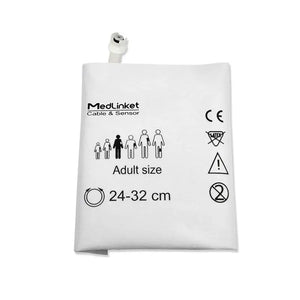
| 24–32 cm | Adult (Standard Universal) | Average adult ward & outpatient | Most widely stocked size in general wards |
| 28–37 cm | Adult Long | Taller or muscular upper arms | Extended bladder length for uniform pressure |
| 32–42 cm | Large Adult | Muscular or obese upper arms | Critical size to prevent 10-15 mmHg over-reading |
| 42–50 cm | Adult Thigh / Bariatric | Bariatric patients / thigh measurement site | Consider forearm site with radial artery if arm is conical |
↔ Swipe table horizontally to view full matrix
Common Sizing Mistakes That Distort NIBP Readings
Oscillometric NIBP algorithms rely on detecting minute pressure oscillations in the cuff bladder as it deflates. Mechanical setup errors introduce significant measurement noise:
| Operational Mistake | Oscillometric Impact | Effect on Blood Pressure | Corrective SOP |
|---|---|---|---|
| Cuff too small / narrow | Requires higher inflation pressure to occlude artery | Falsely HIGH (+10 to +15 mmHg) | Measure mid-arm & size up if on boundary |
| Cuff too large / wide | Spreads pressure over too broad an area | Falsely LOW (-5 to -10 mmHg) | Select smaller size; verify 75% bladder length |
| Wrapped too loose | Bladder must inflate extra before touching skin | Falsely HIGH | Re-wrap snugly using the 1-finger rule |
| Arm below heart level | Hydrostatic pressure adds to arterial pressure | Falsely HIGH (+8 mmHg per 10cm) | Support arm at heart level (4th intercostal space) |
| Arm above heart level | Hydrostatic pressure subtracts from arterial reading | Falsely LOW (-8 mmHg per 10cm) | Lower arm to heart level using support pillows |
Choosing the Right NIBP Cuff by Clinical Department
Each hospital department has unique clinical requirements — continuous monitoring, rapid turnover, stringent infection control, or delicate skin protection. MedLinket offers tailored product lines engineered for each environment:
1. ICU: Soft TPU Comfort Cuffs for Continuous Monitoring
In the Intensive Care Unit, patients require automated NIBP cycles every 5 to 15 minutes for extended periods. Rigid cuffs can cause friction, skin maceration, and pressure injuries. The MedLinket TPU Comfort NIBP Cuff features a soft, skin-friendly TPU shell with a removable TPU inner bladder, ensuring patient comfort during continuous monitoring while permitting thorough cleaning between patient uses.
2. Emergency Department & Outpatient: Durable Blue Nylon Cuffs
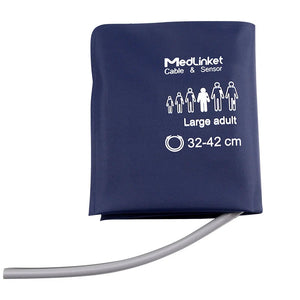
High patient turnover and frequent exposure to fluids require cuffs that withstand harsh hospital disinfectants. The MedLinket Blue Nylon NIBP Cuff utilizes heavy-duty nylon fabric welded to a durable TPU bladder. It wipes clean instantly with quaternary ammonium or alcohol wipes and maintains velcro grip over hundreds of cycles.
3. Operating Room & Isolation Wards: Disposable Non-Woven & Yellow Isolation Cuffs
Surveillance studies show bacterial contamination rates on shared reusable BP cuffs reach up to 69.1%, with MRSA among documented pathogens. In operating rooms, burn units, and contact isolation wards, single-patient disposable NIBP cuffs (Y000D Series) eliminate cross-contamination risks. For strict infection protocols, MedLinket’s Yellow Isolation Cuff Series (Y006D) provides clear color-coded identification for isolation rooms.
4. NICU: Hylink Transparent TPU Neonatal Series (#1–#5)
Preterm infants have exceptionally delicate skin susceptible to Medical Adhesive-Related Skin Injury (MARSI) and pressure ulcers. MedLinket’s Hylink Neonatal Disposable Series (#1–#5, 3–15 cm range) is manufactured from ultra-soft, transparent TPU. The see-through design allows NICU nurses to inspect underlying skin microcirculation without unwrapping the cuff. All neonatal cuffs are 100% latex-free and DEHP-free, individually sterile-packed (Box of 24).
5. Cardiology & ABPM: Soft Cotton Ambulatory Cuffs
For 24-hour Ambulatory Blood Pressure Monitoring (ABPM, Y001/Y002 Series), patients wear cuffs during daily activities and sleep. MedLinket’s ABPM cuffs utilize soft, breathable cotton fabric with an ergonomic pull-ring design, allowing easy self-adjustment and maximum patient compliance during multi-day studies.
Visual Comparison: MedLinket NIBP Cuff Series


Disposable Non-Woven Cuff
Material: Absorbent Non-Woven (Y000D/Y006D)
Best for: OR, isolation wards, burn units
Highlights: Zero cross-contamination, latex-free
OEM: M4575B · Adult Large

Reusable vs. Disposable NIBP Cuffs: Decision Matrix
Hospital procurement managers must balance infection control risks against total cost of ownership (TCO). This matrix guides ward purchasing decisions:
| Clinical Department / Scenario | Primary Risk Factor | Recommended Cuff Type | Clinical Rationale |
|---|---|---|---|
| Operating Room (OR) | Cross-contamination, sterile field | Disposable Non-Woven (Y000D) | Eliminates reprocessing between surgical cases |
| ICU & Burn Units | High HAI rate, skin integrity | Disposable or TPU Comfort | Disposables prevent bacterial transfer; TPU reduces pressure risk |
| Contact Isolation Wards | Pathogen transmission (MRSA, C. diff) | Yellow Isolation Disposable (Y006D) | Color-coded visual cue; discard upon patient discharge |
| NICU / Preterm Nursery | Fragile skin, MARSI risk | Neonatal Hylink TPU (#1–#5) | Transparent material permits visual skin assessment |
| Emergency & Outpatient Clinics | Frequent patient turnover, blood exposure | Reusable Blue Nylon | High durability, withstands repeated chemical wipe-downs |
Monitor Brand & Connector Compatibility
A cuff's compatibility with a patient monitor is determined entirely by the gas connector and air hose assembly, rather than the cuff body itself. MedLinket supports 10+ precision connector standards ensuring leak-free pressure hold across 30+ monitor brands:
Patient Monitor Module ➔ NIBP Extension Hose ➔ Hose Gas Connector ➔ Cuff Connector ➔ Cuff BladderMedLinket verifies every connector tolerance and latch mechanism under 300 mmHg static pressure testing to eliminate air leaks and premature deflation alarms.
Key MedLinket NIBP Connector Types:
- A05 / A06: GE Healthcare, Welch Allyn, Critikon compatible
- A11 / A12 (Submin): Nihon Kohden, Mindray compatible
- A26 / A57 (Quick-Connect / Bayonet): Philips IntelliVue, MP/MX series, Goldway compatible
- A41 / A65 / A79 / A108 / A118: Draeger, Colin, Spacelabs, Comen, Edan, Biolight, and Luer-slip compatible
🔗 Browse MedLinket NIBP Cuffs by OEM Monitor Brand
Direct OEM replacements with factory-fitted connectors. No leak-prone adapters required:
- Philips IntelliVue: M1573A Adult · M1574A Adult · M1575A Adult Large
- GE Healthcare / Critikon: DURA-CUF Adult · DURA-CUF Adult Large
- Nihon Kohden: BSM Adult Submin · BSM Large Adult
- Draeger: MP00915 Adult Bayonet
For Home & Ambulatory (ABPM) Blood Pressure Monitoring
Cardiology guidelines recommend home blood pressure monitoring (HBPM) and 24-hour ABPM to eliminate white-coat hypertension effects. For home users managing hypertension, choosing an upper-arm cuff with validated sizing is critical:
🏠 MedLinket Home & Personal BP Solutions
MedLinket brings hospital-grade oscillometric accuracy to personal healthcare:
- ESM201 Upper-Arm Home BP Monitor — Complete 1-button hospital-grade unit
- Omron-Compatible Replacement Cuff (22–32 cm / 9–13 inches) — D-ring replacement cuff
Proper Cuff Application Protocol: 8-Step SOP
Even a correctly sized cuff will yield erroneous data if misapplied. Follow this clinical SOP:
- Remove thick garments — apply cuff directly to bare arm or over thin fabric (<2 mm). Never roll up tight sleeves (creates a tourniquet).
- Position △ Artery Marker over the brachial artery along the inner elbow crease.
- Apply cuff 2–3 cm above elbow crease.
- Wrap snugly — apply the 1-finger rule: ensure one finger can slide beneath the cuff edge without force.
- Support arm at heart level (4th intercostal space).
- Verify hose path — ensure the air hose is unkinked and uncompressed.
- Keep patient quiet & still for 3 to 5 minutes prior to inflation.
- Confirm extreme values — readings below 50 or above 250 mmHg should be cross-verified manually or via IBP invasive monitoring.
Why Hospitals in 117+ Countries Trust MedLinket NIBP Accessories
Globally Certified Quality
ISO 13485:2016 (TÜV), MDSAP, CE MDR, NMPA (Registration No. 20243072401), FDA 510(k) cleared. 100% pressure-leak tested in Class 100,000 cleanrooms.
20+ Years Manufacturing Expertise
Founded in 2004 in Shenzhen; NEEQ listed (stock code: 833505). 2,822 sets of precision molds, 10,303 product styles supplying 2,000+ hospital clients globally.
30+ Monitor Brands Compatible
Direct compatibility with Philips, GE Healthcare, Mindray, Draeger, Nihon Kohden, Spacelabs, Welch Allyn, Edan, Biolight, Comen, and more.
$5 Million USD Global Product Liability Insurance
Underwritten by Liberty Insurance. Individual "Additional Insured" certificates available for global medical distributors and health systems.
Frequently Asked Questions
How much can an incorrect cuff size skew my blood pressure reading?
An undersized cuff forces the pump to over-inflate, generating falsely elevated readings of 10–15 mmHg (and up to 20 mmHg). An oversized cuff yields falsely low readings. Always measure mid-upper arm circumference and apply MedLinket's 3-step SOP.
How do I know if a cuff is too small or too large?
When wrapped around the arm, the index line on the cuff edge must fall within the range markers printed on the cuff exterior. If the index line falls short of the range, the cuff is too small. If it overlaps past the range, it is too large.
Can reusable NIBP cuffs spread hospital infections?
Yes. Surveillance studies document bacterial contamination rates of up to 69.1% on in-use reusable BP cuffs, including MRSA. In OR, ICU, burn, and isolation units, single-patient disposable non-woven (Y000D) or Yellow Isolation cuffs (Y006D) should be used.
What connector type does my Philips / GE / Mindray monitor require?
Philips IntelliVue monitors typically require A26/A57 Quick-Connect bayonet connectors. GE monitors use A05/A06 or DinaClick connectors. Mindray and Nihon Kohden use A11/A12 Submin connectors. Contact shopify@medlinket.com with your monitor model for free compatibility matching.
What is the difference between NIBP and IBP?
NIBP uses an external cuff for intermittent oscillometric readings. IBP (Invasive Blood Pressure) uses an arterial catheter and disposable pressure transducer for continuous beat-to-beat waveform monitoring in critical ICU and surgical cases.
Related Clinical Guides
- Understanding NIBP Readings: Systolic, Diastolic & MAP Guide
- How to Put On a Blood Pressure Cuff (Step-by-Step)
- Ultimate Guide to Cleaning & Maintaining Reusable NIBP Cuffs
- How to Quickly Find NIBP Hoses for Philips Monitor Series
- NIBP Measurement Errors: Troubleshooting (BMET Guide)
Ready to Standardize Your Hospital's NIBP Cuff Fleet?
Complete arm size ranges (3–50 cm) for adult, pediatric, and neonatal care with brand-matched connectors — CE & FDA certified. Free clinical samples available for hospital evaluation.
Shop Reusable Cuffs Shop Adult Disposable Shop Neonatal Disposable📧 shopify@medlinket.com · 💬 WhatsApp: +852 6467 3105
20+ Years
Countries
Hospital Endpoints
MDSAP, NMPA
2016 (TÜV)
Product Liability
Disclaimer: This article is intended for educational purposes for healthcare professionals and biomedical engineers. Cuff sizing recommendations align with published AHA/AAMI standards and MedLinket internal quality specifications. Always follow your facility's clinical protocols and monitor IFUs for specific treatment decisions.
↑