Quick answer: NIBP errors on patient monitors typically stem from air leaks in hoses or cuffs, incorrect cuff sizing, excessive patient movement, or module faults. Troubleshoot in this order: (1) verify cuff size and placement, (2) check the air hose for kinks, cracks, or loose connections, (3) run the built-in NIBP leak test, (4) rule out patient factors (motion, arrhythmia, extreme BP), (5) test the internal pump and valve. Only escalate to module replacement after the full pneumatic chain has been cleared.
📌 Article scope: This is a BMET-level diagnostic guide for NIBP pneumatic-system troubleshooting and component testing — error diagnosis and fix procedures.
For NIBP hose connector ordering and identification, see NIBP hose connector specifications. For monitor error codes across all parameters, see the patient monitor error codes troubleshooting guide.
📑 Table of contents

How NIBP measurement works (quick review)
Understanding the oscillometric principle is essential for diagnosing NIBP errors. All modern patient monitors use the oscillometric method for non-invasive blood pressure, as defined in the international standard IEC 80601-2-30 (particular requirements for NIBP equipment) and validated per ISO 81060-2 (clinical accuracy validation). The process works as follows:
- The cuff inflates to compress the brachial artery, occluding blood flow.
- The cuff gradually deflates in controlled steps.
- During deflation, arterial wall pulsations generate oscillation waves in the cuff pressure.
- The pressure sensor in the monitor detects these oscillations through the NIBP hose.
- The point of maximum oscillation amplitude = Mean Arterial Pressure (MAP) — the only directly measured value.
- Systolic and diastolic pressures are calculated from MAP using the monitor's proprietary algorithm.
Key BMET insight: because MAP is directly measured and systolic/diastolic are derived calculations, MAP is the most reliable NIBP number. When clinicians report "blood pressure seems wrong," ask them to compare the MAP value first — systolic and diastolic algorithm errors are more common than MAP errors. (In critical care, MAP is also the perfusion number that matters most; a MAP below ~65 mmHg is the widely used threshold for inadequate perfusion in sepsis guidelines.)
💡 Clinical context: oscillometric NIBP has defined operating limits — systolic pressure below ~50–60 mmHg or above ~250 mmHg may produce unreliable results (verify with a manual sphygmomanometer); heart rates below 40 bpm or above 240 bpm may prevent measurement; patients on cardiopulmonary bypass cannot be measured; and continuously repeated measurements affect limb blood flow and can cause progressive drift. These limits are documented in IEC 80601-2-30 and each manufacturer's service manual.
NIBP error messages and what they mean
| Error message | What it means | Most likely cause | BMET first action |
|---|---|---|---|
| "Measurement Failed" / "Unable to Measure" | Monitor could not detect adequate oscillation signals to calculate BP | Wrong cuff size; patient motion; weak pulse; arrhythmia; cuff not on bare skin | Verify cuff size and placement; ensure patient is still; retry on opposite arm |
| "Cuff Leak" / "Pneumatic Error" / "NIBP Pump Leaking" | System detected pressure loss during inflation or hold | Cuff bladder hole; hose crack; loose connector; degraded seal | Run the NIBP leak test; inspect each connection point systematically |
| "Over Pressure" / "Pressure Error" | Cuff pressure exceeded the safety cutoff (typically 300 mmHg adult, 150 mmHg neonate per IEC 80601-2-30) | Kinked hose preventing deflation; wrong patient type (adult on infant); blocked bleed valve | Check patient type setting; inspect hose for kinks; check bleed valve |
| "Cuff Not Inflating" / "Pump Error" | System cannot generate pressure | Hose not connected; cuff disconnected; pump failure; major air leak | Check all connections; if connected and still failing, likely pump or valve fault — escalate |
| "NIBP EQUIP MALF" | Module-level hardware failure | Internal pump, valve, or pressure-sensor failure | Run internal diagnostics if available; escalate to module service |
| "Excessive Motion" | Motion artifact exceeded algorithm tolerance | Patient movement, shivering, or cuff compressed against the body | Support the arm at heart level and keep it off the patient's side |
Systematic NIBP troubleshooting
Follow these four steps in order. Most NIBP errors resolve at Step 1 or 2: in field service, cuff and hose faults are by far the most common findings, and the module itself is the cause far less often. Clearing the pneumatic chain first — cuff, hose, connectors, valve — before condemning the module is what separates an efficient NIBP repair from an unnecessary module swap.
Step 1: check cuff application
The cuff is the sensor in NIBP measurement — incorrect application is the single most common cause of measurement failure. Per AHA measurement guidance, the cuff bladder width should be roughly 40% of arm circumference and the bladder should encircle most of the arm; MedLinket specifies that the inflatable section cover at least ~75% of the arm circumference. Key application requirements:
- Size: the artery marker on the cuff must align with the brachial artery. A cuff that is too small reads high; a cuff that is too large reads low. For sizing guidance, see Which Blood Pressure Cuff Fits Me?
- Tightness: snug enough that only one finger fits between the cuff and the arm.
- Position: on bare skin or a very thin garment, not over thick clothing; lower edge about 2–3 cm above the antecubital fossa.
- Patient type: verify the monitor is set to the correct patient type (adult, pediatric, neonatal). Adult cuffs must never be used on neonates or small children — this is both an accuracy and a patient-safety issue.
⚠️ Safety warning (per IEC 80601-2-30): leaving the cuff on between intermittent measurement cycles can restrict blood flow to the limb, and incorrect cuff use may cause pressure injury, particularly in neonates. Always verify the correct patient type setting before starting. The standard mandates an overpressure cutoff of 300 mmHg for adults and 150 mmHg for neonates.
Step 2: check for air leaks (the definitive NIBP leak test)
The NIBP leak test is the single most important diagnostic for pneumatic-system faults. It follows manufacturer service-manual protocols and is referenced in the patient monitor preventive maintenance checklist:
- Set patient type to Adult (to ensure maximum inflation pressure for testing).
- Connect the cuff and hose to the monitor's NIBP port — verify all connections are firmly seated.
- Wrap the cuff around a rigid cylinder (a rolled towel or a section of PVC pipe works — it must be rigid enough that the cuff inflates against it).
- Navigate to: Main Menu → Maintenance → NIBP Leak Detection (Mindray path shown; Philips and GE have equivalent service-mode menus — consult the Philips & GE monitor service guide for brand-specific navigation).
- Wait about 20 seconds for the automatic inflation and pressure-hold test to complete.
- Interpret: no error message = pneumatic system airtight (pass); a leak message ("NIBP Pump Leaking" or equivalent) = air leak detected (fail).
If the leak test fails, isolate the leak by testing components individually. Disconnect the hose from the cuff and repeat with just the hose and monitor. If the hose-only test passes, the leak is in the cuff. If it also fails, the leak is in the hose or the monitor's internal pneumatic system.
💡 Alternative manual leak test: if your monitor has no built-in leak-test mode, inflate the cuff to 200 mmHg manually (using the NIBP start button), then watch the reading. Pressure should hold within about 5 mmHg over 60 seconds; a faster drop indicates a leak. A practical field technique: during inflation, listen at each connection point — a pneumatic leak is often audible before it is visible, which helps localize it to a connector or seam.
Step 3: check patient factors
Some NIBP failures are caused by patient physiology, not equipment. These limitations are inherent to the oscillometric method and documented in IEC 80601-2-30:
- Severe arrhythmia (especially atrial fibrillation): irregular beats produce inconsistent oscillation patterns that confuse the algorithm. Consider manual BP or IBP monitoring for these patients.
- Very weak pulse / hypotension: systolic pressure below ~50–60 mmHg may not generate detectable oscillations. Verify by palpation or consider IBP.
- Patient movement: even small arm movements generate pressure artifacts larger than arterial oscillations. The arm must be supported and still.
- Rapid BP changes / shock: during rapid hemodynamic change or shock, oscillometric results may be unreliable — correlate with clinical signs and consider invasive monitoring.
Step 4: equipment testing
If cuff application is correct, there are no leaks, and patient factors are ruled out, test the internal pneumatic components. For electrical-safety testing during this step, reference the calibration requirements for patient monitor accessories and the IEC 62353 methods in our medical cable inspection and testing guide.
| Component | Test method | Pass criteria | Fail action |
|---|---|---|---|
| Cuff | Visual: inspect bladder for holes, delamination, seam separation. Functional: inflate and hold-pressure test. | No visible damage; holds within ~5 mmHg/60 s | Replace reusable cuff or disposable cuff |
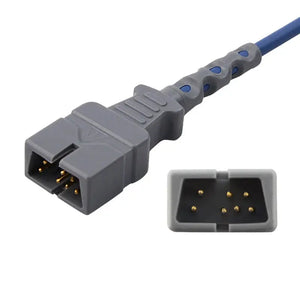
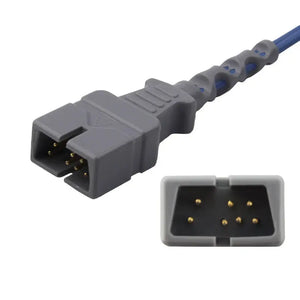
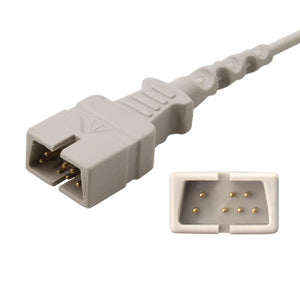
| Hose | Visual: check for kinks, cracks, discoloration. Functional: disconnect from cuff, plug the hose end, inflate and hold. | No visible damage; no air escape when plugged | Replace NIBP hose — identify connector type first via NIBP hose connector specifications |
| Connector | Visual: inspect for cracks, deformation. Functional: ensure firm click/lock when connected. | Clean, undamaged, secure fit | Replace NIBP connector |
| Internal pump | Listen for pump activation when NIBP starts; should produce an audible inflation sound. | Pump activates; cuff inflates steadily | Module service required |
| Bleed valve | After measurement, verify the cuff fully deflates; listen for controlled deflation. | Complete, controlled stepwise deflation | Dust in the valve is a common cause — often clearable with a syringe air purge before escalating to module service |
| Overpressure cutoff | During PM, verify the overpressure safety triggers at the rated limit (300 mmHg adult / 150 mmHg neonate per IEC 80601-2-30). | Safety cutoff activates and deflates the cuff immediately | Module service required — a safety-critical function per IEC 80601-2-30. Document per your BMET documentation and compliance procedures. |
NIBP cuff sizing quick reference
Wrong cuff size is the most common correctable cause of NIBP errors. How large the error can be is well quantified: in a Johns Hopkins randomized crossover trial (the Cuff(SZ) trial, JAMA Internal Medicine 2023), using a regular-size cuff on people who actually needed a large or extra-large cuff overestimated systolic pressure by about 4.8 and 19.5 mmHg respectively, while using a regular cuff on people needing a small cuff underestimated systolic by about 3.6 mmHg. The rule of thumb that follows: when in doubt, size up — a slightly oversized cuff produces a small underestimate, whereas a too-small cuff can overestimate substantially, the more dangerous direction.
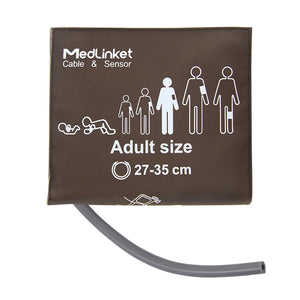
The table below lists MedLinket cuff sizes by arm-circumference range. Different monitor brands use different NIBP connector types — always match the hose connector to the specific monitor series. For help identifying connectors across brands, see the multi-brand compatibility matrix.
| Patient category | Arm circumference | Cuff type | MedLinket product |
|---|---|---|---|
| Neonatal #1 | 3–6 cm | Disposable neonatal | Neonate #1 cuff |
| Neonatal #3 | 6–11 cm | Disposable neonatal | Neonate #3 cuff |
| Child | 15–22 cm | Reusable / disposable | Pediatric cuff |
| Small adult | 17–25 cm | Reusable | Small adult cuff |
| Adult | 24–32 cm | Reusable | Adult cuff |
| Adult (extra-long) | 28–37 cm | Reusable | Adult long cuff |
| Large adult | 32–42 cm | Reusable | Large adult cuff |
| Adult thigh | 42–50 cm | Reusable | Thigh cuff |
MedLinket's neonatal disposable range covers five steps (3–15 cm: #1 3–6, #2 4–8, #3 6–11, #4 7–14, #5 8–15 cm). Where the adult and extra-long ranges overlap (28–37 cm), apply the "size up" rule and choose the larger cuff. For clinical-side selection guidance, see How to Choose a Suitable Blood Pressure Cuff; for neonatal-specific challenges, see Solving Neonatal BP Challenges.
Brand-specific NIBP error codes
The tables below are compiled from manufacturer service manuals. For a comprehensive error-code reference across all parameters, see the patient monitor error codes troubleshooting guide. For brand-specific service information beyond NIBP, see the Philips & GE monitor service guide and Mindray monitor technical resources.
Philips NIBP errors
| INOP message | Cause | Action |
|---|---|---|
| NBP EQUIP MALF | Pump or valve hardware failure | Check the Philips NIBP hose (M1599B) first; escalate if the hose is clear |
| NBP CUFF LEAK | Pneumatic leak detected | Run the leak test; check the Philips Quick-Connect hose |
| NBP INTERRUPTED | Measurement aborted (motion, button press) | Retry with the patient still |
| CUFF NOT CONNECTED | No pneumatic path detected | Check hose and cuff connections; inspect for a disconnected hose at the monitor port |
For Philips NIBP hose compatibility by model, see How to Quickly Find NIBP Hoses for Philips Monitors.
GE NIBP errors
| Error message | Cause | Action |
|---|---|---|
| NIBP – MEASUREMENT FAILED | Insufficient oscillation signal | Verify GE Critikon-compatible cuff sizing; check position; retry |
| NIBP – EXCESSIVE MOTION | Motion artifact | Stabilize the patient; support the arm at heart level |
| NIBP – AIR LEAK | Pneumatic system leak | Run the leak test; check the GE Dinaclick hose |
| NIBP – CUFF OVERPRESSURE | Pressure exceeded the safety limit | Check patient type setting; inspect for a kinked hose |
Mindray NIBP errors
| Error message | Cause | Action |
|---|---|---|
| NIBP PUMP LEAKING | Pneumatic leak | Run the built-in leak test (Main Menu → Maintenance → NIBP Leak Detection); check the Mindray NIBP hose |
| NIBP MEASUREMENT FAILED | Insufficient signal | Cuff sizing; patient position; retry |
| NIBP CUFF TYPE ERROR | Wrong cuff type for the patient setting | Verify patient type matches the cuff size range |
NIBP preventive maintenance checklist
Include these NIBP-specific checks in your regular patient monitor PM checklist. Document all results per your facility's BMET documentation and compliance procedures, as expected under Joint Commission and CMS requirements.
| ✓ | PM task | Frequency | Pass criteria / notes |
|---|---|---|---|
| ☐ | Visual inspection: cuff bladder, seams, hook-and-loop closure | Every PM cycle (6–12 months) | No delamination, cracking, or seam separation |
| ☐ | Visual inspection: hose for kinks, cracks, discoloration | Every PM cycle | No visible damage; flexible without permanent kinks |
| ☐ | NIBP leak test (built-in or manual) | Every PM cycle | Holds within ~5 mmHg/60 s at 200 mmHg |
| ☐ | Overpressure safety cutoff verification | Every PM cycle | Cutoff at 300 mmHg (adult) / 150 mmHg (neonate) per IEC 80601-2-30 |
| ☐ | Accuracy verification with NIBP simulator | Annually or per manufacturer spec | Static pressure accuracy per ISO 81060-2; dynamic accuracy per simulator protocol |
| ☐ | Connector inspection (all cuff/hose connections) | Every PM cycle | Clean, undamaged, firm click/lock; replace worn connectors |
Need reliable NIBP replacement accessories?
MedLinket manufactures compatible NIBP cuffs, hoses, and connectors for Philips, GE, Mindray, Dräger, Nihon Kohden, Welch Allyn and more — ISO 13485 certified, FDA 510(k) cleared, factory tested. ("Compatible with" indicates fitment only and implies no OEM or endorsement relationship; always confirm the connector against your monitor model.) To evaluate whether compatible accessories are right for your facility, see our OEM vs compatible parts analysis and third-party accessory evaluation guide.
Frequently asked questions
Why does NIBP consistently fail on certain patients?
Some patients present challenges oscillometric NIBP cannot overcome: severe arrhythmias (especially atrial fibrillation) produce irregular oscillation patterns the algorithm cannot interpret; very weak pulses in hypotensive or shock patients may not generate detectable oscillations; and some patients cannot stay still enough for the cycle. For these patients, consider manual auscultatory BP or invasive arterial pressure (IBP) monitoring. These are recognized measurement limitations under IEC 80601-2-30, not equipment faults.
How do I perform an NIBP cuff leak test?
Set patient type to Adult. Connect cuff and hose to the monitor. Wrap the cuff around a rigid cylinder. Navigate to Main Menu → Maintenance → NIBP Leak Detection. Wait about 20 seconds. No error message = pass; a leak message = fail. If the built-in test is unavailable, inflate to 200 mmHg and observe: pressure should hold within ~5 mmHg for 60 seconds. Isolate the leaking component by testing hose-only and cuff-only separately. See the full leak test procedure above.
What is the difference between single-tube and dual-tube NIBP cuffs?
A single-tube cuff uses one air path for both inflation and pressure sensing; a dual-tube cuff separates the inflation path from the measurement path. For a BMET, the practical point is compatibility, not a universal accuracy ranking: match the cuff and hose to what the monitor is designed for, because some monitors support only single-tube and others support both. Using the wrong type can cause connection issues or unreliable measurement. Confirm the monitor's NIBP hose connector type before substituting.
What pressure rating should a medical NIBP hose meet?
Medical NIBP hoses should comfortably exceed the IEC 80601-2-30 overpressure limits (300 mmHg adult, 150 mmHg neonate), with hose material (typically TPU or PVC) and biocompatibility meeting ISO 10993, and they must resist kinking under normal clinical routing. Connector materials must be medical grade. MedLinket NIBP hoses are available with Philips, GE Dinaclick, GE sub-mini, Mindray, Nihon Kohden, Dräger and Welch Allyn connector types; confirm the exact connector against your monitor model before ordering. For material and shielding specifications on medical cables generally, see our medical cable specifications guide.
When should I measure blood pressure on the other arm?
If NIBP repeatedly fails or produces questionable readings on one arm, switch arms and compare. A consistent difference greater than about 10 mmHg between arms can indicate vascular pathology (for example subclavian stenosis) and should be reported to the clinical team. For BMET purposes, a successful measurement on the opposite arm confirms the equipment is functioning and the original failure was patient- or site-specific.
How often should NIBP cuffs and hoses be replaced?
Reusable NIBP cuffs should be inspected at every preventive maintenance cycle (typically every 6–12 months) and replaced when the bladder shows delamination, cracking, or seam separation. NIBP hoses should be replaced when they show kinks, cracks, or discoloration, or when they fail a leak test. Disposable cuffs are single-patient use — which also removes the cross-contamination risk associated with reused cuffs. For cost-optimization strategies when ordering replacements, see BMET cost-saving strategies.
Related BMET resources
Clinical staff resources: How to Choose a Suitable Blood Pressure Cuff · Understanding NIBP Readings · How to Put On a Blood Pressure Cuff · Which Blood Pressure Cuff Fits Me?
About MedLinket
MedLinket (Shenzhen Med-link Electronics Tech Co., Ltd, est. 2004) manufactures compatible reusable NIBP cuffs, adult disposable cuffs, neonatal disposable cuffs, NIBP hoses, and NIBP connectors for major monitor brands. A neonatal design feature — transparent TPU disposable cuffs — lets clinicians observe the skin under the cuff, supporting pressure-injury vigilance in fragile neonates. The quality system is ISO 13485 certified; products are FDA 510(k) cleared and CE marked. MedLinket serves 2,000+ hospitals across 110+ countries, with product-liability insurance up to USD 5M. (Brand names are referenced for compatibility only and imply no OEM or endorsement relationship.)
Contact: marketing@med-linket.com · WhatsApp · 1-hour remote-diagnosis response commitment.
References & standards
- IEC 80601-2-30 — Medical electrical equipment: particular requirements for the basic safety and essential performance of automated non-invasive sphygmomanometers (oscillometric limits, overpressure cutoffs).
- ISO 81060-2 — Non-invasive sphygmomanometers, Part 2: clinical investigation of intermittent automated measurement type.
- Ishigami J, Charleston J, Miller ER 3rd, Matsushita K, Appel LJ, Brady TM. Effects of Cuff Size on the Accuracy of Blood Pressure Readings: The Cuff(SZ) Randomized Crossover Trial. JAMA Intern Med. 2023;183(10):1061–1068. (ClinicalTrials.gov NCT04610775.)
- IEC 62353 — Medical electrical equipment: recurrent test and test after repair (electrical-safety testing referenced in Step 4).
- ISO 10993 — Biological evaluation of medical devices (hose and cuff material biocompatibility).
- Manufacturer service manuals (Philips, GE, Mindray) — brand-specific NIBP error codes and leak-test navigation.
Disclaimer: this guide is for biomedical engineering and clinical-engineering education. It does not replace the device service manual, the manufacturer's instructions for use, or your facility's biomedical and infection-control policies. Always follow the specific monitor's service documentation and applicable regulations. MedLinket (est. 2004) manufactures patient-monitoring accessories, not diagnostic devices.