By MedLinket Clinical Education Team | Updated: February 2026 | 9 min read
📚 This article is part of our Hospital Monitor Reading & Accessories Guide series. For the complete overview of all alarm types, see Hospital Monitor Alarms: What Each Alarm Means.
⚡ Quick Answer: Blood pressure alarms on hospital monitors fall into three categories: high BP alarms (hypertension), low BP alarms (hypotension), and "measurement failed" errors. High and low BP alarms always require patient assessment first. Measurement failures are usually caused by incorrect NIBP cuff size, patient movement, air leaks in the cuff or hose, or arrhythmias that prevent the oscillometric algorithm from calculating a result.
NIBP (non-invasive blood pressure) is one of the most frequently measured parameters on patient monitors. Yet BP measurement is also highly prone to error. A landmark consensus document published in the Journal of Hypertension found that a single 5 mmHg measurement error can lead to incorrect hypertension classification in millions of patients. In hospital monitoring, these errors translate directly into false alarms, missed readings, and potentially inappropriate treatment decisions.
Understanding NIBP Readings: A Quick Refresher
For a comprehensive explanation of NIBP readings including systolic, diastolic, and MAP, see our dedicated guide. Here is the essential summary:
| Value | What It Measures | Normal Adult Range |
|---|---|---|
| Systolic (SBP) | Peak pressure when the heart contracts | <120 mmHg |
| Diastolic (DBP) | Lowest pressure when the heart relaxes | <80 mmHg |
| MAP | Mean arterial pressure = DBP + ⅓(SBP − DBP) | 70–100 mmHg |
Hospital monitors use the oscillometric method: the cuff inflates to occlude blood flow, then gradually deflates while a pressure sensor detects arterial wall oscillations transmitted through the cuff and NIBP hose. The point of maximum oscillation corresponds to MAP, and the monitor's algorithm calculates SBP and DBP. This is why MAP is the most directly measured and accurate value — SBP and DBP are derived calculations.
✓ Clinical Insight: In critical care, MAP matters more than SBP/DBP for assessing organ perfusion. A MAP <65 mmHg is the widely used threshold for inadequate perfusion in sepsis management guidelines.
High Blood Pressure Alarm: Assessment and Response
Most monitors trigger a high BP alarm when SBP exceeds the set limit (commonly 160 mmHg) or DBP exceeds 90 mmHg.
| Cause | Associated Signs | Intervention |
|---|---|---|
| Pain | Patient report, guarding, elevated heart rate | Pain assessment, analgesics per order |
| Anxiety / agitation | Restlessness, tachycardia | Reassurance, repositioning, anxiolytics |
| Full bladder | Suprapubic discomfort | Facilitate voiding; check catheter patency |
| Missed antihypertensive dose | Known medication history | Review schedule, notify provider |
| Increased intracranial pressure | Bradycardia + hypertension + irregular respirations (Cushing's triad) | Emergency: notify provider immediately |
When to Escalate High BP
-
Hypertensive urgency: SBP >180 or DBP >120 without end-organ damage — prompt provider notification
-
Hypertensive emergency: SBP >180 or DBP >120 with symptoms (headache, visual changes, chest pain, altered mental status) — immediate IV antihypertensive therapy
-
Cushing's triad — neurosurgical emergency
⚠️ Rule out measurement artifact first: A single high reading may be caused by a blood pressure cuff that is too small, the arm positioned below heart level, or the patient talking during measurement. Re-measure after 1–2 minutes with correct positioning before escalating a borderline reading.
Low Blood Pressure Alarm: Assessment and Response
Low BP alarms typically fire when SBP drops below 90 mmHg or MAP falls below 65 mmHg. The trend matters as much as the number — a patient dropping from 140 to 95 may be in more trouble than one who normally runs 90/60.
| Cause | Associated Signs | Intervention |
|---|---|---|
| Hypovolemia / dehydration | Tachycardia, dry mucous membranes, low urine output | IV fluid bolus, intake/output assessment |
| Active bleeding | Tachycardia, dropping hemoglobin, visible drainage | Urgent provider notification, fluid resuscitation |
| Medication effect | Recent antihypertensive or sedative | Review timing; hold next dose; notify provider |
| Sepsis / vasodilatory shock | Fever, tachycardia, warm skin (early), elevated lactate | Sepsis protocol, antibiotics, fluid bolus |
| Cardiac causes | ECG changes, JVD, muffled heart sounds | 12-lead ECG, urgent provider notification |
When to Escalate Low BP
-
MAP <65 mmHg — inadequate organ perfusion
-
SBP <90 with symptoms (dizziness, confusion, mottled skin)
-
Acute drop >30 mmHg from baseline
-
Low BP accompanied by tachycardia — think bleeding or hypovolemia
✓ Pro Tip: When NIBP seems unreliable in a critically unstable patient, palpating the radial pulse gives a rough estimate: a palpable radial pulse corresponds to SBP of approximately 80 mmHg or higher. Patients needing beat-to-beat monitoring may require invasive blood pressure (IBP) monitoring via an arterial line. Also correlate with other parameters — check SpO₂, heart rate, and EtCO₂ to assess overall hemodynamic status.
"Measurement Failed" Alarm: Complete Troubleshooting Table
The most common NIBP alarm in practice is not high or low BP — it is "measurement failed." This occurs when the oscillometric algorithm cannot extract a valid reading.
| Cause | How to Identify | Solution |
|---|---|---|
| Wrong cuff size (most common) | Range marking doesn't match arm circumference | Measure arm; select correct size from chart below |
| Patient movement | Patient moved during measurement | Wait 1–2 minutes; retry with patient still and quiet |
| Arrhythmia | Irregular rhythm on ECG | Retry; may need manual BP; consider trending MAP |
| Cuff over clothing | Fabric between cuff and skin | Place on bare skin; clothing adds 5–50 mmHg error |
| Cuff not at heart level | Arm hanging off bed or elevated | Position at right atrium level; every 10 cm offset = ~8 mmHg error |
| Air leak in cuff or hose | Pressure drops abnormally fast; "cuff error" message | Inspect cuff bladder; check NIBP hose connections; replace damaged parts |
| Kinked hose | Cuff doesn't inflate or inflates slowly | Straighten hose; ensure it runs freely |
| Weak pulse / severe hypotension | Patient appears unwell | Palpate pulse; manual BP; escalate; may need IBP |
| Wrong patient category | Monitor set to "Adult" for a neonate | Verify patient category setting |
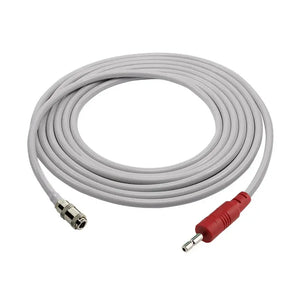
Air leaks are one of the most under-recognized causes of repeated "measurement failed" and "cuff error" alarms. A hose that develops a slow leak at the connector or along a cracked jacket will cause the cuff to lose pressure faster than the algorithm expects — producing intermittent failures that are easy to misattribute to the patient. When a leak is confirmed, replacing the hose with a correctly matched, leak-tested assembly resolves the alarm at its source.
If the monitor shows dashes (---) for all parameters — not just BP — then the issue is broader than NIBP. See our Patient Monitor No Reading Troubleshooting Checklist. For a blank or frozen screen, see Monitor Display Problems.
NIBP Cuff Sizing: The #1 Source of Measurement Error
Research from Johns Hopkins University (JAMA Internal Medicine, 2023) demonstrated that using a regular-sized cuff on patients who need a large or extra-large size can overestimate systolic pressure by 5–20 mmHg — and nearly 40% of study participants were misclassified as hypertensive due to wrong cuff size alone.
| Cuff Size | Arm Circumference | Typical Patient |
|---|---|---|
| Neonatal #1–#5 | 3–15 cm | Premature and term neonates |
| Infant / Child | 15–22 cm | Pediatric patients |
| Small Adult | 17–25 cm | Petite adults, adolescents |
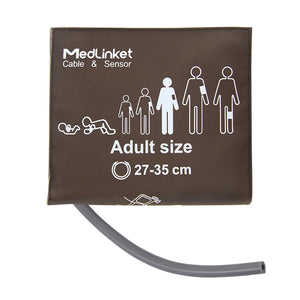
| Adult | 24–32 cm | Most adult patients |
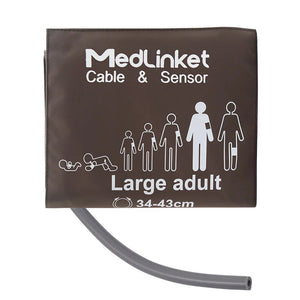
| Large Adult | 28–37 cm | Larger adults |
| Adult Thigh / Bariatric | 32–54 cm | Bariatric patients, thigh measurement |
⚠️ When in doubt, go up one size. A slightly oversized cuff produces marginally lower readings, but a too-small cuff can overestimate SBP by up to 20 mmHg — a far more dangerous error. Stocking the full size range — small adult, adult, and large adult — at the bedside is the simplest way to make correct sizing the default rather than the exception.
📚 Related Reading: How to Choose a Suitable Blood Pressure Cuff | Which Blood Pressure Cuff Fits Me? | How to Put On a Blood Pressure Cuff
NIBP Measurement: Proper Technique Checklist
-
Confirm patient type on the monitor (Adult / Pediatric / Neonate) — sets safe inflation limits
-
Measure mid-upper arm circumference with a tape measure
-
Select the correct cuff size — at the borderline, default to larger
-
Place on bare skin — clothing layers add error
-
Align the artery marker (△) over the brachial artery
-
Wrap snugly — two fingers should fit under the cuff
-
Position the arm at heart level, supported on a surface
-
Patient still and quiet — no talking during measurement
Contraindicated limbs: same-side IV infusion, AV fistula, lymphedema, post-mastectomy side, severe DVT, burns or trauma at cuff site.
When to Switch from NIBP to IBP
Oscillometric NIBP has inherent limitations. Published ICU data shows a median discrepancy of approximately 6 mmHg between NIBP and IBP readings, but in unstable patients, discrepancies widen significantly. NIBP tends to overestimate in true hypotension and underestimate in true hypertension.
| Indication | Rationale |
|---|---|
| SBP >250 or <50 mmHg | Outside reliable oscillometric range |
| Rapid hemodynamic fluctuations | Intermittent cycling too slow to capture changes |
| Vasoactive drip titration | Beat-to-beat data needed for safe titration |
| Major surgery | Continuous monitoring is standard of care |
| Repeated NIBP failures | Arrhythmias, obesity, or shock preventing reliable cuff readings |
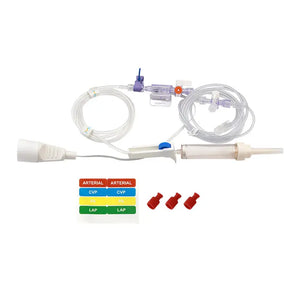
MedLinket provides the full IBP monitoring accessory chain: IBP cables, disposable IBP transducers, and pressure infusion bags — compatible with Philips, GE, Mindray, and Dräger monitors.
Reducing NIBP False Alarms: Equipment Quality Matters
Every failed measurement generates a technical alarm. Every false high/low reading from an improperly sized cuff generates a clinical alarm. On a unit with 30 patients cycled every 15 minutes, that is 2,880 NIBP measurements per day — even a 5% error rate means over 140 false alarms that nurses must assess.
🔗 MedLinket NIBP Products
-
Reusable NIBP cuffs — Full size range, neonatal to bariatric; latex-free, DEHP-free
-
Adult disposable NIBP cuffs — Single-patient use for isolation rooms
-
Neonatal disposable cuffs — Hylink transparent TPU for skin visualization
-
NIBP hoses — Compatible with all major monitor brands
-
NIBP connectors — Replacement connectors for various monitor ports
🎯 Equip One Bed for Correct-Sizing & Leak-Free NIBP
The three high-volume items that eliminate the two leading false-alarm causes: wrong cuff size and hose leaks
Not sure which hose fits your monitors? See How to Identify Which Cables Your Monitor Needs and How to Find NIBP Hoses for Philips Monitors. For the broader comparison of OEM vs compatible accessories, see OEM vs Compatible Accessories.
Why Hospitals Trust MedLinket NIBP Accessories
MedLinket (Shenzhen Med-Link Electronics Tech Co., Ltd., NEEQ: 833505) has manufactured patient monitor accessories since 2004. Our NIBP cuffs, NIBP hoses, and NIBP connectors are used in 2,000+ hospitals across 120+ countries.
-
FDA 510(k) cleared (19 clearances) | CE MDR | ISO 13485:2016
-
3 factories (Shenzhen, Shaoguan, Indonesia) | 16,651+ product variants
-
$5M USD product liability insurance — individual certificates available
-
Neonatal innovation: Hylink transparent TPU disposable cuffs allow skin visualization under the cuff to prevent pressure injury
For recommended cuff replacement intervals across all accessory types, see the Accessory Replacement Schedule. When the issue goes beyond accessories, see When to Call Biomed vs Troubleshoot Yourself.
📩 Contact: shopify@medlinket.com | WhatsApp: +852 6467 3105 — Free cuff compatibility verification and sample kits available.
Frequently Asked Questions
Why does NIBP keep failing on this patient?
The most common causes in order: (1) wrong cuff size, (2) patient movement, (3) severe arrhythmia (especially atrial fibrillation), (4) air leak in cuff, hose, or connection, (5) extremely low BP with weak oscillations. Work through the troubleshooting table systematically. If the problem persists, consider manual BP or IBP monitoring.
Can I use manual BP instead of the monitor?
Yes. Manual auscultatory measurement is appropriate when oscillometric NIBP repeatedly fails, the patient has an arrhythmia that confuses the algorithm, or you need to verify a questionable reading. Manual BP may also be more reliable in very hypotensive patients.
Why do I get different readings each time?
Blood pressure naturally fluctuates based on respiration, autonomic tone, pain, stress, and activity. Variations of 5–10 mmHg are normal. Larger variations (>15 mmHg) may indicate technique issues or true hemodynamic instability.
What is the most common mistake with NIBP measurement?
Using the wrong blood pressure cuff size. Research shows this can skew readings by up to 20 mmHg systolic. A Johns Hopkins study found more than half of participants needed a large or extra-large cuff. Always measure arm circumference, and keep a large adult cuff (34–43 cm, $12, 40% off) stocked alongside the standard adult size.
How often should reusable NIBP cuffs be replaced?
Inspect at every patient use. Reusable cuffs typically last 6–12 months with proper care. Replace immediately if you notice air leaks, fraying, or damaged connectors. See our guide to cleaning and maintaining reusable NIBP cuffs and the Accessory Replacement Schedule.
Related Articles in This Series
This article is part of the Hospital Monitor Reading & Accessories Guide. Explore related topics:
Medical Disclaimer: This article is intended for educational purposes for healthcare professionals and clinical staff. It does not constitute medical advice. Always follow your facility's protocols and consult qualified medical professionals for patient care decisions.
Declaration: All product names, brands, and OEM part numbers (e.g., Philips, GE, Mindray, Dräger, Edwards, and associated model numbers) are used for identification and compatibility-reference purposes only and do not imply any affiliation, partnership, or endorsement. MedLinket products are independently verified compatible alternatives. Product images and actual objects may differ slightly in appearance (e.g., connector design, color) but function the same.