📖 This article is part of our comprehensive Hospital Monitor Reading & Accessories Guide. Explore the full series for detailed guides on every vital sign parameter, alarm troubleshooting, and accessory selection.
By MedLinket Clinical Content Team | Updated: February 2026 | 15 min read
Quick Answer
NIBP displays three numbers on a hospital monitor: Systolic (top number — pressure when the heart contracts), Diastolic (bottom number — pressure when the heart relaxes), and MAP (mean arterial pressure — average pressure during one cardiac cycle, shown in parentheses). Example: 120/80 (93). Normal adult blood pressure is approximately 120/80 mmHg with a MAP of 70–100 mmHg. A MAP below 60 mmHg signals inadequate organ perfusion and requires immediate clinical intervention.
In This Guide
What Does NIBP Mean on a Hospital Monitor?
NIBP stands for Non-Invasive Blood Pressure. It is one of the five core vital signs displayed on patient monitors in hospitals — alongside ECG, heart rate, SpO2, and EtCO2.
On most hospital monitors from Philips, GE Healthcare, Mindray, Draeger, and other manufacturers, the NIBP reading appears in a dedicated area of the screen — typically color-coded in red or white and labeled "NIBP" or "NBP." The display format is:
NIBP (mmHg)
120 / 80
(93)
Typical NIBP display on a hospital monitor: Systolic / Diastolic (MAP)
Unlike IBP (invasive blood pressure) monitoring — which requires an arterial catheter inserted directly into a blood vessel — NIBP uses an external inflatable blood pressure cuff wrapped around the patient's upper arm. This makes it the default method for blood pressure monitoring in general wards, emergency departments, pre-op areas, and many ICU settings.
The Three Numbers: Systolic, Diastolic, and MAP
Every NIBP reading on a hospital monitor gives you three distinct values. Here is exactly what each one represents and why it matters clinically.
Systolic Pressure (Top Number)
Systolic blood pressure (SBP) is the peak pressure exerted on the arterial walls when the left ventricle of the heart contracts during systole. It reflects the force of cardiac contraction and the elasticity of the arterial system.
-
Normal range for adults: <120 mmHg
-
Hypertension Stage 1: 130–139 mmHg
-
Hypertensive crisis: >180 mmHg — requires immediate evaluation
Clinical insight: Systolic pressure tends to rise with age as arteries stiffen. In neonates, a normal SBP may be as low as 60–80 mmHg (based on MedLinket internal training data for neonatal monitoring, where SBP 70–90 mmHg is the accepted reference range), which would be critically low for an adult patient. Always reference age-appropriate ranges.
Diastolic Pressure (Bottom Number)
Diastolic blood pressure (DBP) measures the residual pressure in the arteries when the heart relaxes between beats (diastole). It reflects the tone and resistance of the peripheral vascular system.
-
Normal range for adults: <80 mmHg
-
Hypertension Stage 1: 80–89 mmHg
-
Hypertensive crisis: >120 mmHg
Clinical insight: Isolated diastolic hypertension (high DBP with normal SBP) is more common in younger adults and may signal early vascular disease.
MAP — Mean Arterial Pressure (Number in Parentheses)
MAP (Mean Arterial Pressure) represents the average arterial blood pressure during one complete cardiac cycle. It is displayed in parentheses on the monitor — for example, (93).
The standard formula is:
MAP = DBP + 1/3 × (SBP − DBP)
Example: SBP 120, DBP 80 → MAP = 80 + 1/3 × (120 − 80) = 80 + 13.3 ≈ 93 mmHg
Why the formula weights diastole more heavily: At a normal resting heart rate, the heart spends roughly two-thirds of each cycle in diastole and only one-third in systole. MAP accounts for this timing asymmetry, making it a more accurate reflection of the true perfusion pressure reaching your organs.
🔑 Key Clinical Fact
In NIBP oscillometric monitoring, MAP is actually the only value directly measured by the monitor's algorithm. The algorithm identifies the point of maximal oscillation amplitude in the cuff as MAP, then uses proprietary calculations to derive the systolic and diastolic values. This makes MAP the most reliable number in your NIBP reading — a fact that experienced biomedical engineers frequently emphasize when training clinical staff.
Normal Blood Pressure Ranges by Population
Blood pressure targets differ significantly across patient populations. The following table summarizes the key reference ranges used in clinical practice.
| Population | Systolic (mmHg) | Diastolic (mmHg) | MAP (mmHg) |
|---|---|---|---|
| Healthy Adult | <120 | <80 | 70–100 |
| Elderly (>65 yrs) | <130* | <80 | 70–105 |
| Child (1–10 yrs) | 80–110 | 50–75 | 55–85 |
| Infant (1–12 months) | 75–100 | 50–70 | 55–80 |
| Neonate | 60–90 | 30–60 | 40–60 |
| ICU / Sepsis Target | — | — | ≥65 |
*ACC/AHA 2017 guidelines classify ≥130/80 as Stage 1 hypertension for adults. Elderly targets may be individualized by the treating physician.
Blood Pressure Categories (AHA/ACC Classification)
| Category | Systolic (mmHg) | Diastolic (mmHg) |
|---|---|---|
| ✅ Normal | <120 | <80 |
| ⚠️ Elevated | 120–129 | <80 |
| ⚠️ Hypertension Stage 1 | 130–139 | 80–89 |
| 🔴 Hypertension Stage 2 | ≥140 | ≥90 |
| 🚨 Hypertensive Crisis | >180 | >120 |
When a blood pressure reading triggers an alarm on your monitor, see our detailed Blood Pressure Alarm Troubleshooting Guide for a step-by-step clinical response framework.
Why MAP Matters in Critical Care
While systolic and diastolic values are important for diagnosis, MAP is the number that critical care clinicians watch most closely — and for good reason. MAP reflects the actual driving pressure that perfuses vital organs, including the brain, kidneys, and heart.
| MAP Range (mmHg) | Clinical Significance |
|---|---|
| 70–100 | Normal — adequate organ perfusion |
| ≥65 | Minimum target in sepsis (Surviving Sepsis Campaign Guidelines) |
| <60 | Organs begin to suffer ischemia; immediate intervention required |
| <50 | Risk of irreversible organ damage; neuronal death may ensue |
| >110 | Elevated — may indicate hypertension; increases vascular damage risk |
Important nuance from clinical practice: As experienced ICU nurses on clinical forums frequently discuss, MAP targets should be individualized. A patient with baseline hypertension may need a higher MAP (80–85 mmHg) to maintain adequate cerebral and renal perfusion than the standard 65 mmHg threshold. Always correlate MAP readings with clinical signs of perfusion — urine output, mental status, lactate levels, and capillary refill.
Understanding how alarm thresholds relate to these MAP values is critical. For a broader overview of all patient monitor alarm types and priority levels, read our False Alarms on Patient Monitors: Causes and Prevention guide.
How NIBP Measurement Works (Oscillometric Method)
Understanding how your patient monitor arrives at those three numbers helps you troubleshoot inaccurate readings and explain the process to patients and colleagues.
Hospital monitors measure NIBP using the oscillometric method. Based on MedLinket's internal product training materials, here is the process step by step:
-
Inflation: The NIBP cuff inflates automatically to a pressure above the expected systolic level, temporarily occluding the brachial artery.
-
Controlled deflation: The monitor gradually releases air from the cuff in controlled steps.
-
Oscillation detection: As blood begins to flow through the partially compressed artery, tiny oscillations in cuff pressure are detected by a pressure sensor inside the monitor.
-
MAP identification: The point at which oscillation amplitude is greatest corresponds to the mean arterial pressure (MAP) — this is the only value directly measured.
-
SBP & DBP derivation: The monitor's proprietary algorithm then calculates systolic and diastolic values from the oscillation envelope. Each manufacturer (Philips, GE, Mindray, Draeger, etc.) uses a slightly different algorithm, which is why readings from different monitors may vary by a few mmHg.
This is why experienced biomedical engineers often recommend paying closest attention to MAP — it is the measured value, while SBP and DBP are calculated estimates.
For more detail on the key influence factors, our internal training data notes: a cuff that is too wide tends to give falsely low BP readings, while a cuff that is too narrow, too tight, or too loose tends to give falsely high readings. Arm position also matters — a measurement site above heart level reads low, while below heart level reads high.
7 Factors That Affect NIBP Accuracy
Accurate blood pressure measurement depends on controlling multiple variables. Research shows that a single measurement mistake can skew readings by as much as 50 mmHg, potentially leading to misdiagnosis and inappropriate treatment. Here are the seven most common sources of error:
| # | Factor | Impact on Reading | Solution |
|---|---|---|---|
| 1 | Wrong cuff size | Too small → falsely high (up to +20 mmHg); too large → falsely low | Measure mid-arm circumference |
| 2 | Cuff over clothing | Can add 5–50 mmHg to reading | Always place cuff on bare skin (clothing <2 mm only per protocol) |
| 3 | Cuff position relative to heart | Every 10 cm above/below heart ≈ 8 mmHg error | Position cuff at heart level (4th intercostal space) |
| 4 | Patient movement / talking | Talking can add 10+ mmHg; movement causes measurement failure | Ensure patient is still and quiet |
| 5 | Full bladder | Can raise SBP by up to 33 mmHg | Allow patient to void if possible |
| 6 | Arrhythmias | Irregular rhythms disrupt oscillation detection | May need manual BP or IBP monitoring |
| 7 | Worn or leaking cuff/hose | Air leaks prevent proper inflation → measurement fails | Replace cuff and inspect NIBP hose |
💡 Pro Tip From Clinical Practice
When you get a reading that seems inconsistent with the patient's clinical picture, always repeat the measurement after verifying cuff size and placement. As many bedside nurses share on clinical forums: "If the number doesn't match the patient, believe the patient — not the monitor." A single NIBP reading should never be the sole basis for treatment decisions.
Choosing the Right Blood Pressure Cuff Size
Cuff sizing is the single most common source of NIBP measurement error in clinical settings. Research published in JAMA Internal Medicine found that using a regular-sized cuff on a patient who needs an extra-large cuff can overestimate systolic blood pressure by nearly 20 mmHg — enough to trigger an incorrect hypertension diagnosis.
The American Heart Association (AHA) recommends a cuff bladder width of 40% of the arm circumference and a length of 80% of the arm circumference. Here is a practical sizing guide:
| Cuff Size | Arm Circumference (cm) | Patient Type |
|---|---|---|
| Neonatal #1–#5 | 3–15 | Premature to full-term neonate |
| Child | 15–22 | Pediatric |
| Small Adult | 17–25 | Slender adult |
| Adult (Standard) | 24–32 | Average adult |
| Adult Long | 28–37 | Larger adult arm |
| Large Adult | 32–42 | Large/obese adult |
| Thigh / Bariatric | 42–54 | Bariatric patient / thigh measurement |
How to measure: Use a flexible tape to measure the mid-upper-arm circumference (midpoint between the acromion of the shoulder and the olecranon of the elbow). Match the measurement to the appropriate cuff size. When a patient's arm circumference falls between sizes, always default to the larger cuff — per MedLinket's clinical training protocol.
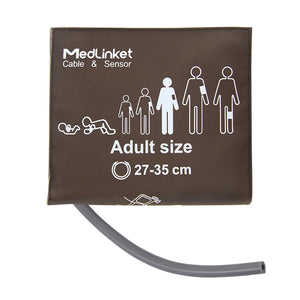
MedLinket NIBP cuffs cover the full age range from 3 cm to 54 cm arm circumference. Our neonatal Hylink transparent series (sizes #1–#5) features TPU transparent material for visible skin assessment, while all cuffs are latex-free and DEHP-free (allergy rate <0.1%) with universal connector interfaces.
For deeper guidance on cuff selection:
When to Escalate: NIBP vs IBP Monitoring
NIBP is adequate for most clinical scenarios, but there are situations where invasive blood pressure (IBP) monitoring via an arterial line becomes necessary. Based on established clinical guidelines and MedLinket's internal patient monitoring training materials, consider transitioning from NIBP to IBP cables and IBP transducers when:
-
Systolic BP >250 mmHg or <50 mmHg (beyond reliable NIBP oscillometric range)
-
Rapid BP fluctuations >40 mmHg within minutes
-
Major cardiac surgery, liver transplant, or other high-risk procedures
-
High-dose vasopressor therapy (NIBP accuracy decreases significantly)
-
Repeated arterial blood gas sampling is required
-
Persistent NIBP measurement failures due to arrhythmias or severe obesity
For hospitals that need IBP monitoring accessories, MedLinket offers compatible IBP cables designed to work with Philips, GE Healthcare, Mindray, and Draeger patient monitors. Our IBP transducers feature full-silicon piezoresistive sensor chips (imported from the US) with ±2% accuracy, fully-closed blood sampling systems, and red-colored tubing for immediate arterial line identification.
NIBP Troubleshooting: When "Measurement Failed" Appears
One of the most common frustrations at the bedside is the dreaded "NIBP Measurement Failed" or "Cuff Error" alarm. Here is a systematic approach to resolve it quickly.
| Problem | Likely Cause | Solution |
|---|---|---|
| Measurement failed — no reading | Patient movement; arrhythmia; loose cuff | Wait for patient to settle, verify cuff fit, retry |
| "Cuff error" / "Air leak" alarm | Damaged cuff bladder; loose NIBP hose connection; kinked hose | Check all connections; replace cuff or NIBP hose |
| Abnormally high/low reading | Wrong cuff size; arm not at heart level | Verify cuff size; reposition arm |
| Inconsistent readings (vary >15 mmHg) | Pain; anxiety; white-coat effect; equipment issue | Allow 5-min rest; take 3 readings and average; check cuff |
| Cuff inflates but never deflates | Bleed valve failure inside monitor NIBP module | Remove cuff immediately; call Biomed engineering |
| Repeated failures in obese patients | Standard cuff too small for conical arm shape | Use large/thigh cuff, or try forearm with radial artery site |
If you encounter persistent issues where the monitor shows no readings across multiple parameters, our Patient Monitor No Reading Troubleshooting Guide provides a comprehensive checklist. For display issues, see Monitor Display Problems: Blank, Flickering, Frozen.
Proper NIBP Cuff Application: 8-Step SOP
Correct cuff application is the foundation of accurate NIBP measurement. Based on MedLinket's clinical training protocol, follow this 8-step standard operating procedure:
-
Confirm patient type — adult, pediatric, or neonatal — to select the correct cuff category.
-
Measure mid-arm circumference with a flexible tape. At the boundary between sizes, choose the larger cuff.
-
Ensure the cuff bladder is fully deflated before application.
-
Remove or thin clothing — maximum 2 mm fabric between cuff and skin per protocol.
-
Align the △ (artery marker) on the cuff directly over the brachial artery.
-
Wrap snugly — you should be able to fit two fingers between the cuff and the arm.
-
Position the arm at heart level, supported, with approximately 45° abduction.
-
Verify placement — check that the cuff is not twisted, kinked, or overlapping the antecubital fossa.
⚠️ Contraindicated Limbs — Do NOT Apply NIBP Cuff On:
-
Same arm as an IV line or arterial catheter
-
Arm with severe thrombosis or lymphedema
-
Arm with burns, trauma, or skin grafts
-
Arm with an arteriovenous fistula (dialysis access)
-
Ipsilateral arm after mastectomy with lymph node dissection
Related Equipment: NIBP Cuffs, Hoses, and Connectors
Accurate NIBP readings depend not only on technique but also on the quality and compatibility of your monitoring accessories. Here is what you need for a complete NIBP setup:
| Accessory | Function | Typical Lifespan | MedLinket Product |
|---|---|---|---|
| Reusable NIBP Cuff | Wraps around arm to occlude artery | 6–12 months | Adult Reusable NIBP Cuff |
| Disposable NIBP Cuff | Single-patient use; reduces cross-contamination | Single patient | Disposable NIBP Cuff (Adult Long) |
| ABPM Cuff | 24-hour ambulatory blood pressure monitoring | 6–12 months | ABPM Cuff with Bayonet Connector |
| NIBP Hose | Connects cuff to monitor; carries air pressure | 2–3 years | Philips NIBP Hose Guide |
| NIBP Connector | Brand-specific connector between hose and cuff | Matches hose lifespan | All NIBP Connectors |
For a complete overview of all patient monitor accessories organized by parameter type — including SpO2 sensors, ECG cables, temperature probes, and more — see our dedicated accessories guide. Need help determining compatibility? Read How to Identify Which Cables Your Monitor Needs or learn the differences between OEM vs Compatible Accessories.
For replacement timing guidance, our Accessory Replacement Schedule covers recommended intervals for every accessory category.
Why Hospitals in 120+ Countries Trust MedLinket NIBP Accessories
MedLinket (Shenzhen Med-Link Electronics Tech Co., Ltd) has specialized in patient monitor accessories and medical consumables since 2004. As the first monitoring consumables company listed on China's NEEQ exchange (stock code: 833505), we bring over two decades of manufacturing expertise to every blood pressure cuff, NIBP hose, and NIBP connector we produce.
| Certifications | FDA 510(k) (19 clearances) · CE (MDR 2017/745) · ISO 13485:2016 · NMPA · MDSAP |
| Compatible Brands | Philips, GE Healthcare, Mindray, Draeger, Masimo, Nellcor, Nihon Kohden, ZOLL, and 30+ more |
| Global Footprint | Exported to 120+ countries · 2,000+ hospital end-users · 14 regions with annual sales >$1M |
| Product Liability Insurance | $5 million USD coverage — individual certificates available for distributors |
| Manufacturing | 3 owned factories (Shenzhen, Shaoguan, Indonesia) · 3,500+ molds · 16,651+ product styles · 100% factory inspection |
| Patents | 45 utility models · 8 inventions · 26 design patents · 1 PCT international · 13 software copyrights |
Related Reading: Hospital Monitor Guides
This article is part of our comprehensive Hospital Monitor Reading & Accessories Guide. Explore other articles in this cluster series:
| Category | Article |
|---|---|
| Parameter Guides | What is SpO2 and Normal Levels? · Normal Heart Rate on a Hospital Monitor · ECG Numbers Explained · What is EtCO2? |
| Alarm Troubleshooting | Blood Pressure Alarm Guide · ECG Leads Off Alarm Fix · False Alarms Prevention |
| Equipment Troubleshooting | Monitor Shows No Reading · Monitor Not Turning On · When to Call Biomed |
| Accessories | Accessories by Parameter Type · Identify Your Cables · OEM vs Compatible · Replacement Schedule |
Frequently Asked Questions
Q: What is a normal NIBP reading on a hospital monitor?
A normal NIBP reading for a healthy adult is below 120/80 mmHg with a MAP of 70–100 mmHg. The monitor displays three numbers: systolic/diastolic (MAP). For pediatric and neonatal patients, normal values are significantly lower — see the population-specific ranges table above.
Q: What does MAP mean on a hospital monitor?
MAP (Mean Arterial Pressure) is the average arterial pressure during one cardiac cycle. It is the best single indicator of organ perfusion pressure. Calculated as DBP + 1/3 × (SBP − DBP). A MAP below 60 mmHg means organs are not receiving adequate blood flow. The Surviving Sepsis Campaign targets a minimum MAP of 65 mmHg in septic patients.
Q: Why do I get different NIBP readings each time?
Blood pressure naturally fluctuates with respiration, stress, activity, and body position. Differences of 5–10 mmHg between consecutive readings are normal. Larger variations often stem from incorrect blood pressure cuff size, patient movement, arm position above or below heart level, or a kinked NIBP hose. Always allow a 1–2 minute interval between repeated measurements.
Q: What does it mean when NIBP measurement fails?
A failed measurement means the monitor could not detect reliable oscillation patterns. Common causes include patient movement, arrhythmias, wrong cuff size, air leaks, or the cuff placed over clothing. See the troubleshooting table above for a step-by-step fix. If failures persist with irregular heart rhythms, consider manual auscultation or IBP monitoring.
Q: What is the difference between NIBP and IBP?
NIBP uses an inflatable cuff on the arm and the oscillometric method — non-invasive, intermittent, and suitable for most patients. IBP uses an arterial catheter (typically radial artery) inserted directly into a blood vessel for continuous, real-time readings. IBP is the gold standard for critically ill patients, those on high-dose vasopressors, or when SBP exceeds 250 or drops below 50 mmHg. Learn more about IBP setup in our Patient Monitor Accessories Guide.
Q: How often should NIBP cuffs be replaced?
Reusable NIBP cuffs last 6–12 months in high-use settings (ICU, OR). Replace when the bladder shows cracks, the fabric frays, the Velcro fails to grip, or you notice air leaks. Disposable NIBP cuffs are single-patient use. Studies show over 58% of reusable cuffs can harbor potentially pathogenic organisms, making timely replacement and regular cleaning essential for infection control. See our Accessory Replacement Schedule for detailed intervals.
Need Help Finding the Right NIBP Cuff or Hose for Your Monitor?
Tell us your monitor brand and model. Our team will verify compatibility and send you a matched product recommendation — free of charge.
MOQ: As low as 10 pcs · Lead Time: 3–5 business days · Samples Available
About This Article
Published by the MedLinket Clinical Content Team. Our team includes biomedical engineers and clinical application specialists with hands-on experience across Philips, GE, Mindray, and Draeger monitoring systems. Content is reviewed against MedLinket's internal product training manuals and current clinical guidelines.
Medical Disclaimer: This article is intended for educational purposes for healthcare professionals and clinical engineers. It does not constitute medical advice. Always follow your facility's clinical protocols and consult with qualified physicians for patient-specific treatment decisions.
Last Updated: February 2026 · Review Cycle: Every 6 months