By MedLinket Clinical Education Team · Reviewed by Biomedical Engineering Department · Updated: April 2026 · 10 min read
To fix an ECG "Leads Off" alarm: (1) assess the patient first — don't assume it's technical until you've ruled out a real cardiac event. (2) Check the specific lead the monitor flags (RA, LA, LL, RL, V/C). (3) Replace the electrode if it's been on more than 24 hours or the gel is dried. (4) Re-prep the skin with alcohol and gentle abrasion. (5) Verify all leadwire snaps fully engage. (6) Reseat the trunk cable at the monitor. Most cases resolve in under 60 seconds. Industry standard requires electrode AC impedance below 2 kΩ for reliable signal transmission.
If you've spent any time on a telemetry unit, ICU, or any monitored care setting, you've seen this scene a thousand times: the monitor flashes "Leads Off", the ECG waveform goes flat or fills with artifact, and somebody has to walk into the room. It's one of the most frequent technical alarms in patient monitoring and a documented contributor to alarm fatigue.
Here's the thing: it's almost always fixable in under a minute once you have a systematic approach. This guide walks through what causes the alarm, the exact 6-step protocol I use at the bedside, and how to keep it from coming back — drawing on more than 20 years of medical cable and patient monitor accessory manufacturing at MedLinket plus thousands of bedside conversations with the nurses and BMETs who actually deal with this every shift.
🌳 "Leads Off" Diagnostic Decision Tree
Start with the patient. End with the cable. Most problems resolve in step 2 or 3.
In This Guide
- What "Leads Off" Actually Means
- Identifying Which Lead Is Off
- 6-Step Fix for the "Leads Off" Alarm
- Why Electrodes Lose Contact: Root Causes
- Handling Difficult Cases
- Why Fixing It Matters: The Alarm Fatigue Connection
- MedLinket Insider: Eccentric Electrode Design Test Data
- Recommended ECG Cables & Electrodes by Brand
- Prevention Checklist
- Frequently Asked Questions
What "Leads Off" Actually Means
When your monitor displays "Leads Off" — sometimes labeled "Lead Fail," "Electrode Off," or "Check Electrode" depending on the manufacturer — the ECG monitoring system has lost a reliable electrical signal from one or more electrodes. The monitor continuously checks impedance between each electrode and the patient's skin, typically several times per second. Once that impedance crosses a manufacturer-set threshold (commonly around 100 kΩ on adult monitors), the alarm fires.
The detail that catches new clinicians off guard: "Leads Off" doesn't necessarily mean the electrode physically fell off. The electrical contact can be lost while the electrode looks visually attached — dried gel, oily skin, or a leadwire snap that's not fully engaged will all trigger the same alarm.
The safety implications matter. When a single lead is off, most monitors continue arrhythmia detection using the remaining leads and display the alert as a low-priority text message. When multiple leads drop out simultaneously, the monitor often suspends arrhythmia detection entirely and escalates to an audible alarm — which means a real life-threatening rhythm could go undetected until ECG signal is restored. That's why this isn't just a noise issue. It's why we work it fast.
When any monitor alarm sounds — including "Leads Off" — look at the patient before you touch the equipment. A flat line on the screen could be a disconnected lead, or it could be asystole. Confirm the patient is responsive and stable, then begin troubleshooting. This three-second check has saved more lives than any equipment fix in this article.
Identifying Which Lead Is Off
Most modern patient monitors tell you exactly which lead has lost contact. Look at the alarm message — it'll show the specific lead abbreviation. Here's the quick reference:
| Alarm Message | Meaning (AHA Color) | Check This Electrode |
|---|---|---|
| RA Off | Right Arm (White) | Right upper chest / right arm |
| LA Off | Left Arm (Black) | Left upper chest / left arm |
| LL Off | Left Leg (Red) | Left lower torso / left leg |
| RL Off | Right Leg (Green) | Right lower torso / right leg (ground) |
| V / C Off | Chest Lead (Brown) | Precordial electrode on chest |
| All Leads Off | Complete signal loss | Check trunk cable connection to monitor first |
Bedside shortcut: if the monitor says "RA Off" but only Leads I and II look abnormal while Lead III is clean, that confirms it — Leads I and II both use the RA electrode, while Lead III does not. Understanding how ECG leads relate to electrode positions turns this into a 5-second diagnosis. For color codes and placement details, see our 5-lead ECG placement guide or 3-lead ECG placement guide.
6-Step Fix for the "Leads Off" Alarm
Work from the patient back toward the machine. Troubleshooting from the patient outward is the recognized best practice because accessory issues are by far the most common failure point in ECG monitoring — and they're also the fastest to fix.
1Visually confirm all electrodes are on the patient
Physically check each electrode. Look for edges peeling up, electrodes that have shifted position, or patches that have fallen off entirely. Patient movement, diaphoresis, and restlessness are common reasons electrodes detach — especially on night shifts when patients roll in their sleep and pull cables under their bodies.
2Check leadwire-to-electrode connections
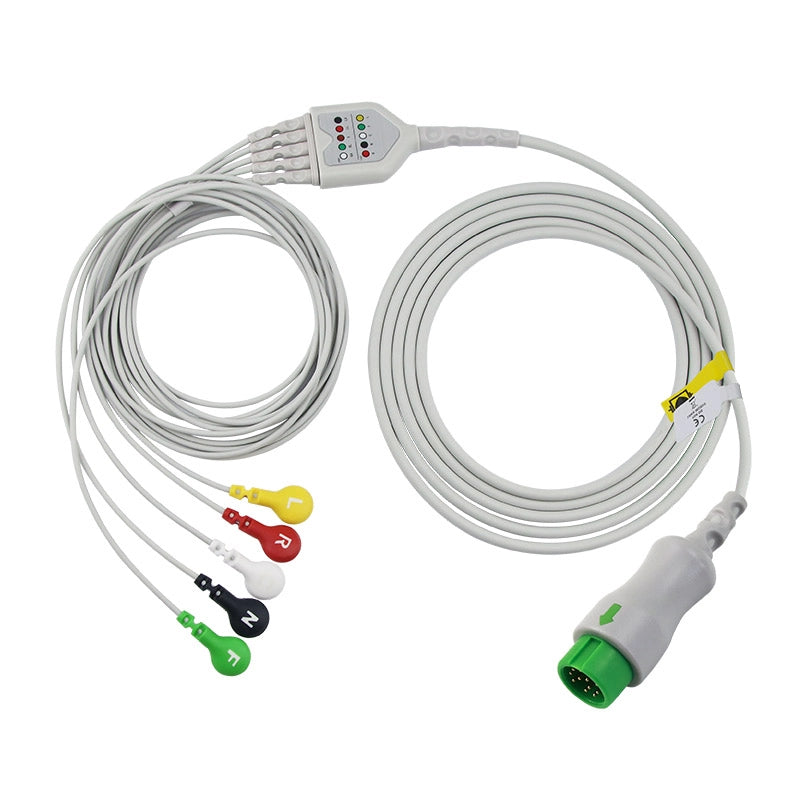
Confirm each ECG leadwire snap or clip is firmly seated on its electrode. Snap connectors should click securely; grabber (pinch) connectors should grip the electrode button without wobbling. A loose connection here is one of the most overlooked causes of "Leads Off" — and it's the one that drives experienced nurses crazy because the visual inspection looks fine.
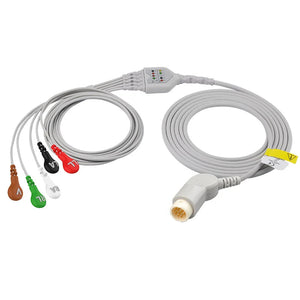
MedLinket ECG cables are available in both snap and grabber configurations to match your hospital's standard.
3Assess electrode quality
Check the electrode itself. The conductive gel should be moist and translucent — if it looks dried, cracked, or discolored, the electrode has lost its ability to conduct the ECG signal cleanly. Three diagnostic questions I run through:
- Has this electrode been in place more than 24 hours?
- Was the electrode package left open before application?
- Is the gel still intact, or has it separated from the backing?
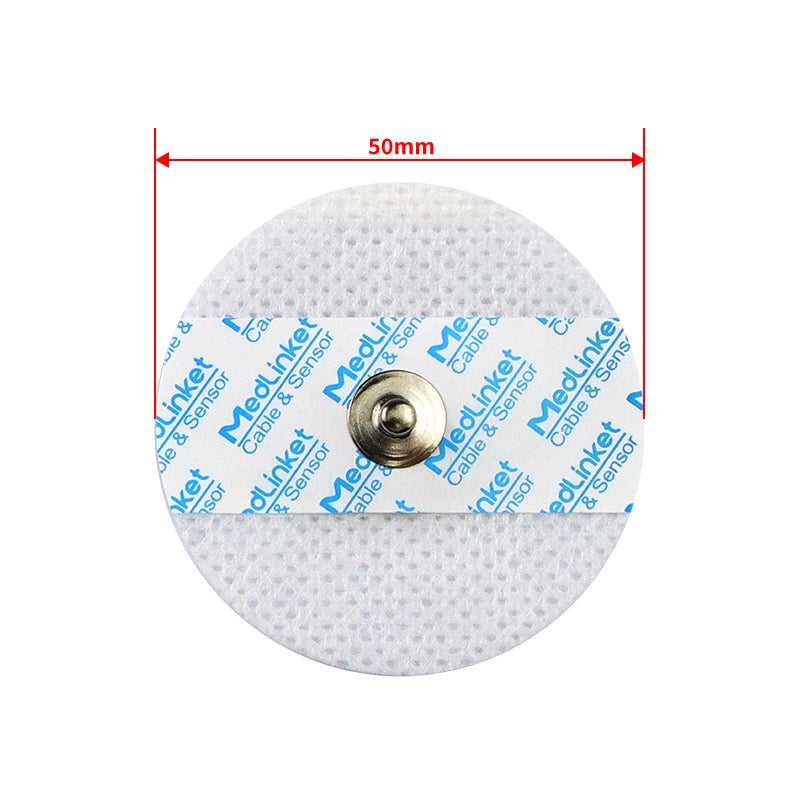
Per industry standard YY/T 0196-2005, ECG electrodes should maintain AC impedance below 2 kΩ for reliable signal transmission. MedLinket electrodes test at 109 Ω — well below that 2 kΩ threshold — with DC offset of only 4.11 mV (standard requires ≤100 mV) and internal noise of 49.5 μV (standard requires ≤150 μV). Once gel dries, impedance climbs sharply and the monitor sees that as a lost connection.
Best practice: replace disposable ECG electrodes every 24 hours, or every 8 hours for neonatal patients with sensitive skin.
4Evaluate and re-prep the skin
If the electrode is fresh but contact is still poor, the problem is skin preparation. Clean the site with 70% isopropyl alcohol. Allow the skin to dry completely — this is the step everyone rushes, and wet alcohol genuinely impedes adhesion. Gently abrade with a gauze pad until the skin appears slightly pink. Clip excessive chest hair at the electrode site (don't shave — that creates microabrasions and an infection risk).
For diaphoretic patients — one of the toughest scenarios in continuous ECG monitoring — experienced clinicians apply tincture of benzoin to the skin around (not under) the electrode site to improve adhesion. Benzoin is flammable, so it should not be used under defibrillation pads.
5Apply fresh electrode and reconnect
Apply a fresh electrode to the properly prepped site. Press firmly across the entire surface — not just the center — for a full 10 seconds to eliminate air pockets and maximize gel-to-skin contact. Then reconnect the leadwire and listen for the snap click.
Maintain correct ECG electrode placement during replacement. Even a small position shift — as little as one intercostal space — alters ECG morphology and affects diagnostic accuracy. If you need a placement refresher, see our 12-lead ECG placement guide or 12-lead ECG placement diagram.
6Check the cable and monitor connection
If replacing the electrode doesn't clear the alarm, work backwards along the signal chain:
- Inspect the ECG lead wires for visible damage — fraying, kinks, exposed inner conductor, or corroded snap heads.
- Check the ECG trunk cable connection at the monitor end. Make sure the plug is fully seated in the correct port (parameter ports look similar across modules — easy to misseat in a hurry).
- Try a known-good cable set to isolate cable vs. monitor. Every unit should keep a verified spare set on hand for exactly this troubleshooting moment.
- Try a known-good cable set to isolate cable vs. monitor. Every unit should keep a verified spare set on hand for exactly this troubleshooting moment.
When you do reach for a spare set, it's worth knowing what "compatible" really means for monitoring cables — connector fit and shielding, not just a plug that physically fits the port, are what keep the signal clean.
If the problem persists after cable swap, it's a BMET call — our guide on when to escalate covers what information to give them.
Quick Troubleshooting Reference
| Symptom | Likely Cause | Solution |
|---|---|---|
| All leads off simultaneously | Trunk cable disconnected from monitor | Reseat trunk cable; try known-good cable |
| One specific lead off | Single electrode dried out or detached | Replace that electrode with a fresh one |
| Intermittent leads off | Loose leadwire snap/clip connection | Reseat leadwire; replace if worn |
| Leads off + heavy artifact | Poor skin-to-electrode contact | Re-prep skin with alcohol, apply new electrode |
| Leads off on every patient | Damaged cable (internal wire break) | Replace ECG cable set entirely |
Why Electrodes Lose Contact: Root Causes
Understanding the root cause helps you prevent repeat alarms — not just fix the immediate one. From clinical experience and ECG artifact troubleshooting data, the failure modes cluster into three categories:
Patient Factors
| Cause | Why It Happens | Prevention Strategy |
|---|---|---|
| Diaphoresis (sweating) | Moisture undermines adhesive bond | Use diaphoretic-specific electrodes; apply benzoin around site |
| Chest hair | Hair prevents gel-to-skin contact | Clip hair at electrode sites before placement |
| Oily or lotioned skin | Residue creates an insulating layer | Clean with alcohol; abrade gently |
| Patient movement / agitation | Physical forces pull electrodes loose | Secure cable routing; use eccentric electrode designs |
| Fragile skin (elderly / neonatal) | Standard adhesives may not adhere or may damage skin | Use hypoallergenic, low-irritation electrodes |
Electrode Factors
| Cause | Why It Happens | Prevention Strategy |
|---|---|---|
| Dried gel | Package opened too early or stored improperly | Open only when ready to apply; reseal unused packages |
| Expired electrodes | Gel chemistry degrades over time | Check expiration dates; rotate stock (FIFO) |
| On skin > 24 hours | Gel dehydrates and adhesive weakens | Replace every 24h (every 8h for neonates) |
Cable and Equipment Factors
| Cause | Why It Happens | Prevention Strategy |
|---|---|---|
| Worn leadwire snaps/clips | Repeated use weakens spring tension | Replace ECG leadwires every 6–12 months |
| Damaged cable insulation | Chemical cleaning or tight winding | Inspect cables regularly; avoid tight coiling |
| Corroded connectors | Moisture ingress or chemical exposure | Use cables with gold-plated connectors; dry before storage |
| Incompatible cable | Wrong cable type for monitor model | Verify monitor brand compatibility before ordering |
Handling Difficult Cases
The Chronically Diaphoretic Patient
When electrodes will not stay on a sweating patient, the sequence that works: (1) towel-dry the chest thoroughly, (2) prep with alcohol and let it fully evaporate (count to ten before reaching for the electrode), (3) apply tincture of benzoin to the surrounding skin, not the electrode site itself, (4) apply a fresh electrode and press firmly for 10 seconds. Some units coordinate electrode changes with daily bathing — washing the chest and replacing all electrodes simultaneously cuts false alarm frequency dramatically.
For patients in special ECG placement situations — burns, chest wounds, surgical dressings — consult your unit protocol for alternative electrode sites.
Persistent "Leads Off" Despite Good Electrodes
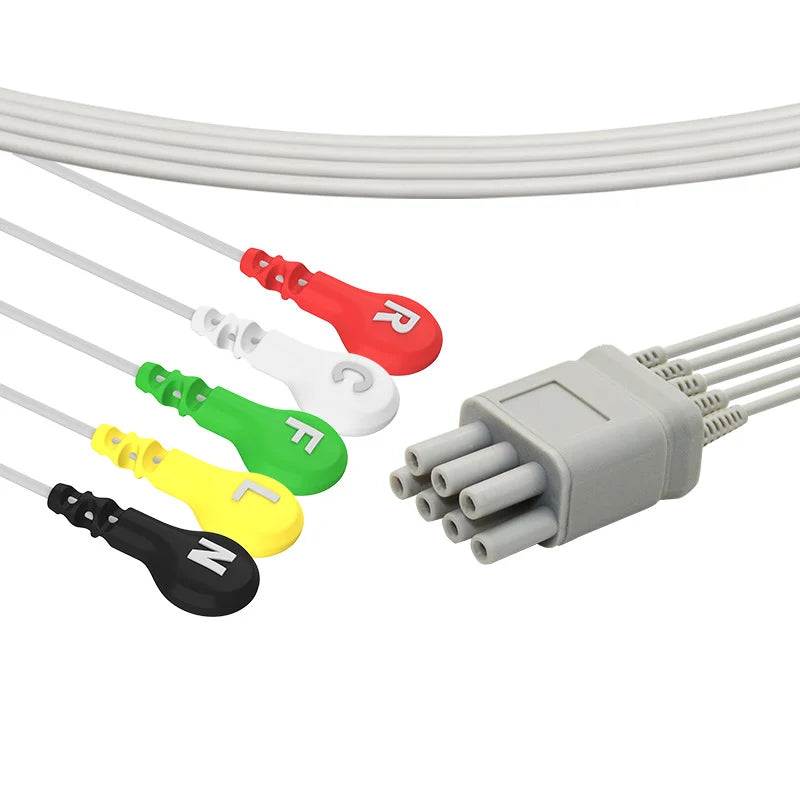
If you've replaced the electrode and the alarm persists, the problem is almost certainly in the cable chain. Swap the ECG lead wires first — they're the most common failure point after electrodes — then the ECG trunk cable. If the problem follows the cable to a different patient, you've confirmed the cable. If the problem stays with the monitor regardless of cable, it's a BMET call. Our escalation guide covers what information to hand off.
Repeated Alarms After Cleaning Protocols
If "Leads Off" alarms recur frequently on your unit — especially after routine disinfection cycles — cable degradation from harsh chemical cleaners is a real possibility. Repeated bleach-based wipe-down can break down cable insulation and corrode connector contacts within 6–12 months on heavy-use units. Inspect cable inventory regularly and replace any ECG cables showing wear. Medical-grade cables with reinforced TPU jackets and gold-plated connectors significantly extend cable life in high-volume environments. When you do replace a set, it helps to see how connector fit and signal stability are verified before shipment, since a marginal pinout or corroded contact produces exactly this kind of recurring intermittent fault.
Why Fixing "Leads Off" Matters: The Alarm Fatigue Connection
This isn't just a nuisance alarm. Research consistently shows 85–99% of hospital monitor alarms are false or clinically insignificant, and ECG technical alarms — including "Leads Off" — are the largest single contributor. A 2019 FDA report identified cardiac monitor alarms as the leading cause of alarm-related patient deaths. The Joint Commission has had alarm management on the National Patient Safety Goals list since 2014.
Every unresolved false "Leads Off" alarm has a cascading effect: it can suspend arrhythmia detection on that patient, desensitize staff to the next alarm (which might be real), and ultimately put patients at risk. For broader strategies on cutting alarm burden, see our deep dive on false alarm prevention on patient monitors.
MedLinket Insider: How Eccentric (Offset) Electrode Design Reduces "Leads Off" Alarms
The test results below come from MedLinket's in-house electrode laboratory. These are proprietary data points not available from other sources.
Standard concentric ECG electrodes place the leadwire connection point directly over the gel contact area. Any cable tension — from patient movement, clothing friction, gravity when lying down — pulls directly on the adhesive pad, causing detachment and "Leads Off" alarms.
MedLinket's eccentric (offset) electrode design separates the leadwire connection from the gel contact area using a patented "narrow neck" structure (Patent CN202120112524.5). The neck absorbs cable tension before it reaches the adhesive pad.
Lab test results comparing concentric vs. eccentric electrodes:
| Test Condition | Standard Concentric Electrode | MedLinket Eccentric Electrode |
|---|---|---|
| Click test (simulated tapping every 4 sec) | Baseline drift up to 7,000 μV | No measurable drift |
| Pull test (1 N force every 5 sec) | Voltage drop 2,000–7,000 μV per pull; incomplete recovery | Temporary drop ~1,000 μV; full recovery within 0.1 seconds |
| 360° rotation test | Electrode detachment risk | No detachment (snap rotates freely) |
These results explain why eccentric electrode designs significantly reduce both motion artifact and "Leads Off" alarm frequency — particularly valuable for Holter ECG, telemetry, and exercise stress testing where cable movement is constant. Learn more about how electrode design affects signal quality in our common ECG placement mistakes guide.
MedLinket also offers a carbon-button electrode variant (V0015H series) that is MRI-safe — it produces no induced currents or imaging artifacts, allowing patients to keep electrodes in place during DR, CT, and MRI scans without removal.
Recommended ECG Cables & Electrodes by Monitor Brand
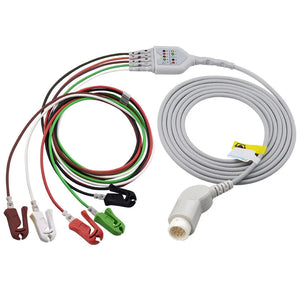
The quality of your monitoring accessories directly drives alarm frequency and signal reliability. Below are the ECG cables and leadwires commonly used in clinical settings, available from MedLinket:
| Monitor Brand | 3-Lead ECG Cable | 5-Lead ECG Cable |
|---|---|---|
| Mindray | EA6232A (Grabber) / EA6232B (Snap) | EA6252A (Grabber) / EA6252B (Snap) |
| Philips | M1603A Compatible (Grabber) | Telemetry 5-Lead (Snap) |
| GE Healthcare | 5-Lead Leadwires (Grabber, AHA) | |
| Universal DIN | 10-Lead DIN (Grabber, IEC) | |
Not sure which cable fits your monitor? Our step-by-step guide: How to Identify Which Cables Your Monitor Needs. For a full comparison of OEM vs. third-party options, read OEM vs. Compatible Accessories: What to Know. If you want to see the actual bench tests behind a compatible part, our breakdown of what gets tested when comparing compatible and OEM accessories walks through the verification step by step.
About MedLinket — Why Healthcare Facilities Trust Our ECG Products
| 🏭 Founded | 2004 · Shenzhen, China (NEEQ: 833505) |
| 🏭 Factories | 3 self-owned (Shenzhen, Shaoguan, Indonesia) · 3,500+ molds · 16,651+ product variants |
| 📋 Certifications | ISO 13485 · FDA 510(k) (19 clearances) · CE (48 Class II) · NMPA · MDSAP |
| 🌍 Global Reach | 120+ countries · 2,000+ hospitals · 30+ compatible monitor brands |
| 🔬 Quality | 100% outgoing inspection · $5M product liability insurance |
| 🔗 Patents | 45 utility models · 8 inventions · 26 design patents · 1 PCT international |
All ECG cables, ECG lead wires, and disposable ECG electrodes are manufactured in-house with full traceability. Compatible with Philips, GE Healthcare, Mindray, Dräger, Nihon Kohden, and more.
Prevention Checklist: Reduce "Leads Off" Alarms on Your Unit
These practices significantly reduce ECG technical alarm frequency and support ECG quality control initiatives:
| Practice | Frequency | Impact |
|---|---|---|
| Replace all ECG electrodes | Every 24 hours (coordinate with bathing) | Maintains gel conductivity and adhesion |
| Proper skin prep before every electrode application | Every electrode change | Reduces impedance, improves signal quality |
| Inspect ECG lead wires for damage | Every shift | Catches failing cables before they cause alarms |
| Replace ECG lead wires | Every 6–12 months | Prevents internal wire fatigue failures |
| Secure cable routing (avoid tension on electrodes) | Every patient setup | Reduces electrode pull-off from cable weight |
| Store spare electrodes in sealed bags | Always | Prevents gel dry-out before application |
| Verify cable compatibility with monitor | Every new cable order | Eliminates mismatched connector issues |
For the complete schedule of when to replace each type of monitoring accessory, see our Accessory Replacement Schedule.
🎯 Stock the Three Accessories That Prevent Most "Leads Off" Alarms
Fresh electrodes + a known-good cable and leadwire set are exactly what the 6-step protocol and prevention checklist call for
Frequently Asked Questions
Why does my monitor say "Leads Off" when the electrodes are still attached?
The electrical connection can fail even when the electrode looks physically attached. The most common cause is dried-out conductive gel — the electrode appears intact, but the gel has dehydrated and can no longer transmit the ECG signal reliably. Other causes: oily skin creating an insulating film, a leadwire snap that's not fully seated, sweat undermining the adhesive seal, or internal cable wire damage. The fix is almost always to replace the electrode with a fresh one and ensure full leadwire engagement.
How do I fix an ECG Leads Off alarm on a patient monitor?
Follow the 6-step protocol: (1) assess the patient first to rule out a real clinical emergency, (2) check that all electrodes are physically attached, (3) verify each leadwire snap or clip is fully seated, (4) replace any electrode that has been on the skin more than 24 hours or shows dried gel, (5) re-prep the skin with alcohol and gentle abrasion, (6) inspect the trunk cable connection at the monitor end. Most cases resolve in under 60 seconds. If the alarm persists after replacing the cable set, escalate to BMET.
How often should ECG electrodes be changed?
Replace disposable ECG electrodes every 24 hours during continuous monitoring. For neonatal patients with sensitive skin, some protocols recommend changing every 8 hours. The conductive gel begins drying within 24–48 hours of skin contact, dramatically increasing impedance and triggering false alarms. If signal quality degrades before the 24-hour mark — common in diaphoretic patients — replace immediately. Coordinating electrode changes with daily patient hygiene is the easiest scheduling approach.
Can I just reattach an electrode that fell off?
No — always use a fresh electrode. Once an electrode detaches, the gel picks up oils, dirt, and skin debris from the surface, and the adhesive loses its bonding ability. A reattached electrode has higher impedance and poorer adhesion, which leads to more alarms within minutes. Reusing electrodes also raises cross-contamination risk. The 60 seconds it takes to apply a fresh one will save you 30 minutes of recurring alarms. Stock fresh disposable ECG electrodes ($11.90, 25pcs/bag) at the bedside so a replacement is always within reach.
What is the difference between "Leads Off" and "Artifact" on the monitor?
"Leads Off" means the monitor detects no electrical connection — high impedance, equivalent to an open circuit. "Artifact" means a signal is present but it's noisy or distorted, typically from patient movement, muscle tension, or 60 Hz electrical interference. Both are technical alarms, but they require different troubleshooting. Leads Off responds to electrode and cable fixes; artifact responds to patient relaxation, repositioning, and electrical interference removal. For artifact issues, see our ECG artifact troubleshooting guide.
Does using third-party compatible ECG cables cause more "Leads Off" alarms?
Not when you use quality, certified compatible accessories. The factors that drive alarm frequency are connector fit, shielding integrity, and conductor quality — not the brand name. Certified compatible cables from FDA-cleared, ISO 13485-certified manufacturers like MedLinket are designed to match OEM specifications. In the United States, the Magnuson-Moss Warranty Act protects your right to use compatible accessories without voiding the monitor warranty — see how the Magnuson-Moss Warranty Act protects compatible-accessory use for the specifics. See our OEM vs. Compatible guide for the full breakdown.
What if the Leads Off alarm keeps coming back after I replace the electrodes?
When fresh electrodes don't fix it, the issue is in the cable chain. Swap the leadwires first — they're the most common failure point after electrodes, especially after 6–12 months of heavy use. If the alarm follows the cable to a different patient, you've confirmed the cable is the problem and it needs replacement. If the alarm stays with the original monitor regardless of cable, the monitor's input module may be failing — call BMET. Persistent alarms despite good electrodes can also point to fabric friction (a sweater pulling on a leadwire) or cable cleaning damage from harsh disinfectants.
How do I keep ECG electrodes attached on a sweating (diaphoretic) patient?
Diaphoretic patients are one of the hardest cases in continuous ECG monitoring. The protocol that actually works: (1) towel-dry the chest thoroughly, (2) prep with alcohol and let it fully evaporate before applying anything, (3) apply tincture of benzoin to the skin around (not under) the electrode site to improve adhesion, (4) apply a fresh electrode and press firmly for 10 seconds. Coordinating electrode changes with daily bathing also reduces false alarm frequency. Note: benzoin is flammable and should not be used under defibrillator pads.
Need Reliable ECG Cables and Electrodes for Your Facility?
MedLinket offers full-range ECG cables, leadwires, and disposable ECG electrodes compatible with Philips, GE, Mindray, Dräger, Nihon Kohden, and 30+ other brands. FDA cleared. CE marked. ISO 13485 certified.
Browse ECG Cables & Leadwires →Free compatibility verification: shopify@medlinket.com · WhatsApp: +852 6467 3105
📚 Continue Reading: Hospital Monitor Reading & Accessories Guide
Parameter Basics:
What is SpO2? · Normal Heart Rate · ECG Numbers Explained · NIBP Readings · What is EtCO2?
Alarm Troubleshooting:
Blood Pressure Alarm · False Alarm Prevention · ECG Artifact Troubleshooting
Equipment & Troubleshooting:
Monitor Shows No Reading · Display Problems · Monitor Not Turning On · When to Call Biomed
Accessories:
Accessories by Parameter · Identify Your Cables · OEM vs. Compatible · Replacement Schedule